Ancillary Conversation

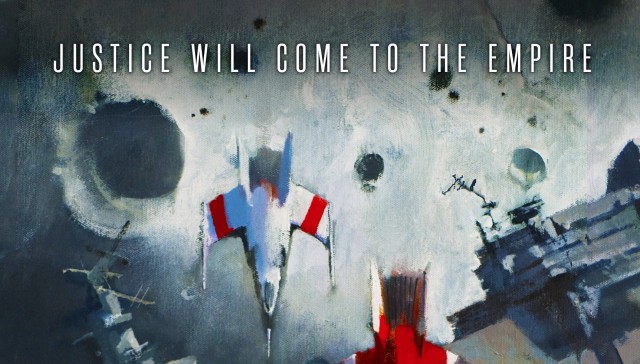
Leckie_AncillaryJustice_long-640x364

Ann Leckie’s 2013 debut novel Ancillary Justice exploded on the SF scene and, in 2014, won a whole lot of awards and considerable praise for its portrayal of imperialism and depiction of gender. The blurb:

On a remote, icy planet, the soldier known as Breq is drawing closer to completing her quest.

Breq is both more than she seems and less than she was. Years ago, she was Justice of Toren–a colossal starship with an artificial intelligence linking thousands of corpse soldiers in the service of the Radch, the empire that conquered the galaxy.

An act of treachery has ripped it all away, leaving her with only one fragile human body. And only one purpose–to revenge herself on Anaander Mianaai, many-bodied, near-immortal Lord of the Radch.

Space opera. Corpse soldiers. Artificial intelligence. Space politics. These are things that No Award is here for. And to the surprise of absolutely no one ever, we have some opinions about Ancillary Justice and Ancillary Sword. So many opinions, in fact, that mere Twitter conversations couldn’t do them justice. Accordingly, we are joined here today by Dr Sophie and Dr Jonathan.

Continue reading “Ancillary Conversation”

book review: the songlines, by bruce chatwin

Here is 1800 words about a book that Stephanie hated! The only thing that saved it being thrown across the train in disgust was that it was a library book, and she has her lines. (Plus Liz would probably tell her off)

The Songlines, Bruce Chatwin, 1987.

The Songlines is a book about discovery. It’s a travelogue and an adventure and an exploration. It’s fiction. It’s autobiography.

It’s a pretentious pile of racist drivel.

It’s beautifully written. There are some excellent turns of phrase, and it’s got a lovely style, but ultimately it’s about an English man, who believes we’re all nomads, coming to Australia and insisting on creating analogies for literally every element of the lives of the indigenous Australians that he meets. ‘It’d be like America and Russia agreeing to swap their own internal politics-’ he says, of a kin exchange between two different countries.

In chapter 2 he compares Indigenous Australians to Coyotito (a coyote) from Ernest Thompson Seton’s Lives of the Hunted.

Yet Coyotito grew up smart and, one morning, after shamming dead, she bolted for the wild: there to teach a new generation of coyotes the art of avoiding men.

I cannot now pierce together the train of associations that led me to connect Coyotito’s bid for freedom with the Australian Aboriginals’ ‘Walkabout.’ Yet somehow I picked up an image of those ‘tame’ Blackfellows who, one day, would be working happily on a cattle-station: the next, without a word of warning and for no good reason, would up sticks and vanish into the blue.

Bruce keeps comparing Indigenous Australians to fauna. Chapter 12, Flynn (an Indigenous man whose country is never stated, but who is a part of the Boongaree Council) describes allegiances and ‘totemic clans.’ “What this boils down to,” Bruce says:

hesitantly, ‘is something quite similar to birdsong. Birds also sing their territorial boundaries.’

Arkady, who had been listening with his forehead on his kneecaps, looked up and shot me a glance, ‘I was wondering when you’d rumble to that one.’

Here Arkady, a non-Indigenous Australian of Russian descent from Adelaide, who has lived for some time in and around the Northern Territory and serves as Bruce’s guide on this particular exploration, practically gives Bruce permission to describe Indigenous Australian songlines in this fashion, as if Indigenous Australians weren’t legally categorised as fauna until 1967.

Chapter 14, he writes “I was not drunk – yet – but had not been nearly so drunk in ages. I got out a yellow pad and began to write.” The audience is left with most of a blank page and upon turning finds

IN THE BEGINNING…

“In the beginning the Earth was an infinite and murky plain, separated from the sky and from the grey salt sea and smothered in shadowy twilight.” This page contains Old Man Kangaroo and Sky-dwellers and Ancestor and Cockatoo Man and Witchetty Grub Man and Bandicoot Man.

Here, drunk on the liquor condescendingly denied to indigenous people in the town and on his own privilege, Bruce begins to construct what he sees as his own story, coherent within a Dreaming (any Dreaming), as if this is a thing he has permission to do.

He writes the exchange of work between Old Stan Tjakamarra, a Pintupi elder who paints, Enid Lacey, a patronising older White Australian, and two American tourists. And he writes it like a con, coy and roundabout and in jokes and a triumphant ‘rrumpff’ of an Eftpos machine as Arkady comments ‘some nerve,’ without commenting if he talks about Stan, Mrs Lacey, or the demanding tourists. He tells of stopping off in Katherine, where an area was a designated National Park but a ‘loophole’ found by lawyers meant that the land was being claimed ‘back for the blacks,’ causing ‘ill-feeling’ in the town. In the men’s room of a pub in Katherine, a ‘black whore’ offers herself to Bruce, and in the time it takes for him to piss after rejecting her, she’s “attached herself to a stringy little man on a bar-stool.”

The 2012 edition begins with an introduction by Rory Stewart; perhaps a poor beginning, with Stewart mentioning that Bruce never portrays ‘Aborigines’ (in 2012!) as either ‘tragic victims or noble savages,’ but goes on to say that ‘he portrays them as almost unknowable;’ as if by saying that he avoids categorising and stereotyping Indigenous Australians means he doesn’t stereotype them.

Aborigines are often reluctant to trust outsiders, their secret songs are in archaic forms of obscure languages, and the traditional belief systems that underlie them are hard to grasp, categorize, or convey…It is difficult to know what exactly one is talking about here. But Bruce is confident that he does.

This view, both a reiteration of the audience (not Indigenous) and that Bruce is able to talk about it, remains unchallenged through the introduction.

Bruce is not just disrespectful and racist towards Indigenous Australians. Oh, no, quokkas. This beautifully written tome, interwoven with his adventures in other places and other times, with the lessons he’s learnt, is speckled with the disrespect he’s shown other people, too.

The picture I pieced together – true or false I can’t begin to say – was of a ‘scientific’ experiment at which an Aboriginal had sung his Dreaming, a Catholic monk had sung the Gregorian Chant, a Tibetan lama had sung his mantras, and an African had sung whatever.

Not even a fauna comparison for the African person earlier described only as “a black one, a fat one;” they sing a ‘whatever’.

In his series of self-reflective, pretentious notebook scribblings, Bruce notes of a Quashgai woman, perched upon a black horse: “She was also suckling a baby. Her breasts were festooned with necklaces, of gold coins and amulets. Like most nomad women, she wore her wealth. What, then, are a nomad baby’s first impressions of this world? A swaying nipple and a shower of gold.”

[Note that here, he probably means Qashqai, a peoples living across regions in Iran]

‘Alone and amid the nations’, masters of the raid, avid for increase yet disgusted by possessions, driven by the fantasy of all travellers to pine for a stable home – no people but the Jews have ever felt more keenly the moral ambiguities of settlement. Their God is a projection of their perplexity.

He witnesses a Bororo ceremony, described in mystical terms and describing an inexplicable event. Two boys fight, and paint, and wear womens’ clothes, and then return to the palace holding hands, with banknotes pressed onto their painted faces. Some of them are more ‘chic’ than others. Then there are drums, and jewellery glows like phosphorescence.

Bruce has an audience, and it is clear who that audience is. “He wanted to show how every aspect of Aboriginal song had its counterpart in Hebrew, Ancient Greek, Old Norse or Old English: the literatures we acknowledge as our own.” Here in chapter 14, it is clear that the audience is defined as Europeans and Anglo-saxons, with a shared history and linguistic tradition. This book, this exploration, then, is written for men like Bruce.

He uses the term frontier to describe Australia, as if it’s applicable and there was never terra nullis. Arkady uses his ‘reverberative Russian voice he usually reserved for women, to calm them,” because women need calming.

Like many travelogue writers, Bruce wants to know himself and the world around him. “The Pharaohs had vanished: Mahmoud and his people had lasted. I felt I had to know the secret of their timeless and irreverent vitality.”

Like many a western author before and after him, Bruce feels it is his right to demand answers of a people.

He folded his arms. ‘I want to. Yes,’ he replied with inconceivable insolence. ‘But not in a school run by racists.’

She gasped, wanted to block her ears, but he went on, mercilessly. The education programme, he said, was systematically trying to destroy Aboriginal culture and to rope them into the market system. What Aboriginals needed was land, land and more land – where no unauthorised European would ever set foot.

He ranted on. She felt her answer rising in her throat. She knew she shouldn’t say the words, but the words came bursting out, ‘In South Africa they’ve a name for that! Apartheid!’

Lydia, the she here, is the one with whom Bruce gives sympathy; Graham, the white man teaching Indigenous locals, leaves the house and her, and is constructed as the one who is wrong throughout his participation in Bruce’s story.

There are concepts he writes and shares beautifully but, due to what comes before and after, I don’t know if I can believe them.

‘All our words for ‘country,’’ [Flynn] said, ‘are the same as the words for ‘line.’’

For this there was one simple explanation. Most of Outback Australia was arid scrub or desert where rainfall was always patchy and where one year of plenty might be followed by seven years of lean. To move in such landscape was survival: to stay in the same place suicide. The definition of a man’s ‘own country’ was ‘the place in which I do not have to ask.’ Yet to feel ‘at home’ in that country depended on being able to leave it. Everyone hoped to have at least four ‘ways out’, along which he could travel in a crisis. Every tribe – like it or not – had to cultivate relations with its neighbour.

One could believe that; and it’s fun to read. But this narrator is untrustworthy; and more importantly, Bruce Chatwin is intentionally untrustworthy. It is an essential part of his schtick.

Later, on further reflection, having discovered the cause of our misfortunes, he wished to understand the reason for them, he found one very good reason: namely, the natural unhappiness of our weak mortal condition; so unhappy that when we gave to it all our attention, nothing could console us.

And then it ends, trite and all wrapped up and presented so neatly.

One was strong enough to lift an arm, another to say something. When they heard who Limpy was, all three smiled, spontaneously, the same toothless grin.

Arkady folded his arms, and watched.

‘Aren’t’ they wonderful?’ Marian whispered, putting her hand in mine and giving it a squeeze.

Yes. They were all right. They knew where they were going, smiling at death in the shade of a ghost-gum.

Isn’t that beautiful and evocative and absolutely terrible? And it is there that we leave Bruce and his adventure, his autobiography; the way he tears up everything and gives it back to you in a way you’re not sure you want, and completely misses the point.

Further reading: I found this essay by Robert Clarke, Star traveller: celebrity, Aboriginality and Bruce Chatwin’s The Songlines, very interesting.

book review: chinese whispers

In Chinese Whispers, Ben Chu “examines the myths that have come to dominate our view of the world’s most populous nation, forcing us to question everything we thought we knew about it. The result is a penetrating, surprising and provocative insight into China today.” It’s provocative and surprising because it’s so poorly referenced and researched, with significant weighting given to personal anecdata, a significant lack of actual referencing, and an over reliance on stereotypes whilst promising to debunk them.

The task Chu assigns himself is not insignificant; nor is it a wrong task to undertake. There are stereotypes of Chinese people, and they can wear a person down. But the way he goes about it is just as lacking in scientific rigour as the stereotypes he promises to debunk, and in the end the book changes nothing and offers no real insights into anything other than more prejudice and stereotypes.

In ‘Whisper Five: The Chinese Live to Work,’ Chu examines the stereotype of the Chinese work ethic, the myth that Chinese people are industrious, more hard working than westerners, willing to pull 20 hour days because of an innate desire to do so. In this chapter he describes the perceived docility of Chinese men working on railways in the USA, the tales of missionaries in the 1800s of peasants out in the fields from dawn till dusk, and Orwell’s 1984, in which the inhabitants of Eastasia can’t be conquered because of their industriousness and fecundity. Chu also looks at domestic and Chinese cultural elements of this stereotype, such as the chengyu 吃苦耐劳, to eat bitterness and endure labour, and how Mao played on this traditional stereotype in implementing workers villages.

He attempts to debunk this stereotype by highlighting how Mao’s model villages were secretly manufactured; and goes on with further evidence of the youth of today, how the 八零后, those born since the 80s, are lazy little emperors, thereby defeating the myth of Chinese innate industriousness. Chu also mentions an interview in which a Chinese labourer in Italy remains, though he has earned sufficient to go home, because he wants to pay for his son’s education, raising the question: why is one of the myths debunked in this book not the Chinese love of money?

This is the point at which I elected not to finish the book. After five whispers (of seven), frustration at the roundabout construction of the chapters and the lack of referencing and consistency (

And it remains today. We hear complaints that Chinese labour teams sent to Africa by their government to work on infrastructure construction projects…do not patronise local shops, but instead shut themselves off in their fortress-like compounds until their work is done and they can return to China.

Do we? I don’t know, because he doesn’t provide any evidence!), and the clear way the book was written for a white audience with an us versus them dynamic (“Why do we assume China’s culture is immutable?” and the vague implication of racism against white people), I finished the chapter (to see if he took the lazy young people analogy anywhere), and gently closed out of the book.

As a Chinese person, this book does nothing for me. In the context of Australia in the Asian Century, and the constant ebb and flow of Australia working within a Chinese business context, this book does nothing for us. As a non-Chinese person looking to learn more about Chinese traditions and, I suppose, Chinese ways of thinking, this book does nothing for you. Do not read this book. I don’t know what I’m going to do with this terrible copy.

ZERO TRAMS OUT OF ANY TRAMS.

Further notes:

  • Whisper Three, on politics, is called “The Chinese don’t want freedom”, a loaded title.
  • “‘Who has more power, businessmen or politicians?’ I once asked my aunt. ‘Politicians, by far,’ was her unambiguous reply” – offered in chapter 3 with no further discussion, as if this is evidence and not an autobiographical note.
  • Whisper Four, on education, is called “China has the world’s finest education system.”
  • “The episode attracted a million hits on the day it was released,” offered (again, with no references), as evidence of the popularity of satire against the government. In a population of 1.37 billion people, can this truly be called evidence?
  • “One constantly hears that representative democracy would lead to violent chaos.” Oh, does one? One wouldn’t know, because Chu doesn’t deign to offer references!
  • “Indeed, the fact that the forms of constitutional government were kept on, even when they were empty, represented a tacit acknowledgement of their legitimacy, just as hypocrisy is the tribute that vice pays to virtue.” What does this even mean?
  • There is so much more, just ask me, I’ve got pages and pages of notes of my disappointment and dislike.

in your face

Hello! As ladies with opinions, Liz and Stephanie are here to bring you some opinions on books recently consumed.

These are not really SFF, but they are Australian, so if you like crime and mystery check out the books shortlisted for the Ned Kelly awards, noted here by friend of No Award Fi. The Ned Kellys are the annual crime awards for Australia. There are some excellent reads on that short list.

On Stephanie’s to be read list this week: The Wrong Turn at the Office of Unmade Lists, Jane Rawson.  Melbourne’s climate change dystopia. SUPER EXCITE.

Liz does not plan her reading in advance, as that’s a level of organisation that’s beyond her.  Her recent reading includes:

The Sleeping Partner by Madeleine E Robins, a mystery set in a very-slightly-alternate Regency England.  This series has been out of print and hard to find for a while, but has just recently become available in ebook form, with a brand new third novel.  I appreciate the way Robins mostly uses her alternate history to increase the presence of women — here, Queen Charlotte becomes George III’s regent, and Mary Wollstonecraft Godwin survives the birth of her younger daughter, albeit with a disability.  The heroine is not quite Lizzie Bennet with a sword, but she’s delightful nonetheless.

For 88 cents, she bought Operation Mincement by Ben Macintyre.  This was picked up because Liz enjoys the interesting corners of history, but it’s also quite funny (if you enjoy shenanigans with corpses and wry observations about imperialism).

Stephanie is currently reading a book that will shortly be included in an article temporarily titled “doing it wrong”. It’s River of Gods by Ian McDonald, which is a gross example of entitlement and cultural appropriation in science fiction and fantasy; in this instance set in and stealing from India.

Liz recently finished Hild by Nicola Griffith, and found it disappointingly dudecentric. Though the heroine is very much bisexual, and has close sexual and platonic relationships with women, her primary attraction is to her illegitimate half-brother, a jerk who badly needs punching in the face.  Hild is interesting despite its flaws, but the reader’s hard work is rewarded with gross non-consensual incest (as Hild’s brother isn’t aware they’re related).

Please use the comments to rec and anti rec this week’s books.


Revisiting My Sister Sif

‘Will Sarah stay with my grandmother?’

‘Sometimes,’ I said warily.

‘Mummy won’t talk about her.  Is she upset because Granny is a brown lady?’

‘Maybe.’

A sailor falls in love with a beautiful Islander woman.  The relationship breaks down over cultural differences; their children struggle to find a place in the world.

A sailor falls in love with a mermaid.  The relationship breaks down because he’s an alcoholic and she is crippled on land; their children struggle to find a place in the world.

Despite the mermaids, My Sister Sif is science fiction.  Published in 1991 and set in 2000, this is the story of Sif and Erika, the youngest children of the marriage between the sailor and the mermaid.  Sif, 17, is dreamy and gentle; Erika is a pushy 14 year old with a cynical streak as wide as the Pacific Ocean.

Following the death of their father, they’ve been living with their older sister Joanna in Sydney.  Joanna is a land-dweller through and through, determined to reject every aspect of her heritage, even their Scandinavian names.  (Erika is the only child with an Islander name — her family call her Riko, short for Rikoriko, but she identifies as Erika.)

Knowing that Sif will never adapt to life in Sydney, Erika schemes to send her home to the Pacific island of Rongo, and makes the trip herself a few weeks after.  But a stranger is coming to Rongo, too, a young American scientist who falls in love with Sif.  Erika hates him, but the real threat to her family is something far more abstract and dangerous.

When I first read My Sister Sif, I was twelve.  I’m pretty certain it was the very first genre book I read where the heroine was a person of colour.  I picked it up on a weekend with my family — my old copy was lurking on my brother’s bookshelf — and wondered if re-reading it now would destroy all my memories of a book I had loved.  The late Ruth Park was a white author, after all, and all the good intentions in the world can’t save you from accidental racism.

The good news is, I didn’t finish the book feeling horribly disappointed and disillusioned.  The bad news is, that’s partially because I don’t know much about Pacific Islanders, their culture or how they’re portrayed in the media.  Well, there’s Chris Lilley‘s Jonah (a delinquent Islander boy played by Lilley in brownface), but that’s about it.  Google brought me a variety of blog posts by New Zealanders, arguing that Pacific Islanders are frequently portrayed as violent, alcoholic and not too bright.  (Sad fact: even racist New Zealand media is more diverse than Australia’s — I’m thinking of the ad where a Maori kid prevents his Islander friend from driving drunk.)

This post is most reflective of Park’s portrayal of Islanders:

Pacific Islanders—particularly Polynesians—are portrayed as a simple people lacking in complexity, intellect, or ambition. Acting always as a group, Pacific characters can be seen running, fishing, eating, or playing with little or no differentiation between one individual and another.

That’s about it for My Sister Sif.  Aside from the mixed race Magnus sisters, the Islander we see most of is Mummy Ti, who, though not their biological parent, is effectively their mother.  Erika’s homecoming:

Soon I was in the small flowery shed behind the airstrip, and there was Sif, eyes sparkling in a brown face, and Mummy Ti, crowned with yellow hibiscus, and yelling with happiness.

Fat, floral and loud.  These traits conform to stereotypes, but they also mark Mummy Ti instantly as a safe person, in contrast to the slender, chilly Joanna.  Late in the book, Mummy Ti sets aside her cuddly persona to confront the girls’ mother, Matira, who wants to take Sif away:

Mummy Ti insisted on accompanying us.  I watched her dress, in the old style — the flowing flowery dress called a Mother Hubbard, her beautiful black hair down her back, and a crown of orange hibiscus flowers on her head.  She was majestic, like a Tahitian princess of ancient days.  Her face was fierce.  I knew she would fight Matira for Sif, if it came to that.  I remembered her words, that she would not allow bad things to happen to us.

Whatever was in her mind — pagan spells or Christian prayers — was powerful.  She said nothing, crouched on the sand above high tidemark, her eyes fixed upon Stig and our mother.  Just the look of her made me uneasy.  I was thankful it was not me she disliked.

Again, there is a strong element of stereotype, but reading this as a child, it was only the second time I had ever encountered a description of non-white majesty.

The first was in this very book, a few chapters earlier, and, of course, it’s Matira herself:

Just then our mother rose like a brown wraith out of the lagoon.  Though she was old, she was not old like a landwoman.  Her hair was a metre long, cloudy in the water like dark weed.  On her head was an ornament of blue staghorn coral.

…Always when her arms were around me I forgot that Matira had run off to live with her own people when I was four, leaving me to my father and Dockie to bring up.  There was enough seaperson in me to understand her homesickness.

Two powerful women, both mothers to the heroines.  What’s remarkable here is that Erika loves and empathises with both of them, even the selfish and imperious Matira.  Erika and Sif’s mother is criticised for her self-aborption, but she’s never demonised for it.

Nevertheless, the portrayal of the islanders as a whole is stereotypical and two dimensional.  The only (human) islander we see much of is Mummy Ti; the rest are an amorphous crowd who enjoy movies, sweet food and a good joke.  The other Rongo-dwelling humans with whom Erika interacts are Dockie, Mummy Ti’s alcoholic Scottish husband, and the local missionary, the Reverend Mr Spry.  Good characters, but very much white dudes.

There is, however, a second group of nonhuman islanders in the mix:  the menehune.  They have their origin in Hawaiian mythology, dwarf-like people who are skilled builders and craftsmen.  Like the mermaids, they aren’t magical fantasy people here, but an indigenous people dealing with colonisation, loss of culture and the destructive effects of climate change.  Erika’s best friend is a young menehune boy named Pig, who is attempting to embrace modern culture:

Pig wore jeans, which he had stolen from a clothes line down in the village.  The legs were too wide for his muscular limbs, so he had slit them up the seams.  The jeans now flapped around his legs like the cowboy chaps you see in ancient Western photographs.  Pig was unbearably arrogant about his jeans.  He was convinced they were magic and could turn him into a modern boy.  He was that rare creature, a menehune who wished to join the rest of the world.  So he caused great anxiety in his tribe.

Pig worries his father by wearing his hair in spikes, eating too much sugar and messing about with human stuff, and he’s closely allied with fellow-outsider Erika.  Erika, in turn, respects his culture while acknowledging, and worrying about, his differences.  The menehune are facing extinction — fewer and fewer girls are being born, and the changing climate is affecting their traditional homes.  This parallels Pig’s attempt to turn away from his heritage, without judging his personal choice.

Reading My Sister Sif as an adult, I found it problematic but still engaging and powerful.  As a kid, I found the environmental subplot tedious and heavy-handed; as an adult who is aware that the Pacific Islands will be the first to suffer the effects of climate change, I found it chilling.  Yet it ends on an ultimately hopeful note, even if my eyes were blurred by tears by the time I hit the final page.

One interesting feature:  the parallels between My Sister Sif and Ruth Park’s most famous novel, The Harp in the South.   Published in 1948, that was a controversial depiction of life among the urban poor of Sydney.  It, too, centred around two sisters, one shy and delicate and the other brash and too clever for her own good.  And it, too, featured a character of mixed race who has trouble finding his place in society.  In that case, the character is Charlie Rothe, a man of Aboriginal descent, a member of the Stolen Generation, who ultimately marries Roie, one of the heroines.  (It’s a portrayal with some fairly racist clunkers, as you’d expect from 1948, but also — a man of colour marries a heroine.  Actually, he marries both of them, Roie ultimately dying from poverty-related complications in childbirth.  In the ’40s and ’50s.  He was totally played by a white guy in the TV adaptations of the ’80s, so well done, Australia.)

In Conversation with Jung Chang at The Wheeler Centre

Last night the Wheeler Centre cruelly made me choose between being queer and being Chinese. Not really, of course. I’m Chinese no matter what, and I’m pretty damn queer. But  I had to choose between Alison Bechdel and Jung Chang, and Jung Chang, Chinese biographer, banned on the mainland but so beloved everywhere else, and lacking the connotations of Amy Tan, was always going to win. Jung Chang has written a new  biography of Cixi, Dowager Empress, scourge of China; Empress Dowager Cixi: The Concubine who launched modern China. This biography has been written exclusively using first-hand accounts, and I’m so excited to get my hands on it.

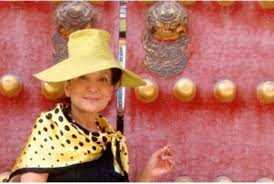
look at this cutie!
look at this cutie!

Jung Chang is an excellent speaker. She has a wealth of adorable stories, a way of turning the most tragic anecdotes into amusing moments, and a lovely way of speaking (and not a little bit of familiarity, with her Chinese words thrown in amongst her accent and her pauses). She tells of being sixteen in 1968, and committing to paper her very first piece of writing, a poem. At the time, being a writer was certainly enough to have one sent down, and that very evening, as she was lying on her bed composing her work, the Red Guards busted in for a random inspection. Desperate to hide her evidence, she tore up the pieces and flushed it down the toilet, and there her writing career stalled for a decade. Everybody laughed, though it’s ostensibly a story of how difficult life was under Mao. Chang just has a way of telling it.

Wild Swans (and her Mao biography) are banned on the Mainland, but Jung Chang herself is not, merely blacklisted. She fought to be able to visit her mother for fourteen days in every year, and while she’s in country (in Chengdu, mostly), she refrains from talking about her work, publicising, and even seeing her friends. Chang shrugged. It is the price of being a writer, she said, and I lack the words to express how this makes me feel, but I’ll try. One of the hardest things for me, when I write about identity (and you know how I love to write about identity), is how much of my family to bring into it; how much of what can hurt me to bring into it. And I love how matter of fact she is of it, how accepting of her situation. This is the fence upon which she sits, and that’s just how it is.

The audience was a delightful mix; I love looking into a queue to see a whole lot of Chinese people, not just older but younger, too, my age or so. Lots of middle-aged to older white people, some others. Sporadic mutters and giggles when the interviewer first pronounced ‘Jung’ as if it were a ‘Y’ sound,* and second repeatedly pronounced Cixi incorrectly (Chang just kept saying Cixi until it sounded okay, and admittedly 慈 is not the most easy of sounds). But then, a sign perhaps of the white audience? Laughter when Chang related of how difficult it was for Cixi to get Chinese people to go overseas, to get a Chinese person to be ambassador to foreign countries. The first Chinese ambassador to the USA was an American. But Chinese people were afraid: afraid of being kidnapped, afraid of being killed. And there were giggles from the audience, as if this isn’t something truly to fear? (Clearly they’ve never been a Chinese person in a Western country)

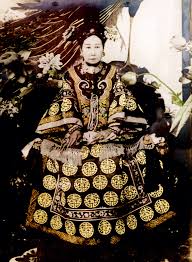
funny story: the first airbrushed photo in chinese history

When asked if Cixi’s history had been influenced by any thing in particular, Chang demurred, explaining the misrepresentations. What she meant to say was, surely, misogyny. Just like Wu Zetian.

When Cixi was young, she had a eunuch lover. Eunuchs were always despised, though Chang suggests they should be figures of sympathy. Cixi instigated a canal cruise for her lover’s birthday: there were dancers, and singing, and revels. This caused an outcry, because EUNUCHS and LADIES MAKING CHOICES, and her lover was put to death, the dancers were sent off to be prostitutes, and Cixi had a breakdown.

I loved the way Chang told of Cixi’s reforms, from the sweeping societal, through to the court etiquette, and how Cixi, who loved curiosities, never rode in a car – because the driver couldn’t bow AND drive at the same time. I also loved that she waved at foreign photographers, because she had heard that foreign monarchs did that (very different from the tradition of being hidden from view all one’s life, as Chinese royals were).

I was most interested to learn about Cixi, but as an endnote, I also learnt about George Morrison, whom Wikipedia tells me was also known as ‘Morrison of Peking’ or ‘Chinese Morrison.’ He came up because a man in the audience asked if Morrison, from Geelong, was in Chang’s new book, noting that he features predominately in many other biographies of Cixi and of the period. “No,” said Chang, after a pause. It wasn’t a ‘trying to remember’ pause – it was an awkward pause, a ‘how do I say no?’ pause. Morrison, says Chang, didn’t speak Chinese. He got a lot of his information from Backhouse, a man who claimed to be Cixi’s lover and who claimed that on her deathbed Cixi told him “never let a woman rule.” It had better not surprise you, reader, to learn that he was a giant liar.

This was a free (but booked out) event at the Wheeler Centre. If you’re in Melbourne, The Wheeler Centre is a great way to see/hear some awesome stuff, for free or for cheap! Get to it.

*!! This tweet from the Wheeler Centre tells me that Jung Chang pronounces her name Yoong! Which is super interesting that she’s chosen a pronunciation that’s so different from the pinyin/romanisation. How non-standard! I apologise for making fun of the interviewer for that.

Fantasy Worlds and Real World Commentary

Emperor Weishu Maorin Guangong Zhian, sixth of the Long Dynasty, of Yanjing, lives in a walled palace. He greets his guests in the Hall of Imperial Greeting; he has beautifully cultivated gardens of flowers and rocks. Those who see him must bow, their heads to the ground, nine times; delicately clothed in silk, fastened with silk frogs. The Master of Presentations is a eunuch. The erhu and the pipa are common instruments; Yanjingyi eat ‘water-reed shoots’ and steamed dumplings with eating sticks. Beside Yanjing lies Gyongxe, a great high plateau, where religions flourish and temples and temple dedicates are most at peace. Premier amongst the religions of Gyongxe is the Living Circle: a religion where one one feels the magic flowing through everything. It is like Qi, says one of the Emperor’s mages. Gyongxe is ruled over by the 298th God-King, implied a reincarnation, who can channel thoughts from gods and other beings.  In Gyongxe they drink butter tea and eat dumplings. Sky burial is an ancient, beloved practice, and though Briar feels disgust as an outsider, he respects their tradition.

It took me 200 pages before I put together what I was reading, because I didn’t want to believe it.

When a rose bush in the carefully sculpted gardens of Emperor Weishu, Eagle of the Heavens, the Leveller of Mountains, wilts with rot, he orders it torn up, the roses set alight, and the gardeners responsible tied up in the middle as the roses burn. His mages are dedicated to him, and his wars, and his closeness to heaven. He is the absolute ruler, and his armies are innumerable, and at their head he is ruthless. Emperor Weishu keeps prisoners; his favourite is Parahan, whose twin sister is Soudamini, who comes from Kombanpur, one of the Realms of the Sun. They speak Banpuri. Parahan is kept with magic chains across his wrists and ankles, and sits on occasion chained to the emperor’s dais.

I love representations of non-white cultures in Fantasy. I’m bored of epic European-based fantasies, reimagings of Arthurian or Greek or Roman or Christian mythos.* So this is great! A world of magic, with these cultural reference points that are familiar to me, that are home to me; or that are completely different but still belonging to someone. It’s great and rich and excellent.

Having taken the countries adjacent to his own, Emperor Weishu, Son of all the Gods, Master of Lions, is moving on to Gyongxe, the spindle of the world. He must have his empire encompass such a point. He has subjugated neighbouring Inxia, and is secretly holding the borders, preventing traders from travelling, and suppressing the Living Circle, this fantasy universe’s calm, meditative religion.

I don’t love Westerners passing judgements on issues they know nothing about; Westerners using our own political situations as the plots for their fantasy worlds; Westerners bringing horrible stereotypes into their fantasy texts, reinforcing these views.

I do not disagree with the heart of it. As an overseas Chinese living in Beijing, I kept my mouth shut on the Tibet issue, learnt the coded key words, and went about my business. I support sovereignty along religious borders, and I definitely have issues with the PRC’s methods of maintaining dominance and control, and the way it’s exterminating real world cultures. I have so many thoughts on Chinese colonialism, and its push into African countries and its railway through Tibet and its suppression of Xinjiang.

But these are complicated issues, with complicated factors and outcomes, and real world impacts. And representation affects that, too.

Borrow our cultures with respect; represent our cultures and our countries with thought and research and interest. Incorporate our fun elements and our bad elements and our mediocre elements. Have fantasy countries that look like China and Tibet and India and Indonesia, and sound and feel like it to us.

I want a less white fantasy landscape. But I don’t want this passing of judgement on a real world issue through a fantasy lens, through a White person’s fantasy lens. I don’t want to see my culture distorted so it is nothing but a stereotype; I don’t want my history disrespected and my culture manipulated so that all is left is a plot point.

I love this author (who I have not named, because she likes to have conversations with her critics and her fangirls like to pile on, but there is all the information here that you need to identify this author and series), and I have read and reread so many of her books. She works hard and works well to build an inclusive universe, that’s not a random European monoculture and is instead full and realistic (across not-ethnicity things, too). And I appreciate that. But this felt like Carthak again: I remember the Emperor Mage, who was so exorbitant and opulent he covered Daine’s bird shit covered clothes with new silk; whose slaves had their tongues removed; who felt he was heaven’s son, and closer to heaven than the gods; who wanted to invade Tortall and all that the protagonists held dear. And it makes me mad and it breaks my heart.

We are more than antagonists in your fantasy world.

(We are more than antagonists in your real world fantasy)

*though Jesus was a black man, Christianity is still primarily a thing associated with the West and with Europe. And of course historically there were black Europeans.

Saturday morning links

Note: Links may not actually be posted until Saturday afternoon

Stuff Stephanie has been doing

Writing!  She has a series of posts about Chinese-Australian identity at Peril, and has written a piece on voluntourism, ethics and actually making a difference for The Toast.

Australia (is terrible)

Australia Day has more violence than any other public holiday!  What this article doesn’t mention is that very few of this violence is directed at white people, which means the current HARD LINE LAURA NORDER stance currently being adopted by New South Wales isn’t going to help in this instance.

This might be time-sensitive, but comedian Aamer Rahman has been retweeting some of the racist hate he gets.

Feminisms

Group dynamics on a female podcast – a bunch of my friends do Verity, an all-women Doctor Who podcast.  Now, I am terrible with podcasts, so I don’t listen to it regularly, but it’s clever and interesting and often very funny.  However, some people (male people) think Team Verity need to be a bit … nicer.

New blog: Intersectionality Times, “a place that hopes to provide a safe space for those of us who are ‘othered’ by mainstream Australian feminism.”

Stealing sexy calendars isn’t Jesus and it isn’t radical – “If your activism involves turning over tables and then leaving them there for minimum wage workers to clean up, please rethink. If your feminism involves “breaking glass ceilings” and leaving other women to sweep up the glass, stop.”  I really couldn’t put it better.

Dear James Delingpole: You are the problem – “Little boys are not universally sociopaths in training: nurturing and love are not exclusively feminine traits. But that’s what they can sometimes become, if, as so many people do, you assume that boys are naturally monstrous, and consequently neglect to teach them the empathy, kindness and respect for others you’ve already decided they’re incapable of learning.”

Media

A Chinese space opera trilogy is coming to the US Anglosphere – this isn’t new news, but I’m reblogging it mostly so I remember.  Also, it looks like some of Liu Cuxin’s short fiction is available in English on Amazon, so note to self, get into that.

I’ve been re-watching Star Trek: Voyager for the first time since … well, since I stopped being a Trekkie, back in the early 2000s.  I’d like to say that I’ve been inspired with meaningful and clever thoughts about the series, but … well, apparently nothing has changed since I was 14.  Except that I’m playing a fun game of, “Did I actually watch this multiple times, or did I just memorise Jim Wright‘s review?”

But in the same universe, Grant Watson has been watching and blogging about the first season of Star Trek: The Next Generation.

Economic injustice

Why your shoes won’t save the world – the problem with “buy one, give one” charity.

Race

Not your Asian sidekick – the fight for diverse identities – an Australian account of the recent hashtag, and why it’s important.

Why I prefer “black” – On identity, race, nationalism and more.  Of note:  I don’t use the term “person/woman of colour” for myself because, from an Aboriginal perspective, this phrase does not carry the same political weight and indeed, to be “of colour” to me is to also be comfortable with people defining my background by those old blood quanta percentages, which I reject.

This is something I try to keep in mind:  although “person of colour” is widely accepted, and generally not considered offensive, it is by no means a universal phrase.  (I had to explain this to an American recently.  It was … challenging.)

Food

How did toast become the latest artisanal food craze?  This article covers a lot of ground, but the answer is basically “intersectionality”.

Also, I am kind of touched by the notion that $4 is a lot to pay for toast.  Bless you, America, but your prices are artificially low.

(It’s not just America.  Mel from Subversive Reader was ranting on Twitter … yesterday?  About $2 baby shirts, and the fact that the fabric alone costs more than that.  As she said, someone isn’t being paid their due, and you can bet it’s not the Australian retail worker at the final point of sale.)

Frozen

Last week, Melbourne experienced a record-breaking heatwave.  I coped by hiding out in an air-conditioned cinema and watching Frozen.  

I had initially planned to give Frozen the old boycott-by-ignoring-and-basically-forgetting-it-existed, because of that animator’s comments about it being sooooooo haaaaaaaaaard to animate women, because they have to have facial expressions but still remain pretty!  I was like, dude, you work for a company that’s fairly well-known for its animated female characters, I’m pretty sure you can figure it out.

However, increasing numbers of my friends were seeing it, and coming away talking it up as totes feminist and progressive.  My curiosity was piqued!  Also, it was really hot.

And I enjoyed it!  I thought it was a decent movie in its own right, but played with Disney tropes in an interesting way.  And if you  had told me that Disney would do a movie about an agoraphobic princess, I wouldn’t have believed you.  AND YET.

Okay, I don’t think Elsa is actually agoraphobic, or has any other condition that maps to contemporary psychology.  But the way her fear of her magic, and hurting people with her magic, manifests is so close to agoraphobia (and other things — Anna hints that she assumed her sister was obsessive-compulsive) that it felt quite right to me.  Likewise, in finally embracing her abilities, she displays a hint of the femme fatale, making her possibly the most knowingly sexual Disney princess queen yet.

Also, Anna is basically me, if I was a Disney princess.  Except that I wouldn’t go haring off after my sister in a snowstorm, wearing a summer dress.  (Sorry, sis.)

With that in mind, here are some interesting and useful Frozen posts:

7 moments that made Frozen the most progressive Disney movie ever – I try to avoid that kind of hyperbole, because it’s nearly always wrong/oversimplified/ALSO WRONG.  But these were good features!

How Ariel became Disney’s bad woman: a look at Frozen and The Little Mermaid – so I completely disagree with this post’s taken on Frozen, but I really love it for reclaiming the feminism of The Little Mermaid.  IT’S COMPLICATED.

(Having said that, as an adult, I now find it quite sad that Ariel is only 16 when she makes the irrevocable decision to change species and get married.  That’s so young!)

Here I Go (Despair of an Alto) – I can’t actually hit a note or hold a tune, but if I could, I’d be an alto.  So this speaks to me on a very profound level.


summer reading: lady friendly australian crime novels

I’ve recently been reading some Australian crime novels! The standout authors for me have been Katherine Howell and Kathryn Fox. I sometimes refer to them as the two katherines because I get them mixed up, I’m sorry my friends. 

Crimes happen, ladies get attacked and sometimes murdered. We’re talking about crime novels, of course ladies get attacked (Not that I approve of this! And neither does my friend Fi, you can read her opinion on this in Women in Boxes). But unlike most crime novels, ladies are saved, misogyny is discussed, we don’t have to read about the assaults in detail, and excellent women do some excellent work.

The feminism in these books is explicit. In Deserving Death (by Katherine Howell), Detective Ella is talking to the ex-housemate of a murder victim. He was asked to leave the house because he kept asking his housemate to date him. Sulkily, he says: “In movies, the guy who’s determined always wins in the end. But it’s not true.”

“That’s because it only works in movies, Ella thought. In real life it’s called stalking.”

I shrieked when I read this line. It’s so unusual to have creepy, horrible behaviour called out in crime novels.

Kathryn Fox’s protagonist, forensic physician Anya, is so woman- and victim-centric it’s a pleasure to read her stories. In Death Mask, Anya explicitly looks at, researches and talks about pack behaviour in male-dominated team sports, what that means at a greater societal level, and how that reflects on treatment towards women. She talks in depth about the burden placed on the victim in assault cases, emotionally and physically, and although going into it I thought I understood, I appreciated this look at it.

Anya also goes in depth into the science behind forensics, and gathering evidence for assault cases, and it’s excellent to not only have this lady-centric science and scientists, but to use science as a way of deflecting the horror of constant lady attacks. I appreciate it.

Katherine Howell spent 15 years as a paramedic; Kathryn Fox was a medical doctor. It shows, and I love it.

I rarely read crime novels, and I started off reading these for work; but I’m genuinely enjoying them and bought a Kathryn Fox novel to give to someone as a Christmas present. If only all crime novels could be this respectful to women and science; I’d probably read them more.

ETA: Liz talks about the whiteness of the Katherine Howell books at her other blog.

For your bookshelf: The Ghost Bride by Yangsze Choo

All too often, someone examines the Young Adult shelves and comes up with damning statistics: few authors of colour, few characters of colour, and if a book happens to be about a non-white person, chances are that character won’t be on the cover.

So I was pretty excited when I wandered through a bookstore a few weeks ago and found The Ghost Bride by Yangsze Choo, a novel about a young Chinese-Malaysian woman who is asked to become marry the recently deceased son of a wealthy family.  It broke all the restrictions I listed above, and further research (you know, I googled) revealed that it was also the subject of a fair amount of publisher and industry hype.  As the author’s website lists:

  • Oprah.com’s Book of the Week
  • An August 2013 Indie Next List pick
  • Barnes & Noble Fall ‘13 Discover Great New Writers selection,
  • Glamour Magazine 2013 Beach Read
  • Good Housekeeping Magazine Book Pick
  • The Bookseller Editor’s Pick
  • Library Journal Barbara’s Pick

All this is really cool, and I hope it’s the beginning of a trend of inclusivity in the publishing industry.  Even if the cover is one of those dreadful headless girl covers so beloved of publishers, and is also kind of badly composed.

But, of course, we ask, does the novel live up to the hype?

The cover of The Ghost Bride: an Asian woman with high cheekbones and an enigmatic smile is lying ... on her side?  And there's, like, blurry flowers around her? This is not actually a good cover.
The Ghost Bride by Yangsze Choo

In my opinion, yes.  It has too many subplots, with the result that some go undeveloped, but it was entertaining, difficult to put down, and left me seeking out more information about Malaysia, Chinese-Malaysian culture in the 19th century, Chinese beliefs and practices about the afterlife, and more.  If I finish a book and find myself surrounded by Wikipedia tabs, that’s a good sign.

Of course, as a Nice White Lady, I’m not in a position to judge Choo’s depiction of Malaysia’s Chinese population, or Malaysia in general.  (Let’s all take a moment to cast some casual side-eye at the GoodReads reviewer who suggested Choo’s portrayal of Asia was inferior to that of Alison Goodman, white Australian author.)  But I never had the feeling that Choo was writing for a default white audience.  She stops and gives context to various plot-relevant things, but I still had to look up foods and clothing styles to fully appreciate the setting.  I contrast this with Cindy Pon’s Silver Phoenix, where chopsticks became “eating sticks”.

Additionally, the Malacca of the book quickly felt like home.  It didn’t seem exoticised or cliched.  I can’t speak to the accuracy of the setting, but it certainly felt like a real, vivid place, familiar to its heroine and very much loved.

Ah, the heroine.  Certain GoodReads reviewers will tell you that she was passive and boring, and those reviewers are WRONG.

I mean, yes, Li Lan is a quiet character who respects and loves her opium-addicted father and the servant who raised her.  For much of the book, she observes rather than acts, and I guess that can be frustrating.  Truthfully, I found the first quarter of the book pleasant, but slow going.  “Just hurry up and marry the dead guy so we can get this show on the road,” I was thinking.

Hah!  Li Lan mocks your puny assumptions about how things should go!  I mean, she won’t actually say anything, but she’ll be judging you.  Silently.

Around the point where my Kobo told me I was at 25%, something happens.  I’m not going to spoil it, because I absolutely didn’t see it coming, but it completely defied my expectations.  And from that point, Li Lan has to take a much more proactive role in the story.  She makes mistakes, stubbornly refuses to do what I keep silently telling her to do, and she is possibly the worst judge of character since Dance Academy gave me Tara Webster.  But she’s wonderful, because here she is, stuck in a situation she does’t understand and cannot control, and by God, she is going to make this work or die trying.

Okay, so things I did not love: the subplots.  There were too many.  First we have the Lim family, their eligible post-mortem bachelor and their many, many other dysfunctions.  Like the bit where the eligible bachelor was murdered.

Then we have the corrupt bureaucracy controlling the afterlife.  Then we have Li Lan’s dead mother.  Then we have — actually, his whole name is a spoiler, it turns out.  Not for me, because I had to Google him, but if I name him, Stephanie will probably have a good idea of what he’s all about.  Anyway, there’s a guy, and he has a an agenda, and Li Lan spends a lot of time yelling at him.  SORRY, GOODREADS, SHE’S NO ACTUALLY PASSIVE AT ALL.  GO STAND IN THE CORNER.

Now, all these subplots were really interesting, but there were SO MANY that they felt a bit muddled, and certain resolutions happen off-stage.  I don’t actually know which one I’d exclude, though, so maybe the book just needed to be slightly longer.  (It looks like it wasn’t marketed as YA in the US?  Which also explains some of the lukewarm reactions from reviewers.  It could go as either YA or Whatever The Hell New Adult Even Is, but I think it’s a better fit in YA.)

One thing The Ghost Bride didn’t have was, you know, white people.  Much.  There is one white person in the entire book, and he’s … well, spoilers, he’s dead long before the action takes place.  I guess Stephanie will be a better judge of this when she reads it, but I went in expecting a book with more overt discussion of colonialism, and found hardly any at all.  At one point Li Lan is offered the opportunity to visit England, but her actual dreams of travel involve Japan and China.

I’ve been trying to decide whether this avoidance of the issue was … well, you know, avoidance, or a subtle middle finger being raised in the general direction of imperialism: “You may occupy our land, impose your values on ours, but you’re not part of our stories.”  Mostly I think it’s just not relevant to Li Lan’s experiences.

(One bit where colonialism intruded, although I only learned this later, on my Wikipedia binge, is the use of the term “hell money” for the fake money burned for the dead.  As Wikipedia tells it, and feel free to correct me if it’s wrong, it picked up that name after Christian missionaries told Chinese people they were going to hell for their pagan beliefs (well done, people, really nice attitude there), and the Chinese were like, “Okay, so ‘hell’ is clearly the English word for heaven.  Cool!”)

(So I don’t know if “hell money” is the appropriate word for the setting and character, but it’s evocative and fits the mythology of the setting.  But I’m not wholly comfortable with its use, and will just sit tight until Stephanie tells me how to feel.)

The Ghost Bride is AU$7.39 on Kobobooks, and is probably some similar sort of amount on Kindle, or in paperback, and stuff.  It’s $19.99 at Readings in Melbourne, which is why I bought the ebook.  Also, arthritis and stuff, and my hands are delicate flowers.  I think more people should read it so we can make flappy hands at each other about [SPOILERY THING THAT HAPPENS AT THE END].  In the meantime, I’m going to go stalk Yangsze Choo’s website and wait impatiently for her next book.