fearing the familiar; and bitter suites, by otto fong

I am a superstitious being.

I hold my breath as I pass by cemeteries; I won’t go near a number which contains 4; there is an upside-down 福 by my door and I’d hang a 八卦 mirror by my door if I thought I required it. I don’t wear black to weddings; I bow before the buddhas and the red altars I pass, just in case. At 春节 I stuff the mouth of the Kitchen God so he can’t tattle on me to the Jade Emperor.

But

I walk under ladders, I don’t throw salt and I don’t care about mirrors breaking. I don’t understand the thing about magpies, or umbrellas inside, and I forget about thirteen until it’s come and gone.

Because

I am afraid of Chinese ghosts.

This is, in many ways but entirely anecdotally, a peculiarity of overseas Chinese. It’s something I didn’t encounter quite so much when I was living in Beijing, wandering through its old hutongs and talking to old Beijingren who have lived in those alleys their whole lives. But it’s something I’ve lived and breathed all through Singapore and Malaysia, through growing up part of the Chinese diaspora in Sydney and Perth. Even now, as an adult in Melbourne, it’s something I often glimpse out of the corner of my eye.

In part this could be due to the nature of the media – horror movies and etc are restricted in China, and this could feed into a lack of ghost discussion? But surely not that much.

In Singapore this fear of ghosts is best captured in my memories by Haw Par Villa, a theme park dedicated to Chinese mythology, religion and Confucianism. It was designed as a place to teach about traditional Chinese values, but mostly all I remember is fear, twisted faces, decrepit models and the ten courts of hell.

The ten courts of hell can be found in a ‘cave’, ten separate dioramas of molten faces, rendered corpses, and disjointed limbs. I wanted to tell you more, but reading about it online to get my facts straight caused my stomach to turn and my breath to quicken, so I shall simply link you to this walk through and say that if I were ever religious, and pious, and motivated by my religion, it would be fear of the courts of hell and their kings that would prompt me to be a beautiful person.

I picked up Bitter Suites, by Otto Fong, on a recent jaunt to Singapore. It’s a very Singaporean book in so many ways, not only in its every day Singaporean setting and the Singaporean ridiculousness of its main characters, but in the way it wove Haw Par Villa into the plot and speared my heart through with a childhood fear I hadn’t realised would come back.

I found Bitter Suites terrifying and compelling, mostly through my growing horror as I realised just how important a role the early visit to the Haw Par Villa and the ten Chinese hells would play in the story, as those who had committed a cruel practical joke were slowly and eventually, eternally, punished for their crimes. I found the writing adequate but it was the illustrations that sold me, and the little softer asides.

I fear, however, that this is a very specific book. I suspect that one might need to be overseas Chinese, and specifically SEAzn Chinese, familiar with the ridiculousness of Haw Par Villa’s decay and yet indoctrinated from childhood of the ever-presence of spirits, their constant needs for placation and the reality of the hells until reincarnation.

It’s not that it’s a book opaque to outsiders. It’s that it’s a book that plays very specifically to one thing, and it’s a thing that I will probably always hold in the depths of my psyche, and probably looks ridiculous to everyone else.

Horror is, after all, subjective.

If you want to read it, let me know; I have a copy hiding under several piles of paper where I cannot see it.

book pusher (not a white cis dude edition)

There are books that I recommend to everyone, books that I want everyone in the world to read and love, and I am always interested when people tell me their always-recommends. So I was excited at the recent open thread up at Captain Awkward looking at exactly that; and super disappointed that it was super dudely and super white. I know that’s inevitable, in its way and in the nature of our internet and our (western) society, but still, disappointment. So I made my own open thread.

What are the books that you always recommend to people, that you always want people to love, that you shove at people and wave your hands about and reread constantly? Only rule: the author cannot be a cis white dude. Trans white dude, fine. Cis asian dude, fine. Ladies, all fine. Author doesn’t conform to your gender binary? All good.

Here, I’ll start.

The Pillow Book of Sei Shonagon: the only book I took with me in hardcopy when I moved to Beijing; a book I’ve filled with annotations and which was one of the most formative books on my writing style; a book that filled me with joy the first time I ever read it. I give it as presents and I talk about it a lot, but I never lend out my copy because it says a lot about me. TOO MUCH.

Growing Up Asian in Australia (ed Alice Pung): I wish this book had come to me when I was younger, but even as an adult it resonates and is an amazing reflection on the Asian-Australian experience that should be vital reading for all Australians.

Heartsick for Country (ed Sally Morgan, Tjalaminu Mia & Blaze Kwaymullina): another must read for all Australians. I cry every time I read this book, this reflection on being Indigenous Australian and the connection between Indigenous Australians and their countries, and that feeling of heartsickness at damage to the land, at history, at racism and at everything else. ALL THE CRIES. ALL THE RECOMMENDS. This book always reinflames my desire to be the best Australian I can be, prioritising Indigenous Australians and the land and just adflkadf.

Okay, go. Your turn.

indigenous literacy day and getting caught reading

Today is Indigenous Literacy Day! This is great because it means we are talking about Indigenous Literacy! This is bad because Australia, it means we still need to talk about Indigenous Literacy.

There is a huge gap in English literacy rates between Indigenous and non-Indigenous people in Australia. A disgustingly enormous, we should feel ashamed of ourselves gap. By year 3, the gap in reading, writing and numeracy is already significant, and by the age of 15, “more than one-third of Australia’s Indigenous students ‘do not have the adequate skills and knowledge in reading literacy to meet real-life challenges and may well be disadvantaged in their lives beyond school’.” MORE THAN ONE THIRD. That is so uncool I cannot even. But Indigenous Australians should just pull themselves up by their bootstraps and Australia is totally not racist, amirite?

The Indigenous Literacy Foundation works to alleviate this disadvantage for Indigenous Australians, and Indigenous Literacy Day (every September 4) is one of the ways it gathers public support. So far in 2013, $360 000 has been donated, with 100 000 books supplied in 230 remote communities. But through Indigenous Literacy Day, we can help increase those numbers! And through the rest of the year too.

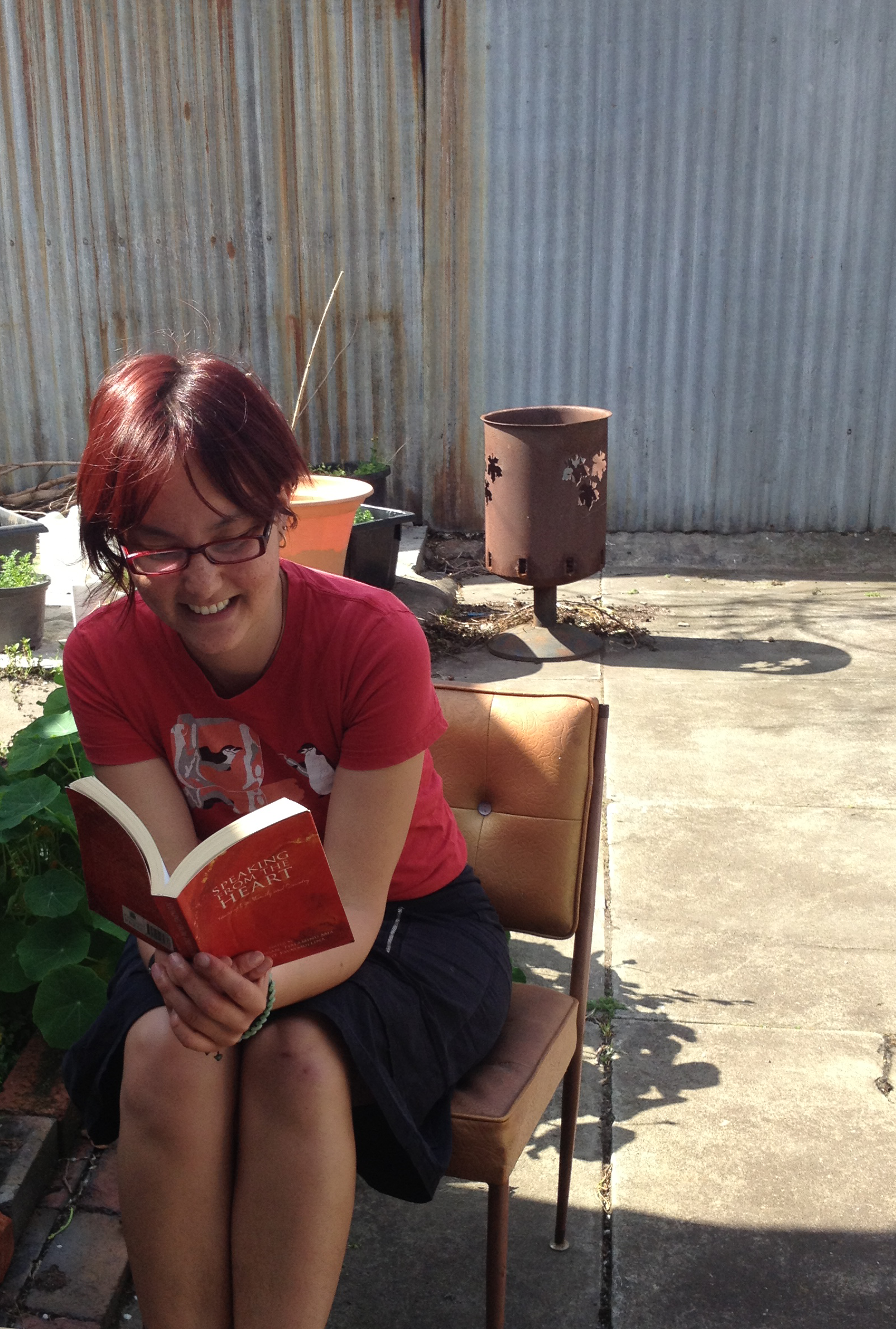
You can directly make a donation to ILF, and you can also get caught reading!  Today Liz and I are making a donation to the Indigenous Literacy Fund and we have been caught reading Speaking from the Heart (by Sally Morgan, Tjalaminu Mia and Blaze Kwaymullina), and To Say Nothing of the Dog by Connie Willis.

liz getting caught reading steph getting caught reading

A number of bookstores around the country are donating a percentage of all sales today to the ILF, so if you’re looking for a new book buy it from one of them today! (My book today will be purchased from Readings Carlton, who are donating 5% of all book sales today)

There is also a great blog post up at the Reconciliation Australia blog if you’d like some more info and stats and things.

My Island Homicide: a book review and writing someone else’s face

This is mostly a book review rather than a 101 on writing someone else’s face, so we’re going book review first, issues town second.

The Book: My Island Homicide by Catherine Titasey (2013, UQP)

[Mild spoilers to follow but nothing about the crime or anything]

My Island Homicide is the first novel by Catherine Titasey, not quite a crime novel set on Thursday Island in the Torres Strait, though I received it under the guise of being a crime novel. I would not describe it as a crime novel, though the crime is there and looms large: it’s more a slice of life, and it’s kind of fun.

There are not that many fiction books about the Torres Strait, and there are even fewer books that end happily (as it were); that have an Islander protagonist; that are this great slice of Torres Strait Life that I wanted to just keep on keeping on. I loved the minutiae in the book. I loved the Sissys getting more and more animals as Jack palmed them off. I loved everyone’s casual acceptance of maydh (a curse), and the mostly natural weaving in of the local Broken English, and I loved loved loved the protag’s mum coming home to Thursday Island and finding herself again.

And I wanted to love it as a book. But it reads weird. It was billed as a mystery (and it is), but it’s also a romance and it’s also a slice of life. On pg 138, almost halfway through the book, there’s suddenly a family mystery! At times it seems as if the pedestrian plodding of the story – not of the plot, but the pace of the book itself – is a reflection of life on Thursday Island, just going with the flow and letting it happen, but at other times it simply felt like uninspired pedestrian writing. I wish that the book had been able to settle into what it wanted to be, rather than hopping back and forth.

My Island Homicide talks about all sorts of issues, but only briefly. It mentions in passing the predominant local crimes (assault and theft) and their causes (alcohol, hunger). It makes a major plot point of the lack of education in the Torres Strait, and how easy it is to pretend like the white man is doing something when really he isn’t. It laughs away DV and assault, and it’s hard to tell when it’s poking fun with versus when it’s poking fun at the things that happen in island life. These are major issues in the Torres Strait and also incredibly damaging stereotypes when seen through non-TSI eyes, and I wish more had been done to flag this as not okay.

There’s a lot of unquestioned behaviour and acts which seem less than ideal. A white person describes the abuse they’re suffering from a black person as ‘racist,’ with no looking at the fact that it’s not possible (due to the equation of privilege + power = racism). There was some super dodgy stuff going on around the young gentleman who was unable to talk (sometimes it was implied he had suffered brain damage, sometimes just that he couldn’t speak and refused to sign) in terms of attitudes.

The book keeps making jokes at the expense of Gen Y, followed by some vegan hate, which didn’t endear it to me. (At one point a member of Gen Y declares they don’t know what Twister the board game is, which, I call nope). This is obviously less critical than the class and social issues in the Torres Strait, but also totally not cool!

Thea’s mother thinks Thea’s under maydh, and though Thea is unsure she goes with it, being treated for the curse and in the end she recovers with two answers: a western medicine answer, and a maydh answer. I love this resolution. Of course there’s a western medicine answer, because western medicine is always trying to quantify non-western traditional methods and outcomes. But there’s a ‘traditional’ outcome and solution too, and we’re never told which one is right in the context of the text. It just is.

It was really nice to read a book set in the Thursday Islands, and to be reading a book that was trying so hard to do justice to the Torres Strait and to this part of Australia’s population and culture. But it wasn’t a great book, and I can’t whole-heartedly recommend it to you. It was fun and easy to read, but it took me about 100 pages before I was actually into it. If I was handed another book by this author I would consider reading it, and I would certainly support what she’s doing (writing about Torres Strait Islander communities) but I wouldn’t leap to read it. Three out of five jiaozi.

If you want to read the book, let me know, there’s a possibility this copy is mine.

People as Food

Milk chocolate. Almond. Burnt honey. Olive. Dark olive. Peanut brown. Nut brown.

I made a list of the ways brown people are described in My Island Homicide. I recoiled at that last one, particularly as it was the last sentence of the novel, used to described Thea’s (the POV character) baby. Note Thea describes herself as light brown. (Her mother is milk chocolate)

Hey you know what we are not? We are not a menu. We are not food items or items for export or exploitation or fetishisation, even after you give birth to us, much like many of these items were (or still are). Coffee and cocoa in particular, with their slave labour connotations and the indigenous exploitation inherent within, makes these comparisons, even when unintentional, totally on the dodgy side.

It is not a compliment to describe brown characters in food terms.

Working with (and Reading) Someone Else’s Culture

This blog post is not a cultural appropriation primer or anything like that, because I don’t have the time nor the patience, and also because many other people have done that work, though maybe not from an Australian point of view. So maybe that’ll come another day.

My Island Homicide is very firmly a book set in the Torres Strait. It is on Thursday Island and Horn Island and a couple of tiny dotted islands in between. Titasey is white; though she is married to a Torres Strait Islander with TSI children, and has lived on Thursday Island for 20 years.

The POV character is a half-Islander, half-Caucasian woman whose family moved away from the Torres Strait and now she’s come back, wanting to live her stereotypical idyllic island lifestyle and maybe along the way she’ll learn some things. This worked for the most part as a frame for explaining things about the culture to an assumed non-Torres Strait audience. Thea learning Broken English was woven with shame (at not knowing it) and embarrassment and also naturally into the text, in a way that didn’t throw me out and that was awesome. Things were explained where explanations worked, but the text didn’t assume the reader was completely lacking in knowledge (except, inexplicably, when it explains that Billabong is a surf company).

You can tell, when you’re reading My Island Homicide, that Titasey is an outsider but has worked to not be an outsider. She presents this culture that isn’t hers as respectfully as she can, and though I wish it’d been better written I really appreciated that.

The Exotic Place as Other (and notes on cinder, by marissa meyer)

Futures and dystopias are frequently set in completely fabricated cities and worlds and planets, often but not always rising from the ashes of some war or climate catastrophe on Earth. There is extensive world-building and backgrounds established, and aside from the shared past of ‘Earth’ there is at times little else shared; Earth, and the issues of now translated into the text.

Frequently, though, those new dystopic futures are in New Something. New Beijing, New Singapore, New Istanbul. When they’re written in English and set in New Asian Something, I will bet you all the tea in my house that it is shorthand for an exotic distant (future) other; that the name of that place bears no actual relation to the plot or the world building other than something superficial like chopsticks, or the heat, and could have been set in New New York or New Londontown.

When you give the name of a place, you conjure connotations of that place, images and memories and ideas. When you name a place and there is nothing similar between the place you describe and the place you have named, what connotations exactly are you trying to conjure? In many cases, that image is other, and the exotic.

Exotic as Shorthand and the Place as Other

Exotic is a problematic term all on its own, particularly so when it’s applied to some culture you don’t know; in English-language Science Fiction, that’s almost always a place that isn’t a Western place. Tori Truslow wrote a great post in 2012. It’s got totally racist connotations, especially when we’re talking about beauty, particularly women; it separates us, and it others us. It’s frustrating when it’s applied to your food and your culture (as I wrote about five years ago). These are all different topics, but you see the connection: the exotic as other.

And the exotic in a text assumes an audience; but more importantly, it makes assumptions on who is not considered the audience.

In Australia, the term ‘exotic’ is used to refer to introduced species of plants and animals; primarily, English species. Roses are exotic; as are rabbits. I delight in this usage; particularly in my industry where this is the correct terminology.

The words ‘New Place’ are not required to create this artificial and lazy sense of place as other. Firefly, the Joss Whedon space western, is set 500 years in the future when the USA and China have combined to form one governing body and there’s nary an Asian city or country name in sight. There are swearwords in ear-twitching Mandarin, though, and comments about cooking bao and some kitschy East Asian set dressing. There’s no actual evidence of the alleged Chinese upper class, and despite claiming to be a fusion universe the show features no actual Asians (and indeed, described as Pan-Asian rather than the logical outcome of Pan-Chinese). It creates this great sense of place, of other, of how our dystopic future might turn out without resorting to green skies and triple moons…if you’re not sitting there, foaming at the mouth while someone appropriates your culture for its trappings and none of what it could actually contribute (say, actual Asians. And 100 kuai says terraforming was invented by an Asian scientist. Because have you met the Asian monolith?).

Dystopic future Los Angeles as represented in Blade Runner (you know what’s great about Blade Runner? Edward James Olmos) is like the perfect summing up of my point. It’s so perfect, I found some lecturer’s class notes on the internet that agree. This 2019 LA has lots of East Asian elements and non-English languages, and a whole lot of brown people, which reflected a (1980s but still relevant today!) fear of East Asian growth (Japan then, but China now) and an increase in white flight, which in Blade Runner are used as short hand for dystopia.

My disdain for The Wind-Up Girl remains strong, for many reasons, and in my original review I noted that (sorry, I’m totally quoting myself here):

there is really no point to setting the novel in Thailand. Thailand in this novel is othered just like many of the characters, and at most point it feels like any old made up exotic back drop. There’s very little about the setting that is really clearly a future Thailand, except from some mythology stuff. It could have been any old country, so why make it Thailand? Except I guess to make use of its sex trade issues WHY OH WHY. Some reviewers (okay, one commenter on one review) mentioned that it could be because Thailand is the only country that was never colonised by some white dude, which, okay, but that doesn’t change the fact that it’s still totally The Other.

And as Jaymee points out in her review, there is not only no justification for this geographical choice, there is also no explanation for inexplicable changes in neighbouring geography, such as the xenophobic fundamentalism of Malaysia (called Malaya in the book) which is inconsistent with a nuanced understanding of Malaysia’s history and racial politics. This oversight highlights the other issue with the exotic as the other: a necessary understanding not only of that one city, but of all its other interactions in the world.

Hilariously, I discovered this review of The Wind-Up Girl (which includes a review for River of Gods, which is a book I really want to read to see how terribly it uses India as a dystopic future setting) which completely disagrees with me, on the grounds that a good future dystopia based on an existing city should be totally different due to science and technology and in fact let me quote from this review, because this bit I agree with:

The right way is to recognize the historical fact that no country reaches the tech frontier without undergoing serious social changes. The faint echoes of samurai and cowboys in the Panasonics and Googles of today are just that – faint echoes. Writers who realize this will try to preserve some element of the spirit of the old in the form of the (imagined) new, rather than trying to cut-and-paste.

True! I will buy this theory, or some of it. However I disagree that The Wind-Up Girl has done so, primarily because I ask this: who are you to make the decision that it is sufficiently echoey? The biggest problem with this theory is that we are writing in the today. As an author not from these cities (as every author I am talking about in this blog post is), can they ever truly be trusted to make these sorts of judgements on a city? Instead, they pick and choose and turn up a city that is never quite right, precisely because it could just as easily have been set anywhere and it has brought nothing to the story other than the exotic as dystopic and different, particularly as the stories are written today, in our actual current world politics. (Thanks once again for making Thailand a stereotype of poverty and sexual slavery, Paolo! It’s not like every Western produced text that features Thailand makes the same statement!)

The Accidental Exotic is My Backyard

There is a flip side to this: the unintended Exotic. Elizabeth Knox suggests that non-USA/English in English writers may do this by accident or even consciously, where one’s normal is in fact the “audience”‘s exotic and different. This again makes assumptions about audiences, and asks what we can expect a reader to know and to understand. Famously Avatar: The Last Airbender was considered by some viewers to be entirely fantasy, including some elements taken directly from Japanese, Chinese and Korean myths and traditions. How much of this is because readers (and viewers) are used to the completely familiar, and the exotic as other?

New Beijing, Imagined (No, Seriously, Imagined) in Cinder, by Marissa Meyer (spoilers included)

Despite its capital of New Beijing, the Eastern Commonwealth is not a China. It can’t be, not with far-flung provinces such as Mumbai, an Emperor named Kaito, and kimonos as formal wear. The emperor eats with chopsticks at one point, and Cinder’s sisters are named Pearl and Peony, and family names before personal names. In the market is a sweet bun baker named Chang Sacha, which I guess could potentially be a pan-Chinese name. There is a moon calendar celebration.

Some reviews mentioned how Chinese it all sounded but it is so not Chinese sounding that I cannot even. It is not even very pan-Asian, which I wouldn’t forgive but would at least be something.

Pearl and Peony are Western stereotypes well before they’re actual Chinese names, especially in a text that’s Linh and Chang and Kaito. Their mother, Adri, makes no sense in this context as a name. Indeed their names even translated, with no naming schema, confuse rather than clarify. There is an Emperor, and with that Japanese name and the Changs and the Linhs (Vietnamese, by the way, if you’re wondering, and also usually a personal name) we’re moving solidly into pan-Asian territory.

The likelihood of China entering an alliance with Japan is as always slim to none for varied historical reasons; I would believe a China-Korea alliance before a China-Japan alliance, though the Singapore I’ll grant, especially if it were a one commonwealth two systems deal.

It’s a lot for me to say that it can’t be New Beijing because the names are broken, but it’s basically all we’re given. This New Beijing could be any North American city that I’ve seen on a tv screen (but surely even then the USA, with its history, is unlikely to accept a hereditary ruler so perhaps not even then). The chances of it being even pan Asian, let alone Chinese, are unlikely. There is nothing in Cinder that gives a sense of place, let alone a sense of a sprawling Chinese city. There is no ridiculous architecture, no noisy press, no constant flux. There is a cluster of apartments rising high into the sky, kids playing in corridors and in my head I imagined Chungking Mansion, the Hong Kong monstrosity, but that was more me than the text.

Awkwardly for me this New Beijing is in a far-flung renumbered distant future, so a defence of this book could be that Earth politics has changed so much that Emperor Kaito (Japanese) could indeed peacefully rule the Eastern Commonwealth of (unnamed) China and Singapore and Mumbai at least, living in New Beijing, and it’s all good.

But uh we live here, in the real politics of the world, and to imply that there is a Japanese ruler of a combined China and Singapore and India is there are no words, imagine me lying on the floor making choking noises as I bury my head in my arm and laugh and laugh and laugh.

The Book Smugglers in a review note that the story is set in New Beijing but really fails to capitalise on that and in addition the story goes out of its way to make Cinder first assumed European, and then Lunar (and we assume, caucasian) – what even is the point? they ask. The point is to use the city as shorthand for characterisation and move on, and this is why representation and research and every thing else is so important. We are not making a needlessly big deal! We are making an actual facts big deal.

Our dystopic future is very scientifically unlikely to be white, because of genetics, and science, and look white people are a minority already, you know? And climate change and the sun and recessive genes, and a lot of our scientific breakthroughs are coming out of Asia and Africa. Do you know how advanced Chinese alternative energy research is? And the fact that authors continue to write our dystopic future as white, or as white hero in a pretend brown world, simply proves the point that we’re used as a backdrop and there’s no actual real reflection of our dystopic future (or our current) in these texts.

(It’s funny how easy it is to misread a thing. Another review claimed that for the ‘sensitive readers’, there was nothing to worry about, unless you were offended by cyborgs. Oh sure, nothing, except the explicit medical trauma where Cinders is offered up for medical experimentation by her step mother, and then we are treated to pages and pages of her tied to a lab table, panicking, having her blood drawn by med robots, her protesting and saying she was not a volunteer, having a disembodied voice telling her too bad. Sure. Nothing to worry about for anyone.)

Imagined World Politics and Their Implications in 2013

New Beijing is in the Eastern Commonwealth, which is ruled by the hereditary ruler Emperor Kaito. An emperor of any Chinese-something alliance is unlikely, given China’s history with hereditary rulers and though the Emperor was such for nearly 2000 years, it will take much to move him back again. The Emperor lives in a palace in New Beijing, so we can assume that New Beijing is the capital of the Eastern Commonwealth. This book was published in 2012, so we can assume that New Beijing implies something about the original power of China moving into this commonwealth, particularly in light of page 28, at which point I gasped out loud: “Subjects had been carted in from provinces as far-reaching as Mumbai and Singapore.”

The provinces of Mumbai and Singapore. The author’s website implies that the ‘Eastern Commonwealth’ is basically Asia, and that there are other similar conglomerates (Africa, Europe and Australia, ruled by a Governor-General).

Speaking of Africa, one of the key components of Cinder is the deadly plague which found its first outbreak in a small village in the African Union. This is revealed to be a disease brought to Earth by refugee Lunars, who have fled to the African Union’s unpopulated areas. It’s problematic that ‘unpopulated Africa’ is the location selected for runaway Lunars (and not, say, unpopulated Europe or unpopulated North America), due to its implications of a continuing ’empty’ or backwards Africa.* It’s problematic that this feeds into the concept of dirty brown people.

In the previous section I talk about why implying the Japanese-China alliance or commonwealth or whatever is a completely ridiculous notion given our real world politics. This conglomeration of the Eastern Commonwealth which I cannot even take seriously because it then refers to the province of Singapore (as opposed to the country of Singapore, which surely is the point of a commonwealth) just continues to give rise to the idea of pan-Asianism, a particularly vexing problem when we are talking about the representation of Asian people in Western texts; that is, we are interchangeable.

My Face

I could really do without authors choosing to set stories in my exotic different cities and then choosing to make the city some random Western smush, with no real need to be set in that city and no real understanding of how my city works.

Please don’t misunderstand me, I’m not all up on my rant horse because she’s ruining my city or my feelings or whatever. But this is definitely a personal issue as well as an intellectual one. It assumes that a non-western audience is not your audience; it assumes unfamiliarity with the setting, because it’s a short-hand; it assumes that my city is short-hand for cool and exotic. And it is lazy and unnecessary and occasionally it makes me very angry.

*a footnote! I’m trying to avoid footnotes but this one is important and definitely a foot: I hate ‘#firstworldproblems’. you know what African countries have? commutes to work that are so short you can’t listen to a whole song, the movie you pirated being only available in poor quality so looking bad on your tv screen, and really expensive socks (all items I have taken from the hashtag right at this moment).

The Sea and Summer

I’ve never been an advocate of the idea that you must be familiar with certain writers and works in order to call yourself a science fiction fan, but sometimes I find a gap in my reading that’s frankly embarrassing.

So it was with George Turner, the Australian, Melburnian author of acclaimed SF and literary novels. Until The Sea and Summer was quoted in Sophie Cunningham’s Melbourne, I had never heard of him.

Born in 1916, he was already an accomplished critic and novelist (winner of the Miles Franklin Award in 1962) before he started writing SF in the late ’70s. Wikipedia describes his science fiction writing as being remarkable for “detailed extrapolation and … invariably earnest approach to moral and social issues”. Joe Haldeman called The Sea and Summer “didactic”, and apparently meant it as a compliment.

My curiosity was piqued, and The Sea and Summer — published in America as The Drowned Cities — has recently come back into print. I bought the ebook and settled in.

Francis Conway is Swill – one of the millions in the year 2041 who must subsist on the inadequate charities of the state. Life, already difficult, is rapidly becoming impossible for Francis and others like him, as government corruption, official blindness and nature have conspired to turn Swill homes into watery tombs. And now the young boy must find a way to escape the approaching tide of disaster.

What the publisher’s blurb doesn’t tell you is that this is a novel about two brothers, Teddy and Francis. As the novel opens, they’re “little Sweet” — in a society with 90% unemployment, their father has a job, which means they’re lower middle class. Then their father is laid off and cuts his own throat, and so the Conway family becomes rapidly downwardly mobile. They are not actually Swill, but fringe-dwellers, living just a few blocks from the vast skyscrapers that hold the Swill population.

Teddy is “gifted”, so he’s swiftly spirited away by the State, to train in police intelligence. Francis, left behind, is a skilled mathematician in an age where mental arithmetic has been forgotten, and so he becomes involved with a white collar criminal who needs to hide her records from the government.

As a kid in the ’80s and ’90s, I read a lot of didactic science fiction about climate change. I didn’t really enjoy these books (for one thing, my parents were/are climate change skeptics, and regarded environmentalism as a left-wing plot, and as a wee child I absorbed these ideas), but in those heady, pre-internet days, reading SF filled the gap between episodes of Star Trek: The Next Generation.

(The best of those earnest middle grade novels was The Lake at the End of the World by Caroline MacDonald, which surely deserves an entry here if I ever find my copy.)

The Sea and Summer reminded me very strongly of those books. It’s grim, largely humourless, and contains long passages of conversation explaining human nature. I had hoped that Turner’s literary background would be reflected in the quality of his writing, and it was, but it was an assemblage of the traits that put me off “literary fiction” as a genre: a narrative that speaks for the characters instead of letting them demonstrate their qualities through dialogue, and, when they do speak, they all sound basically the same.

Part of this might be down to the framing device: The Sea and Summer is a novel written in the very far future, after humanity has survived the Greenhouse Years and is preparing to face another Ice Age. I wondered if we’re meant to think the author of the novel-within-the-novel is just not very good, but all the far-future characters are written in the same way.

(The far-future setting has no narrative of its own, save for one character — an Indigenous Australian actor who plays caucasians in whiteface — who is seeking to write a play featuring the novel’s characters. There are lots of earnest discussions about human nature, many featuring a Christian character who, as the stereytype goes, cannot speak without moralising. He’s thoroughly judgmental and unpleasant, but apparently we’re meant to find it appalling that he’s studying church history, because what a waste of intellect?)

It’s always hard to judge near-future science fiction without sniggering at the things it gets wrong. (Remember the Eugenics Wars of the late 1990s? Well, who doesn’t?) But I tried very hard, as I was reading, to separate any feelings of superiority I might have at spotting the “wrong” history from my response to the story itself.

This was difficult, though, because the novel deals with issues that are happening right now — financial collapse, harsh austerity measures, chaotic weather — and the responses of the characters, and society in general, bear no relationship to reality. If millions of people are crammed into 70-story buildings and all but left to rot, is it really going to take decades for social unrest to develop? Is it going to be years before people start thinking of re-learning the homesteading arts and becoming self-sufficient?

(As I write, within 24 hours of the government announcing its inhumane policy of sending asylum seekers to Papua New Guinea, protests were being organised by the inner-urban left wing. The Swill v Sweet policies affect the urban poor of the western suburbs — if we tried treating that demographic the way we treat refugees, there would be riots.)

The novel discusses — at great length — the extent to which this status quo is deliberately maintained by the government, but again, it’s not convincing. Coupled with the explanation that the lower classes need to be coaxed into revolution by intellectuals, and the portrayal of the Swill as anarchic and dangerous, I was increasingly uncomfortable with the subtext. There are lots of scenes where characters realise to their amazement that Swill are, in fact, people, but there is such emphasis on the special qualities of Billy Kovacs, the Tower Boss who is an object of fascination throughout the book, that it starts to feel tokenistic. Our best look at an “average” Swill is a scene with a 14 year old prostitute, who is animalistic, violent and frankly a bit stupid.

The novel’s treatment of race, such as it is, is similarly troubling. We have the intellectual, elite Aboriginal in the framing scenes, which is a nice change from the usual absence of Indigenous Australians from any future setting. (I’m troubled by the whiteface aspect, but I can’t quite articulate how. And it’s just a one-off line that I may be blowing out of proportion.) On the other hand, in the novel-within-a-novel, we also have a reference to Asians — okay, a series of racist slurs — moving into central Australia and promptly destroying the environment with artificial weather programs.

Later, Teddy recoils from the realisation that his future mentor is ethnic. I mean, he’s Greek. Now, racist bigotry against Mediterranean immigrants was big in the ’50s and ’60s, but it was dying out in the ’80s — save for a few last gasps in the form of bad comedy — and is pretty much laughable now. Nick is a great character, by far the most likeable in the novel, but I’m still confused by the attitude towards his Greekness.

I don’t mean to be ticking off social justice talking points, but I really can’t not discuss the women of The Sea and Summer. It won’t take long, because there aren’t many. There’s the scholar in the framing device; Alison Conway, mother of the heroes and lover of Billy Kovacs; Nola Parkes, a public servant or businesswoman; and Vi, Billy’s wife, who is immensely fat (“gross” is one word that’s used) but also his political confidant. Oh, and there’s Carol, the love interest for one of the Conway brothers — but don’t worry, she has a couple of scenes, then vanishes from the stage as soon as they become a couple.

I found this interview illuminating:

Do you think there is a difference between the way you set your female characters and your male characters, or not? For instance in The Sea and Summer, the two mothers: were they two characters that were already set?

No they weren’t. The middle-class mother (Alison Conway) was an afterthought.

[The rest of the interview goes into some detail about Turner’s processes for creating female characters, and how that differs from his writing of men.]

It’s a bit silly to complain that a 78-year-old man, speaking in 1994, holds attitudes that aren’t compatible with mine, when I am a 31-year-old woman in 2013. On the other hand, one needs to balance that against the ageist idea that old people are automatically less enlightened, etc. I respect Turner’s attempts to create women with strength, but I disagree that the outcome is successful.

(Not to ding the interviewer as well, but “the two mothers” he refers to are Alison — and Nola Parkes, whose maternal status is completely irrelevant to the role she actually plays in the novel.)

I have to say that I wouldn’t have guessed Alison was a later addition, but I found her character incredibly frustrating. She’s terribly passive, sometimes passive-aggressive, held up by Billy as a figure of ideal womanhood to be protected, kept ignorant and generally put on a pedestal. This was quite annoying, because there were occasional glimpses of a really strong, brave character, but the narrative kept undermining her.

Although I have to say, the narrative didn’t do a great job of supporting her sons, either. Much is made of Francis being unlikeable and generally unpleasant, but until the very end, and an incident that frankly didn’t match up with his earlier behaviour, he didn’t seem like an especially weak or nasty person. Desperate, yes, and somewhat conniving, but his behaviour made sense in the context of his life, and seemed quite understandable coming from a young boy and teenager. Until the very last moment, his punishment doesn’t seem to fit his crime.

I think perhaps the age of the protagonists misled me into approaching this as a young adult novel, ie, it wouldn’t take it for granted that its audience hated and feared teenagers. The lack of sympathy for Francis — and apparent support of Teddy, who is essentially a member of a secret police force — was confusing.

With all these complaints, why did I keep reading?

Well, stubborness, and a strong sense that I wanted to talk about this book.

And it’s an Australian novel that’s set in Melbourne, my adopted city. I really loved the glimpses of the future city (even as I wonder, if rising oceans necessitate the building of sea walls, is the central business district really going to be that dry and well-maintained?), the vast towers dominating Newport and Richmond.

There’s also a glimpse of the past city, as Teddy walks through the long-abandoned Jolimont Railyard, a landmark that no longer exists in 2013 — wiped out by urban renewal, not decay.

The Sea and Summer was described as a novel of Melbourne that advanced its science fiction presence beyond Neville Shute’s On the Shore, updating the apocalyptic city for a new threat. I wonder if perhaps Melbourne is due to be destroyed again, fictionally speaking, and what the 21st century approach will look like.