Tribe: One Heartbeat

You can be forgiven for not knowing what that means. I’ve read the flyer and looked at the facebook page, and I still don’t know.

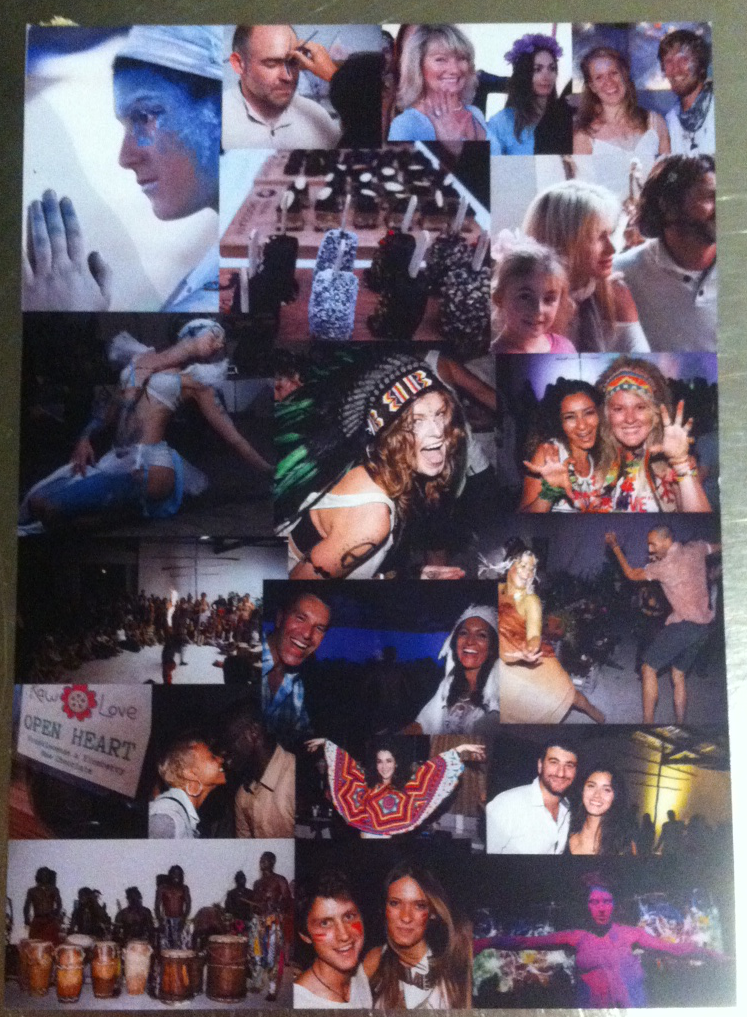
What I do know is that this is what the back of the flyer looks like:

tribe ugh

And that the front of the flyer says ‘connect feeling, share expression, awaken life.’ This event is apparently about community, but whose community? At between $55 to $80 for a ticket, with a WHITE AS clientele except for performers (and that one kissy face dude in the corner), I have my suspicions.

From the Trybooking page: WHO COMES: Everyone is invited! From children to grandparents! The main clientele is usually conscious people who want to celebrate their hearts openly in fun and play. And by defacing the heritages and cultures of other peoples, I guess. This event will apparently open with a sacred ceremony (sacred to whom? Cannot wait to see whose culture they indiscriminately mine to contribute to this feeling of transformation).

As always, thank you for including brown people in your event. By paying us to be performers and then abusing our cultures and heritages.

the bata shoe museum and the centering of the western experience

I’m in North America at the moment, having a grand old time, visiting museums and eating at vegan restaurants and buying more things than I should. Last week I visited the Bata Shoe Museum in Toronto, which has a lot of shoes, and some interesting curation notes, including the one notation about Australia, which I have in part transcribed for you. Only in part because my photo didn’t really turn out, but you get the gist:

Among the indigenous people of Central Australia a Kurdaicha is a respected elder … the spiritual power to execute a transgressor. With this ability, the Kurdaicha is able to … with a pointing stick and secretly send some of the energy to the transgressor that will kill. The shoes the Kurdaitcha wears are … constructed out of emu feathers and kangaroo hair.

The museum was fun, but it was all like this. A complete disrespect of indigenous people, and non-European histories.

Deerskin slippers made by Wendat women in Canada impressed visitors at the Universal Exhibition in 1855. These deerskin vamps are decorated with very fine moose hair in a floral pattern appealing to the Western market.

Some questions one might ask:

  • Central Australia is pretty big and filled with a number of peoples. Is there any one peoples in particular this tradition belongs to?
  • How did you get these shoes, museum? Did some coloniser steal them?
  • I’m so glad the slippers impressed visitors! WHY ARE WE CENTRING THE WESTERN EXPERIENCE?
  • How did you get these slippers?

I love museums so much. But other problems this museum had: outdated names for indigenous Canadian nations and peoples, and a general lack of specificity around a number of cultures and countries. This is hardly a unique problem; it’s just disappointing. The colonial gaze is prioritised, and the voices of those whose lands we’ve stolen are smushed together and silenced. Great. Good job.

**

Other things at the museum: the family behind me who looked at the lotus flower shoes and said “Are these for a child? These must be for a child” despite the notes on bound feet right there; learning about crinoline fire death; the chestnut crushing clog; and the smuggler’s clog, that looks like it’s stepping in the reverse direction.

Revisiting My Sister Sif

‘Will Sarah stay with my grandmother?’

‘Sometimes,’ I said warily.

‘Mummy won’t talk about her.  Is she upset because Granny is a brown lady?’

‘Maybe.’

A sailor falls in love with a beautiful Islander woman.  The relationship breaks down over cultural differences; their children struggle to find a place in the world.

A sailor falls in love with a mermaid.  The relationship breaks down because he’s an alcoholic and she is crippled on land; their children struggle to find a place in the world.

Despite the mermaids, My Sister Sif is science fiction.  Published in 1991 and set in 2000, this is the story of Sif and Erika, the youngest children of the marriage between the sailor and the mermaid.  Sif, 17, is dreamy and gentle; Erika is a pushy 14 year old with a cynical streak as wide as the Pacific Ocean.

Following the death of their father, they’ve been living with their older sister Joanna in Sydney.  Joanna is a land-dweller through and through, determined to reject every aspect of her heritage, even their Scandinavian names.  (Erika is the only child with an Islander name — her family call her Riko, short for Rikoriko, but she identifies as Erika.)

Knowing that Sif will never adapt to life in Sydney, Erika schemes to send her home to the Pacific island of Rongo, and makes the trip herself a few weeks after.  But a stranger is coming to Rongo, too, a young American scientist who falls in love with Sif.  Erika hates him, but the real threat to her family is something far more abstract and dangerous.

When I first read My Sister Sif, I was twelve.  I’m pretty certain it was the very first genre book I read where the heroine was a person of colour.  I picked it up on a weekend with my family — my old copy was lurking on my brother’s bookshelf — and wondered if re-reading it now would destroy all my memories of a book I had loved.  The late Ruth Park was a white author, after all, and all the good intentions in the world can’t save you from accidental racism.

The good news is, I didn’t finish the book feeling horribly disappointed and disillusioned.  The bad news is, that’s partially because I don’t know much about Pacific Islanders, their culture or how they’re portrayed in the media.  Well, there’s Chris Lilley‘s Jonah (a delinquent Islander boy played by Lilley in brownface), but that’s about it.  Google brought me a variety of blog posts by New Zealanders, arguing that Pacific Islanders are frequently portrayed as violent, alcoholic and not too bright.  (Sad fact: even racist New Zealand media is more diverse than Australia’s — I’m thinking of the ad where a Maori kid prevents his Islander friend from driving drunk.)

This post is most reflective of Park’s portrayal of Islanders:

Pacific Islanders—particularly Polynesians—are portrayed as a simple people lacking in complexity, intellect, or ambition. Acting always as a group, Pacific characters can be seen running, fishing, eating, or playing with little or no differentiation between one individual and another.

That’s about it for My Sister Sif.  Aside from the mixed race Magnus sisters, the Islander we see most of is Mummy Ti, who, though not their biological parent, is effectively their mother.  Erika’s homecoming:

Soon I was in the small flowery shed behind the airstrip, and there was Sif, eyes sparkling in a brown face, and Mummy Ti, crowned with yellow hibiscus, and yelling with happiness.

Fat, floral and loud.  These traits conform to stereotypes, but they also mark Mummy Ti instantly as a safe person, in contrast to the slender, chilly Joanna.  Late in the book, Mummy Ti sets aside her cuddly persona to confront the girls’ mother, Matira, who wants to take Sif away:

Mummy Ti insisted on accompanying us.  I watched her dress, in the old style — the flowing flowery dress called a Mother Hubbard, her beautiful black hair down her back, and a crown of orange hibiscus flowers on her head.  She was majestic, like a Tahitian princess of ancient days.  Her face was fierce.  I knew she would fight Matira for Sif, if it came to that.  I remembered her words, that she would not allow bad things to happen to us.

Whatever was in her mind — pagan spells or Christian prayers — was powerful.  She said nothing, crouched on the sand above high tidemark, her eyes fixed upon Stig and our mother.  Just the look of her made me uneasy.  I was thankful it was not me she disliked.

Again, there is a strong element of stereotype, but reading this as a child, it was only the second time I had ever encountered a description of non-white majesty.

The first was in this very book, a few chapters earlier, and, of course, it’s Matira herself:

Just then our mother rose like a brown wraith out of the lagoon.  Though she was old, she was not old like a landwoman.  Her hair was a metre long, cloudy in the water like dark weed.  On her head was an ornament of blue staghorn coral.

…Always when her arms were around me I forgot that Matira had run off to live with her own people when I was four, leaving me to my father and Dockie to bring up.  There was enough seaperson in me to understand her homesickness.

Two powerful women, both mothers to the heroines.  What’s remarkable here is that Erika loves and empathises with both of them, even the selfish and imperious Matira.  Erika and Sif’s mother is criticised for her self-aborption, but she’s never demonised for it.

Nevertheless, the portrayal of the islanders as a whole is stereotypical and two dimensional.  The only (human) islander we see much of is Mummy Ti; the rest are an amorphous crowd who enjoy movies, sweet food and a good joke.  The other Rongo-dwelling humans with whom Erika interacts are Dockie, Mummy Ti’s alcoholic Scottish husband, and the local missionary, the Reverend Mr Spry.  Good characters, but very much white dudes.

There is, however, a second group of nonhuman islanders in the mix:  the menehune.  They have their origin in Hawaiian mythology, dwarf-like people who are skilled builders and craftsmen.  Like the mermaids, they aren’t magical fantasy people here, but an indigenous people dealing with colonisation, loss of culture and the destructive effects of climate change.  Erika’s best friend is a young menehune boy named Pig, who is attempting to embrace modern culture:

Pig wore jeans, which he had stolen from a clothes line down in the village.  The legs were too wide for his muscular limbs, so he had slit them up the seams.  The jeans now flapped around his legs like the cowboy chaps you see in ancient Western photographs.  Pig was unbearably arrogant about his jeans.  He was convinced they were magic and could turn him into a modern boy.  He was that rare creature, a menehune who wished to join the rest of the world.  So he caused great anxiety in his tribe.

Pig worries his father by wearing his hair in spikes, eating too much sugar and messing about with human stuff, and he’s closely allied with fellow-outsider Erika.  Erika, in turn, respects his culture while acknowledging, and worrying about, his differences.  The menehune are facing extinction — fewer and fewer girls are being born, and the changing climate is affecting their traditional homes.  This parallels Pig’s attempt to turn away from his heritage, without judging his personal choice.

Reading My Sister Sif as an adult, I found it problematic but still engaging and powerful.  As a kid, I found the environmental subplot tedious and heavy-handed; as an adult who is aware that the Pacific Islands will be the first to suffer the effects of climate change, I found it chilling.  Yet it ends on an ultimately hopeful note, even if my eyes were blurred by tears by the time I hit the final page.

One interesting feature:  the parallels between My Sister Sif and Ruth Park’s most famous novel, The Harp in the South.   Published in 1948, that was a controversial depiction of life among the urban poor of Sydney.  It, too, centred around two sisters, one shy and delicate and the other brash and too clever for her own good.  And it, too, featured a character of mixed race who has trouble finding his place in society.  In that case, the character is Charlie Rothe, a man of Aboriginal descent, a member of the Stolen Generation, who ultimately marries Roie, one of the heroines.  (It’s a portrayal with some fairly racist clunkers, as you’d expect from 1948, but also — a man of colour marries a heroine.  Actually, he marries both of them, Roie ultimately dying from poverty-related complications in childbirth.  In the ’40s and ’50s.  He was totally played by a white guy in the TV adaptations of the ’80s, so well done, Australia.)

On awards and self-promotion

It seems like every year, the SF community has a kerfuffle about promoting one’s award-eligible work with the aim of getting it nominated.  There are those who think it’s unbelievably tacky, but there’s also the point that marginalised groups tend to be overlooked if they don’t put themselves out there.

Have some links!

John Scalzi made a series of tweets, which basically boiled down to “Promote away, don’t be a jerk.”

Adam Roberts writes, essentially, “Sure, marginalised groups are easily overlooked, but self-promotion is really tacky and distorts the nomination process, so don’t do it.”

Scalzi politely disagrees so we don’t have to.

For women, this issue came to the fore last year, when Seanan McGuire was accused of excessively promoting herself.  She had made, in fact, two posts about her eligibility for nominations.

Amal el-Mohtar writes further on that subject.

All of this is to say that the Chronos Awards are now accepting nominations, and No Award is eligible for Best Fan Publication.

Additionally, our individual posts are eligible for nomination under Best Fan Writing.  We are particularly proud of these:

(by Liz Barr)

For Your Bookshelf – The Deep by Tom Taylor

For Your Bookshelf – The Ghost Bride by Yangsze Choo

The Sea and Summer

Pacific Rim, welcome to the blog!

(by Stephanie Lai)

The Exotic Place as Other (and notes on Cinder by Marissa Meyer)

Pacific Rim and the Chinese Jaeger program (and what that means in 2013)

Australia’s Jaeger Program, ps racism and history

It’s a shame, mind, that Stephanie’s series of posts on Serangoon Road don’t count as science fiction, fantasy or horror, because they surely deserve all kinds of awards.  Someone should buy her a bottle of vegan wine as compensation.

Clause 6.4 of the Chronos Awards rules states:

6.4 No Award: “No Award” shall appear last on the ballot for all categories.

So, you see, you’re practically obliged to nominate us!  Right?  RIGHT?

Look, our original purpose here was trolling, and we’re not going to let a little thing like “Liz, that’s a terrible joke” stop us.

Nomination rules:

5.1 Eligible nominators and voters: Nominations will be accepted only from natural persons active in fandom, or from full or supporting members of the event hosting the award. Where a nominator may not be known to the Awards subcommittee, the nominator should provide the name of someone known to the subcommittee who can vouch for the nominator’s eligibility.

5.2 Nominations: The nomination may nominate any number of works in any category. However, the nominator may nominate any given work only once in a category. All nominations must include the name of the nominator. Where a nominated mark does not meet the criteria for its nominated category, the committee may move the nomination to the appropriate category; or where a work does not meet any criteria, refuse the nomination.

5.3 Timing of Nominations: Nominations shall be open for a minimum of 30 days. Postal nominations shall be counted as valid based on postmark or receipt, whichever is earliest, if received before the final deadline set by the committee.

I have some feelings about that “must be active in fandom” bit, and “known to the organisers” and all.  But the first time I nominated someone — hey, I think it was Stephanie! — I said, “I am active in fandom, and here is my blog to prove it SO THERE,” only without the SO THERE.  Alternatively, you can become a supporting member — or even a full member!  Please feel free to come to our convention! — of Continuum.  It’s a great convention!  And I’m the membership officer, and shall think loving thoughts as you are entered into my database.)

More information about nominating, and other categories, and a link to a longer list of eligible works, can be found on Continuum’s website.

A summer Christmas

YOU GUYS, IT’S CHRISTMAS!  I mean, it’s the Christmas season.  And while I used to be quite grinchy about the whole thing, I’ve given in and admitted that I love the tinsel, the food, the drink and Billie Piper’s cover of “Last Christmas“.

I mean, it probably helps that Christmas is a religious holiday for me, so in addition to the general secular cheer, the season has another layer of meaning.  Hell, Christmas has lots of meanings, some of them contradictory.

And some of them are pretty localised.  Christmas is a beacon of hope in the darkest time of year!  It’s a time for families to huddle together against the cold!  Why, Christmas just isn’t Christmas without snow!

Yeah, nuh.

A crowd of Santas stand on a beach. Many carry red and white striped surfboards. One holds a ham up to the camera.
These surfing Santas are part of supermarket chain Aldi’s Christmas advertising.

Christmas, in Australia, takes place in early summer, just a few days after solstice. Most years, if a church has air conditioning, it’s running full blast through the Midnight Mass.  The Christmas Eve vigil Mass is often held outside.  (Well, it was in my home town, where “outside” meant a nice, empty field, not a busy inner city street!)  

Mulled wine is just the starter for sangria.  (No, seriously, you know that vile glögg sold at Ikea?  A third of a bottle, a third of a bottle of cheap shiraz, some soda water and some orange.  SO GREAT.)  My mother only drinks at Christmas, so we drink a bottle of fizzy, cheap Lambrusco with lunch and then have a siesta as the afternoon gets hotter.  

Oh, the food.  Even if I became vegan tomorrow, I’d have to make an exception for Christmas.  Sure, we have our turkeys and our chickens, but one year, Mum baked fish and served it with a vast array of salads.  Most years, she roasts a lamb on Christmas Eve, and we eat it cold for lunch the next day.  (If it lasts that long.  “Elizabeth, stop picking at the lamb!” is the annual Christmas refrain.)

I haven’t been home for Christmas for a few years, and this year I’m feeling really low about that, so forgive me if I become nostalgic.

In fact, all this festive nostalgia drove me to Pastures of the Blue Crane by H F Brinsmead, one of my favourite books as a kid.  It’s the story of a lonely, snobbish girl whose father dies, leaving her a grandfather she never knew, property in northern New South Wales, and a bunch of family secrets.  For a book with an explicitly anti-racist message, it’s also amazingly racist, but that’s the ’60s for you.  Here is the heroine’s new next door neighbour describing her Christmas plans:

‘Now, I’ll be very hurt if you and your grandad don’t come over and have Christmas dinner with us!  I’m counting on you.  I’ve got a turkey – we’ll have it cold – and avocado pears with french dressing and stuffed peppers.  I feel really inspired over tomorrow’s dinner.’

And it’s taken me this many years to realise that “avocado pears” just means avocado, not some unholy combination of avocado and pear.

The event itself:

It was eaten on a trestle table under the great Moreton Bay fig-trees at the edge of Clem’s lawn … Clem’s new brick house was not large and would never have contained the eighteen diners whom they managed, without any trouble, to muster.  These included two very old aunts, a married daughter with three small children, the married daughter’s husband and parents-in-law, Clem’s father – who was about Dusty’s age and universally known as Butch Bradley – and various other people claiming connexion.  This assortment of people seemed to enjoy each other’s company with gusto, drawing the newcomers into their circle as though they, too, were part of the country and its life.

The meal was such a major affair that it trailed on well into the afternoon, finally merging into a cold tea.

That, to me, has always seemed like the ideal Christmas:  outdoors, with lots of food and even more family and friends.  Which is kind of weird, now I think about it, because mine is a rather small, isolated, indoorcentric sort of family.  We have never gone to the beach on Christmas Day (too crowded) to play beach cricket (too crowded, also, cricket is a team sport, and therefore something we do not do).  I have vague memories of my grandparents hosting a barbecue in summer once, but whether that was for Christmas, I have no idea.

Things we don’t do for Christmas in Australia:

  • Holly.  Doesn’t grow here.  You can buy plastic holly, but … why?
  • Mistletoe.  It does grow here, but it’s a noxious exotic parasite.  Except for native mistletoe, obviously, which belongs to the local ecosystem, but no one kisses under that.  (Do northern hemisphere types really kiss under mistletoe?  Seriously?)
  • Hang Christmas stockings over a fireplace.  Okay, we might do that, in houses that have fireplaces (mine does, and we done), but we also don’t…
  • Have roaring fires at Christmas time.  Apparently that needs to be pointed out.

Things Australians do do on Christmas Day:

  • Dream of a white Christmas.  IDEK.
  • Roast stuff, leaving the kitchen a steaming oven of PAIN and HEAT.  Why?  I DON’T KNOW.  But those baked fish were totally worth it.
  • Drink a lot.
  • Drink seasonally inappropriate beverages.  I don’t know what it is about Christmas that has me saying, “Yes.  Brandy.  That’s what I need in my belly right now.”  But there you go.
  • Exchange cards and sing carols featuring snow.
  • Write op-eds about how seasonally inappropriate traditions have to go.
  • Eat at halal restaurants and lament that the shops are closed because of some damn Christian holiday, and it’s not like anything changes for Eid or Ramadan, does it?  (Cultural variations may apply.)

CHRISTMAS.  I love it.  Even this year, when I’m probably going to spend the day by myself, playing Mass Effect and drinking cider.  And I hope that everyone reading this has a happy, safe day.

Worldbuilding: The Australian YA Dystopia

This post started life on Tumblr, in response to the following conversation:

dominiquemorgenstern:

The Great Unanswered Question:

What the hell happens to every country on the planet that isn’t the US in YA dystopias

HMASFatty:

We’re just getting on with our lives. And mocking. So much mocking.

Me:

“Hey, Bazza, Panem’s 75th Hunger Games are on.”

“Seriously? Again? Why haven’t we invaded them and imposed democracy yet?”

“‘Cos I’m still waiting for my download of the 74th Hunger Games to finish.  Fucking fibre to the node.”

And that would have been the end of it, except that, still chuckling at my own joke, I went and had a shower.

You know what happens in showers, right?

IDEAS.  Unless you’re deliberately showering in the hopes of brain stimulation.  Then your brain just laughs at you, and you sadly realise you’re doing nothing but wasting water.

I got thinking about what an Australian YA dystopia — well, really any Australian dystopia — would look like, and how it would work.  Not that I’m treading new ground — remember my rant about The Sea and Summer? — but it’s not like America lets the existence of a couple of iconic dystopias stand in the way of publishing and filming more.

From Tumblr:

Apropos my last post, because this is something I think about a lot, especially since I saw Catching Fire last week, and am now re-reading The Hunger Games.  And, dammit, I get sad that we don’t have a YA dystopia with an emotionally stunted iconic heroine played by Shari Sebbens and brooding and handsome hero played by Jordan Rodrigues of our own!

So the thing about Australia is, we’re roughly the same size as the United States, but much more sparsely populated.  So in the event of some kind of technological cataclysm, such as a nuclear electromagnetic pulse coupled with radical climate change, we’re less likely to wind up with a totalitarian one-party state than a series of isolated communities that occasionally fight over resources.  Some of those isolated communities might be totalitarian one-party states, though, if you’re into that sort of thing.

For example, Perth is separated from the rest of Australia by a GIANT DESERT, and Western Australia is a vast state in its own right, so that would be the first to separate.  (Nightsiders by Sue Isle is a collection of novellas set in a dystopian Perth.)  I’ve never actually been to WA, but it was the last state to join up when we were federating.  (At one stage, “Australia” was going to be the eastern and central states, plus New Zealand.  Ah, good times.)  WA also has, to a considerable extent, its own isolated legal system, not to mention a lively secessionist movement.  How well it would do on its own is debateable, but if we assume a system where the Federal Government and Constitution no longer function, I reckon WA would be the first state to go full independence/Mad Max style leather-clad anarchy.

Tasmania would go next, because it’s an island, and I shall refrain from making cannibal jokes out of consideration for … you know.  We would also shed Darwin, which is closer to South East Asia than it is to other Australian cities.

Likewise, far north Queensland would probably be cementing its close geographic ties to the Torres Strait and New Guinea — in the coastal regions, at least.  Further inland, you’d probably have your isolated homesteaders, the kind of people who already think they’re living in the End Times and prove it by voting for Bob Katter.  Queensland, as people like to point out whenever the issue of daylight savings is raised, is basically several states smushed together anyway.  I expect my mum will end up in Clive Palmer’s People’s Republic.

…Come to think of it, there’s a lot of mineral wealth in WA and QLD, not to mention uranium in the Northern Territory, but how much of that is of use to those states if large-scale international trade has collapsed remains to be seen.  But it certainly brings them closer to self-sufficiency than, say, Canberra.

Then you have your larger state capitals, Brisbane, Sydney, Melbourne and Adelaide.  They’re all within driving distance, albeit a couple of days’ drive, so I can see that they wouldn’t be entirely isolated.  But how much power the Federal Government has in those circumstances is debateable.  (I mean, the Constitution gives a lot more power to the States than the Federal Government, but Federalism developed along with the technological resources for faster communication and travel.)

ANYWAY, what you end up with are several separate communities, not hugely trusting of one another.  (Even now, you can see the old rivalries in the scrum that develops around GST revenue and Federal funding.)  Stack on a few generations, let this develop as the status quo, let technology re-develop but keep in mind the effects of climate change, and what do you have?  A totalitarian state?  A laissez faire corporatocracy?  Anarchy?  All this and everything in between, depending on where you are?

Not to mention all the nations around us would dealing with their own problems, many of them small island states being swallowed up by the rising oceans.  ”SCARY FORNERS INVADING HONEST, WHITE AUSTRALIA” is one of those right-wing tropes I prefer to avoid, but there comes a point where you’re wondering why they’re not knocking on the door.

Again, this comes back to those odd US dystopias where the rest of the world apparently doesn’t exist.  Certainly in The Hunger Games, Panem includes Canada, but what’s meant to have happened to the rest of North America is a mystery.  But that’s set so far in the future that no one — well, not Katniss, whose education has mostly involved coal and revolution — has any particular understanding or memory of the United States as a thing that existed.

Australia doesn’t get to be an isolated dystopia, because, much as some politicians would like to think otherwise, we’re not an isolated nation.  The lines might wind up drawn differently, but we don’t get to stand alone.

Some local dystopia for you:

The Interrogation of Ashala Wolf by Ambelin Kwaymullina is the first in a YA trilogy (I think) about young people with special abilities in a future, dystopian Australia.  It’s also one of the few works of science fiction by an Indigenous author — oh, look, she’s a guest of honour at Continuum next year, plug, plug, plug. I actually didn’t finish the first book, because it wasn’t what I was in the mood for at the time, but I couldn’t actually say whether it’s good or bad or in between.

Karen Healey’s When We Wake isn’t precisely a dystopia — its future Australia is pretty great, provided you don’t care about refugees, or incredibly powerful militaries, and what not.  In short, it’s very much like the present day — quite fantastic, as long as you don’t look at things too closely.

(Karen responded to my Tumblr post and described When We Wake as a pre-dystopia, which I think is great.)

An anti-rec: The Rosie Black Chronicles by Lara Morgan.  I can’t remember if this is actually dystopian, or just plain old sci-fi.  I was too busy facepalming at the terrible writing and general racism to pay attention.

66th down under feminists carnival

Hello! Welcome to No Award and the 66th edition of the Down Under Feminists Carnival! I last hosted the 54th edition over at one of my other eleven million blogs, which means it has been exactly twelve months! I guess November is just the time for me (Steph).

We’ve got some categories here for ease of perusal; and just a note that things without categories only mean they were singular in their category this month, not that we don’t love them! And there are some amazing articles here this month, as there are every month – but just because the month is over don’t think you need to hold back! If you have a comment to make or somewhere to go with the conversation, go for it, even if you’re encountering these bloggers for the first time through the carnival! More chat is great. Thank you to everyone who contributed links – and of course all the great antipodeans writing awesome things.

Next month’s edition is planned for 5 December, 2013: MJ at Kiwiana (inked). Submissions to burningthescript [at] gmail [dot] com for those who can’t access the blog carnival submissions form. Previous carnivals can be found on the blog carnival index page. Please do submit if you think something is relevant to interests, you can submit your own work and/or someone else’s.

On Sex and Sexuality

At A Life Unexamined, Fixed and fluid sexual identities (from an ace perspective).

Claire at Sextracurricular Studies brings us two great posts this month: Mythbusting the Hymen by Claire at Sextracurricular Studies, on virginity and education and the dangers of this myth; and on pornography and sexual culture.

Nausea Nissenbaum presents us with Hot & Hotter: interviews with sex workers’ rights activists.

On Misogyny and support for women

Women need resilience to rise to the top, by Zoe Krupka at New Matilda.

Over at Hoyden About Town, Maybe if we all went barefoot by Mindy, on how ladies buy too many shoes which means they can’t buy houses, amirite.

Sikamikanico writes “I don’t need feminism”: The Women of a Voice for Men (a Voice for Men is a group with a MRA agenda).

In Ministerial responsibility, Ben at CXLI writes on Tony Abbott as the Minister for Women and what this might mean.

Rachel Rayner writes Spare us from idiots, on a particularly gross piece of opinion piece published in the NZ Herald re: women.

“A Dirty Game”: One woman’s retrospective on the UQ elections looks at the reinforcement of patriarchy (and also in harassment) in the UQ elections. Also up at Womynews is a 2013 Reclaim the Night recap.

On Anonymous Hatred

Broken at Fat Heffalump. This is also about fat hate and also a nice story about people being nice.

By Amy Gray, the text of a speech: Reading the Trolls

Things to Read and Watch

Molly Eliza at Womynews reviews Destroying the Joint: Why Women Have to Change the World, edited by Jane Caro.

Chally reviews About Time, the latest Richard Curtis movie.

Fi at Reading Kills talks about Every Breath, a Melburnian YA murder mystery by Ellie Marney.

Amy Gray has put up the text of an ACMI speech she gave: Enlightenment and the need for unlikable women.

Here at No Award, Liz read The Deep by Tom Taylor (who she later met!!!), an Australian comic about a multiracial family of aquanauts. (I really want to read it)

Media and Representation

At HaT, Today in Fantasy Film Sexism: Disney tries to pat some feminists’ heads, on Frozen, the new Disney film.

I navel-gaze about Chinese dating show If You Are The One (非诚勿扰) and discuss what it means for dating and stereotypes, and why it’s so popular in Australia; and in love me long time ugh help i’m dying I talk about the ongoing representation of South East Asian women in Australian media as other and hypersexual and ugh.

Also at No Award and by me, I have been reviewing the ABC-TV HBO Asia coproduction Serangoon Road, set in Singapore in 1964 and featuring way too many white people (primarily Australians). In my reviews I discuss the show but also colonialism and imperialism and white attitudes in the SEA region in the period.

Stalking, Sexual Assault and the Gilmore Girls is a look at the character of Jess on the show. Includes discussions of sexual assault and rape (and pop culture as vehicle for rape culture).

Fi writes from eighteen to thirty with nothing in between, about the dearth of crime fiction featuring protagonists under thirty.

Scarlett Harris compares Book VS. TV: Stephen King’s Under the Dome. Scarlett also writes in Defence of Sex and the City and The Problem with Sex and the City 2.

On Health (including Mental Health)

Elizabeth at Spilt Milk writes A Good Mother, on motherhood and society and mental health.

Rachel Rayner writes The Cost of It, a beautiful piece about getting an IUD and the situation around it. (Beautiful as in, it’s a poetical and lovely piece of prose)

The Little Pakeha writes Presents well, on living with depression; and Coley Tangerina writes It’s Mental Health Awareness Week.

On Racism, Race, Ethnicity

Te Ika-a-Māui and Te Waipounamu are not second-class names, by Queen of Thorns.

Australian feminists need to talk about race by Kelly Briggs up at the Guardian.

Jennifer at No Place for Sheep presents Immigration Minister Morrison instructs his staff to lie.

On Specific Women

friday feminaust: Nabila Farhat

A Friday Feminist over at HaT: Soul singer Tina Harrod.

Feminists in Fiction: Mulan at a Life Unexamined. (No Award note from your resident Chinese lady: This is a great look at the Disney Mulan but I’d just like to remind everyone that Hua Mulan is considered by many to be an actual figure in history, not just in fiction)

On Julia Gillard in conversation with Anne Summers: Carly Findlay: Julia Gillard in conversation with Anne Summers: “You have a decision to make: you could have a crap rest of your life”, [or you can move on]; Catherine Fox: The Gillard Effect: A role model we are lucky to have; Scarlett Harris: Anne Summers in conversation with Jullia Gillard.

On Marriage

Thoughts on being married by Gaayathri at A Human Story

O Brother, Where Art Thou On Gay Marriage? by Rebecca Shaw.

The logic behind Julia Gillard’s same-sex marriage opposition by Simon Copland at Ausopinion.

Poverty, Classism, Society, and getting a free pass

Poverty is Political by Anjum at Kiwi Stargazer, on the politics of poverty (and the assumption that poverty can be reduced through individual action).

The Left must own its shit and stop defending abusers by Queen of Thorns.

Dreaming of Home, by El Gibbs, on housing in Australia.

Fat Hate

Kevin Hague jumps aboard the fat-hating bandwagon, by Queen of Thorns.

Rebecca Shaw at The King’s Tribune: What do you see?

Abortion

At Idealogically Impure Queen of Thorns writes Teacher abuses position to slut-shame a teenager, gets a slap on the wrist – how moral! and From a prochoice position, changing our abortion laws DOES MATTER (the laws referred to here are NZ laws). Also by Queen of Thorns, 25 ways to be a smug slacktivist antichoice wanker.

Talk about Assault (warnings for discussion of rape, sexual assault, rape apologism, victim blaming, people being jerkfaces)

Something is happening here, but you don’t know what it is, do you Mr Jones? by Luddite Journo over at The Hand Mirror.

Chally discusses Sexual assault discourse where the listener is the cautionary tale.

The News with Nipples makes two posts on Mia Freedman’s rape apologism: Ah Mia Freedman, it all makes sense now and Today in what Mia Freedman has done now. And further on Mia (though not really), Ben McKenzie writes re: Mia Freedman et al and their “advice”.

At Hersute, Alcohol is a Misdirection When We Talk About Rape; and at Sikamikanico, Sexual Assault and Alcohol: it’s not common sense, it’s not true, and it’s not helping.

On Bob Jones and related: Gaayathri at A Human Story writes Bob Jones: An advocate for violence against women; One girl’s response to Bob Jones at Rape Crisis Dunedin; Fuck off, Bob Jones: and advertisers? Be warned at Idealogically Impure.

Tangerina reports that Wellington Rape Crisis might have to cut its services again.

And the gold goes to… by ShoniaS at Hoyden About Town (includes warning for discussion of child sexual abuse).

The Little Pakeha writes The vast majority of rapes are committed by shrubbery.

Andie writing at Women’s Agenda: To the unconvinced: the perpetrators of crime are responsible for crime.

Tigtog at HaT with Advising women to prevent their own rapes is not brave or edgy or helpful.

Clementine Ford writes Excused for sexually humiliating a woman at Daily Life.

Misc Stuff

Five Questions to Kelly Briggs is about this week’s Indigenous X tweeter – and if you’re not following the Indigenous X twitter, highly recommend.

freedom, by Stargazer, is about burqas and prejudice.

A letter to my non-black friends by Pheeby at Different Strands, talking about black hair (and what not to do).

Veronica Foale writes My disabled body, my choice, on disability and fertility.

Can HECS debt be privatised? at HaT.

Sarah Burnside at Overland on Helen Razer’s beauty myth (this post is actually from today Nov 1 but I went to school with Sarah and you can’t stop me hahaha)

Why the opal card could be a bad thing by Mindy over at HaT, on the introduction of a new PT smart card in Sydney.

feminist fashion? feminaust fashion?! by MsElouise is a look at whether truly feminist fashion can exist.

Kate Davidson looks at Bikes, sexism and Australia over at Overland.

Permission to geek out – granted, by Fat Heffalump, on women geeks and geeky interests.

At the Washington Post, How British colonialism determined whether your country celebrates Halloween, brings up some interesting notes about Victorianism, colonial social mores, and colonialism.

Are women underselling themselves at maths? A post by Sarah Macdonald at Daily Life

On Stigma and Violence by Gaayathri at A Human Story.

A Public Confession by Morgana Lizzio-Wilson at Womynews.

A poem! Refuge, by Anna Caro.

Yay! See you next time!

serangoon road s01 e05: heatwave

In Heatwave, Episode Five of Serangoon Road, white people try to save brown babies, the MI6 dude tries and fails to be menacing, and CIA dude takes the Secretary of My Heart on a date and is super embarrassing and rewarded for pushing and pushing after she kept turning him down. Also the text explains ang moh, and Tony Martin is drunk. 

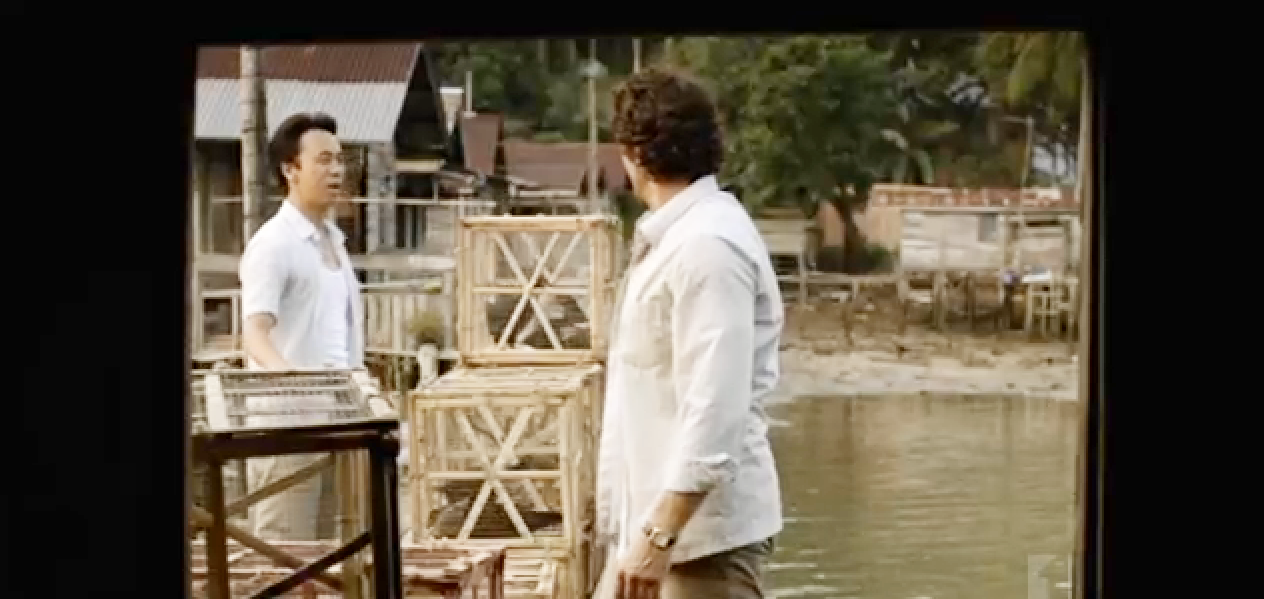
The episode opens at the boat shed, where Alaric talks about how with a few more good jobs of easy money, he can buy a new boat. Don is a downer but he is wearing a new shirt!; Alaric takes money very seriously.

Frank, Claire, Black and Macca turn up at the boat shed to go on an excursion; Macca is drunk and declares that Don should “shoot me now.” Alaric is super unhappy that Claire has come along on their first security job. I do enjoy the continuity of Alaric being suspicious of Claire, and I’m hoping that it goes somewhere in the show. It turns out the company for which Black and Frank work is doing aid work in Malaysia, funding and supplying a hospital. Black goes on and on and on about the good work they’re doing here, and I have a lot of issues. Because while aid work and funding is all well and good, the history of especially Europeans of parachuting in and doing a thing and then buggering off is hugely problematic, and this situation highlights all of that.

Alaric speaks for us all

I think I can’t roll my eyes any further, but then Claire sits beside a child dying of malaria and the child looks on in wonderment and touches her hair. He’s super ill, and Claire interrogates the nurse, who hints that maybe something is wrong when Claire is all “you can tell me, you won’t get into trouble,” which, Claire, you’re the Australian wife of a businessman in Singapore, you’re hanging out in some Malaysian village and you seriously think you have any power? Let me tell you a thing, my friend, and that thing is that you are wrong.

Claire tries to convince Black and Frank to investigate and Black is having none of it and when she threatens the image of the company Frank gets annoyed and insists that she leave it alone.

There are too many white people in this episode, where are all my hilarious and great Singaporeans? This show is set in Singapore, I don’t need white saviours we got enough of those already!

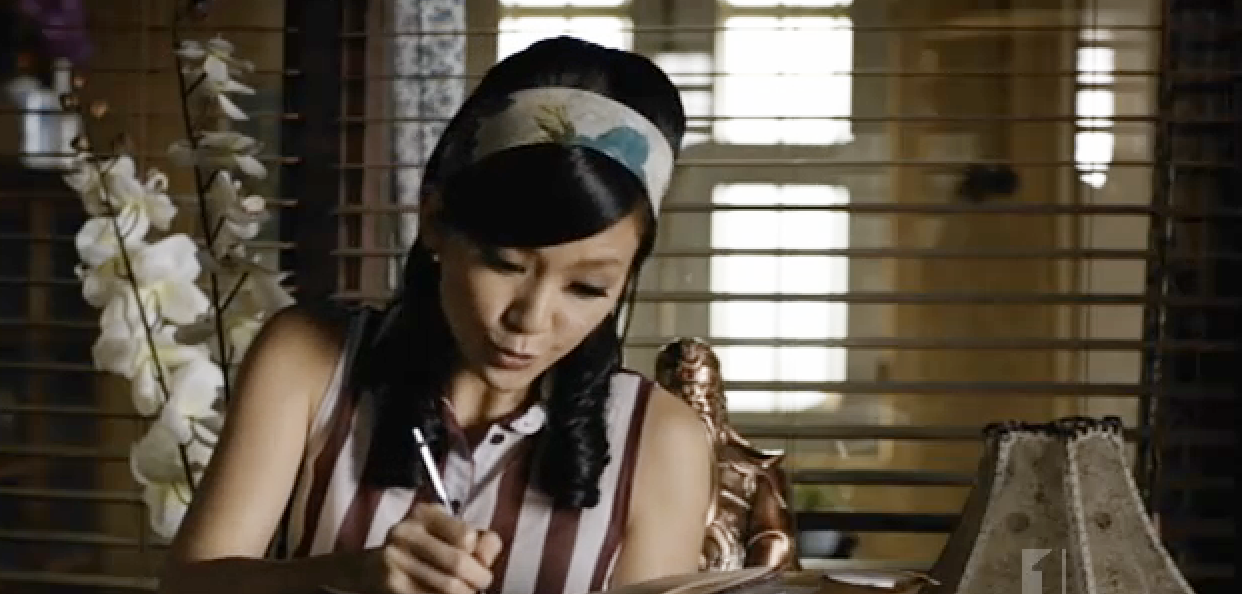
On Victoria Street, Pamelyn is getting a cup of tea and CIA dude taps her on the shoulder. “You ang moh have the most terrible manners,” she says, and then actually explains ang moh which sure, I guess. Also it’s true, ang moh do have the worst manners. CIA dude talks her into a date; Joan tells her off and makes fun of her. I am pissed off that the text is rewarding CIA dude for ignoring her repeated nos, and that Pamelyn says he saved me from a problem, I can let him take me to dinner, there won’t be a second. Just another boundary that the show is going to erode, I bet, and I’ll be disappointed in you all.

Don bribes a lab to run tests on the medicine that has been given to the malaria kids; it’s been watered down! “Who would do such a thing and why?” Claire asks. Even Don rolls his eyes.

This is the second job that the detective agency has taken from the company; first the investigation to bribes last episode, and now investigating who is watering down the medicine that the company is paying for at the hospital. I’m hoping that this is a developing plot point, and not just lazy writing.

Pamelyn notes “patronising ang moh woman; only she can save the children” at Claire coming along to deliver the new supplies; Alaric asks why is she even here, the question we are all asking. I like that the text is interrogating and questioning the idea of the white saviour and the short term aid work done especially by Western interests; but it’s such a simplistic, obvious questioning. It’s so formulaic, so basic, that it almost begs a question: what even is the point of this? This storyline, this episode, this work and this show?

"patronising ang moh woman; only she can save the children" preach it pamelyn
“patronising ang moh woman; only she can save the children” preach it pamelyn

On the boat to Malaysia, Don asks if Claire and Frank will ever have kids. I seriously don’t care. I know this is supposed to add depth but, especially when Claire mentions that when she thinks of being a mother she thinks of a boy about the age of Amir in the hospital, it simply serves to highlight that any aid work, any investigation and assistance, is only being done to assuage the guilt of white interests, rather than in the interests of real local change and capacity building.

Surprise! At the hospital, Amir is already dead. Claire is sad, and I’m relieved that at least she’s not sobbing, because I was worried it would happen. Alaric continues to say what we’re all thinking: it’s not the first time someone went with the cheapest option, and “short-term do-gooders – now it’s all blown up in your face isn’t it?” Alaric I love you and your anger. You’re beautiful. He points out that Amir died because the other kids had parents who could afford to buy the real stuff on the black market.

Back in not the Raffles, Frank tells Claire to drop the issue, and not to get people mad. So Claire gives an interview to Macca, who doesn’t mention her name but makes no attempt to hide her identity. Don goes to the Duke bar and chokes Macca, making him spill his drink. Macca gets all sassy about Don protecting Claire; “And if it was her, she’s over eighteen,” he snaps, and ends with “and you’re a bloody prince charming yourself, aren’t you?” It’s interesting, actually, that the only people who ever really question Don are Macca, Joan and Alaric. Everyone else just accepts his image. I hope this goes somewhere.

Claire continues to be incredibly naive; she also says that she doesn’t want to stop, and gazes meaningfully at Don.

sometimes the cinematography is really good

Macca, drunk and in the dark, gets picked up by some bully boys in suits and escorted to see the dude from MI6. I seriously don’t care about the MI6 storyline, but I suppose I should because of the history of the British in Singapore/Malaya/etc. “Is that a threat?” Macca asks. “Of course not, we’re MI6.” I laugh.

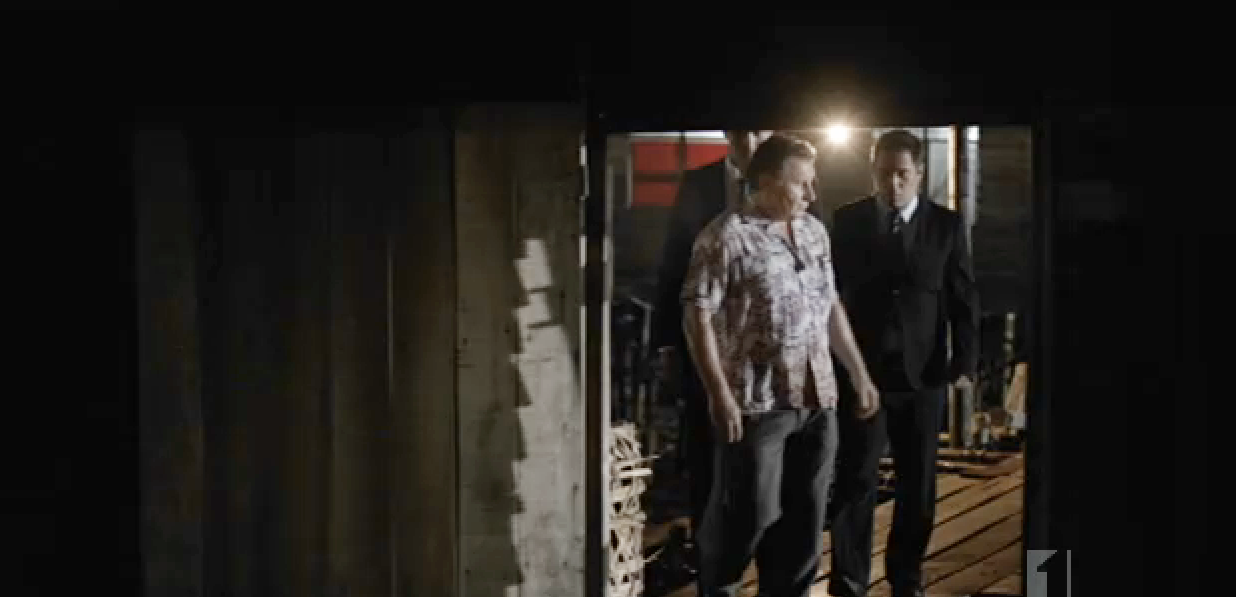
Frank is taken off a big project as a punishment for Claire going to the newspapers; Frank gets annoyed, and wants Don to find out what’s going on. In a warehouse in the dark, Don and Alaric watch some guys come to pick up some boxes, put them in a boat, and unload deported unionists who have been smuggled back in. I don’t understand what Alaric is doing here, given he’s only in the Import Export, but I’m glad he’s here!

On the date, Pamelyn wears an awful debutante dress. They are surrounded by white people. Because Pamelyn wants to move to the USA to study, CIA dude has American food served to Pamelyn, including a hotdog on a plate and wine from his father’s vineyard. He says “music is also a part of [her] education,” and a guy comes out playing violin and CIA dude sings Yankee Doodle Dandy in the middle of the restaurant and I’m so embarrassed by how awkward this is that I press the mute button until it’s done, I just can’t deal with it. Is this supposed to be charming? There’s no way she’s gonna consider that charming, I speak as an arrogant, embarrassing to my parents, Gen Y SEAzn and I find that behaviour frankly embarrassing, and I’m not even Peranakan. I call bullshit. Unless she’s rebelling against her parents. Then I buy it.

Back at the Detective Agency, Alaric suspects something and everyone suspects it’s one of the secret societies, because a boat captain on his own wouldn’t be able to pull off something like this. Alaric dashes off into the jungle, discovers the secret lab where dilution is taking place, and there’s lots of Malays smoking and siphoning. Somebody spots him because of course, he runs and is chased and I am worried for him, why didn’t he say where he was going? He does the worst hiding job ever but somehow he isn’t found.

When Don is surprised at Alaric going off to find the lab, he reminds Don – “I said I didn’t pretend to care.” TAKE THAT WHITE PEOPLE. With Ario and the police in tow, they discover the lab has been cleared out, and when they surveil the warehouse Ario lets the boat captain go, but captures the men he’s with. This scene moves fast and frankly could do with better exposition but, we learn that MI6 swooped in to bust the union leaders being smuggled in earlier in the day, and the captain is being let go because he’s their informant. The meds is just whatever.

throwing shade from shade

Joan gives a smile when she reports back to Claire. Nobody is being punished; “Welcome to Asia.” I cry laughing.

There’s a lot of romance in this episode, and it’s bugging me. CIA dude comes to tell Pamelyn that he’s being sent to Saigon, and the implication is that it’s because of what he said to Black in the previous episode. But CIA dude is secretly CIA! How can Black have this much control over CIA dude’s postings? Pamelyn gets sad because despite telling him there will be no second date, they haven’t kissed yet so they do, and then she’s all “oh my god we’re in trouble,” and Pamelyn is working it but I’d find it more moving if it were at all believable, see rant three paragraphs previous.

NO STOP DO NOT WANT
NO STOP DO NOT WANT

Because white people in Singapore in the 60s all knew each other, Claire knows exactly who to talk to despite never having interacted on screen before. She confronts MI6 dude, threatening to expose him, and MI6 dude threatens right back, implying he knows about her and Don getting it on. She backs down, and in a completely excruciating scene Don and Claire officially break up and there’s lots of moody music and they awkwardly hold hands and I’m crying laughing and I just don’t understand why we’re supposed to care.

This scene goes on and on and on and frankly highlights how this episode was just too much white people. I want more Singaporeans!

singaporeans! as background

Next week: SINGAPOREANS. And my Tong Boyf Chin Han.

We’re halfway through the season, and I still don’t know where we’re going with this. There are some amazing beats, some excellent cinematography, and some excellent threads. Joan Chen is basically phoning in her performance, but every now and then she’s given a great bit of dialogue and someone excellent to work off, like in episode two with Xiang Yun, and you see what could have been. Even if it’s often clunky, I’m grateful that the series does present some realities of the era and the setting and attempts to interrogate them, not just being all “wow it was a great time!” – which it was, if you were white.

Serangoon Road has a lot of potential in its themes, in the stories it’s telling, and in the way it’s trying to widen the audience for shows heavily featuring stories and faces that aren’t white. And I do feel like all of those things have been improving from episode to episode. I just wish I could trust it to keep on improving. At some points, only my love of the setting and my familiarity with the Singaporeans is what keeps me going.

A Miscellany

  • Rachael Blake I love you so much, when are you going to actually have a role in this show? “Darling it sounds too hideous for words” yes you’re the best.
  • At Claire’s house, Don takes off his shoes before entering. YES GOOD. However this is ruined by Claire wearing her shoes in a BEDROOM later in the episode. WHITE PEOPLE. YOU ANG MOH HAVE THE MOST TERRIBLE MANNERS.
  • I didn’t want to include all of Alaric’s amazing lines, also including “This is a bad idea. Sorry, this is another bad idea. You never have any good idea.”
  • Macca is so drunk through the whole of this. I love him.
  • MI6 dude on why he doesn’t care about dying brown babies: “there’s a greater good in ensuring the successful transition of the region.” a) oh god, the british in SEA in the 60s ugh; b) UGH
  • Anachronisms of the week: Claire wearing short dresses. Like, I know we’re nearly up to mini skirts here but maybe still too short? Please hold while I ask my mum.

if you are the one (stereotypes for dating)

While living in China I met my friend Wendy, also a Chinese-Australian from Melbourne. We would hang out often, through the afternoon and into the evening. Eventually, though, she would run off from me, to go watch her Chinese dating show. I would make fun of her. Then we came home to Melbourne.

fcwr-4

If You Are The One (非诚勿扰) is that Chinese dating show. I love it.

The premise is that there are 24 women, and they stay on the show episode after episode until they end up with a date. Each episode features 4 guys; they show some (pre-filmed) videos and the women ask questions, and through this process the women turn their lights off if they become disinterested in the contestant. At the end, if there are lights on, the guy can choose one of those remaining women.

Often, even if there are lights on, the guy will say no to those remaining, and leave without a date. Frequently, they will leave without a date anyway, because all 24 women will have turned off their lights. Sometimes the contestant will have a large number of women to decide between, and the women will have done the hard sell on themselves, which is always super excellent – I love a woman who puts herself forward, and is in a situation where she is supported in putting herself forward, as they all are on 非诚勿扰.

Each guy is on stage for between five and ten minutes, so everyone has to decide fast. The guys might have a better idea of the women, as the women stay on episode after episode (and are filmed and screened regularly), and viewers can get an idea of their personalities. The questions are pointed, and cover all sorts of things; the decisions are snap and sometimes seemingly random. The outcome is serious.

Prior to watching 非诚勿扰, I’d always considered dating shows boring, superficial things; nothing wrong with them, but kind of pointless and not for me. At the end of each opportunity, two people leave to have a date, and if it doesn’t work out it doesn’t work out. 非诚勿扰 is not like that. It is portrayed as very life or death, must end in marriage stuff. If it’s going to be ‘let’s have a date and it might not work out,’ people clarify with “let’s start as friends and see what happens,” rather than the other way around.

fcwr-1

Now that we are home, and 非诚勿扰 airs on SBS2 Tuesday through Thursday nights, Wendy and I watch it together, from our own couches. We text our often snarky comments back and forth, making snap pronouncements and guesses as to the outcomes. It is easy to do.

非诚勿扰 is incredibly stereotype based; it’s all snap decisions and assumptions, and every word and every choice is weighed for significance and, usually, allows someone to be found wanting. One contestant came out in a t-shirt, and a woman berated him for not caring about his appearance. Another woman came to his defence – she was an art gallery owner, and analysed his clothes, correctly deducing that he had designed the print on the shirt and was wearing it for the first time this evening, and based on that deduction would be happy to leave her light on for him. (He chose her, in the end)

If a contestant is a little large, or 胖, we assume they will lose a number of lights. If the contestant is nerdy looking, or old, or bald, or too ridiculous when they come out; if they focus too on one thing, or talk too much about their parents, then the women will turn their lights out.

One contestant says “I lived in Taiwan for so many years, and most girls I have met are Chinese, so I’ve become accustomed to getting along with Chinese girls…Unlike foreign girls who always keep talking during a chat, showing no respect to others, Chinese girls are generally more considerate,” said Joel. “Maybe they’re influenced by traditional Chinese culture, Chinese girls are good listeners.”

Gosh! We are, aren’t we? I know I totally am.

fcwr-3
(the contestant’s reply to ‘every girl you know in Australia is very independent?’ was ‘i don’t hang out with locals’)

Over two weeks SBS2 aired the Australian specials of 非诚勿扰, and despite the many things I could say about the show, it is this in particular about which I would like to chat.

非诚勿扰 is allegedly based on failed Australian dating show Taken Out, and is currently so popular in Australia it’s discussed on AFL forums. It’s been profiled on the Vine, with an article entitled ‘Why we’re obsessed with If You Are The One’.

Why ARE Australians obsessed with 非诚勿扰? Why am I?

We’ve seen dating shows before, and we’ve seen this dating show in particular before, and it failed. But it’s now so popular here it’s on SBS2 three nights a week (though last night’s episode was a repeat).

How much is laughing with, and how much is laughing at? These two screencaps at The Vine really highlight that for me:

fcwr-2 fcwr-1

This is a Chinese way of speaking, of communicating; of making sense of the world. Was this cap set chosen because we’re making fun of Chinese people? I mean, I know it’s awkward in English but are we as Australian viewers being encouraged to make fun of Chinese language quirks? (an aside: I totally struggled with this when I spoke Mandarin every day)

Don’t get me wrong, I make fun of Chinese people. But that’s a thing I get to do as a Chinese person, having lived in China, understanding what it is exactly that I’m making fun of; understanding that I am, in essence, making fun of my self, of my family, of my history.

And I wonder, what is the line between real and unreal; between stereotypes for good and for bad? And how will that impact me, in my life? People take this show seriously, so I feel justified considering its messages seriously.

There is growing scepticism within China as to whether foreign specials, and participation of foreigners on the show, is viable and realistic, or simply a ratings grab. Can foreigners have stable long-term relationships with Chinese people, due to the cultural differences?

The Australians on the show (all Chinese, born outside of Australia – from China and Malaysia), if they mention dating an Australian woman, say it didn’t work out due to cultural differences.

As someone with an Anglo-Australian father, even I’ve had a whole lot of cultural differences in failed relationships with other non-Chinese Australians, yes, but to attribute all of them?

My mother, when I first started dating, advised me not to date a mainland Chinese man – for fear he would be too traditional, too feudal; he would expect me to stay at home and look after the children. The opposite, indeed, as suggested by this article:

Zhou also said she believes that many foreigners don’t fully understand China. “All they have learned is the old feudal culture, which says that women should stay at home raising children and doing housework. I also met one who didn’t want his girlfriend to be a model or an actor, as he thought that was not appropriate for Chinese women.”

Even news.com.au is talking about 非诚勿扰, and they mentioned the Australian special:

If they’re serious about a dating show, they – and you – need to get onto If You Are The One. Chinese dating show. Big there – 50-odd million viewers – but not huge given the population. It’s culty though. You wait til you watch it. SBS has now put it on Tuesday through to Thursday, because people are discovering it and its frank charm. It’s a kind of panel show, the guy comes out, there are questions, they give their assessment, he gives his, his friends appear in a video and say their piece, he picks his girl, the end. It’s sensational. None of the fakery of The Bachelor. It just feels fake doesn’t it? They’re all too scared to say anything real, I feel like. So last night there’s a guy on, Luo Si, 29, he’s from Sydney, where the universities have no gates – this is what he says – and his experience with relationships is very discouraging. “Like waves, they don’t settle down … I just want to find the right girl. But who is the right girl? Can you tell if you believe in love? What is love?” Fantastic. His friends came on – and it would’ve been better if this bit hadn’t been shown – and talked about how he was in love with a girl he chased for two years. She showed “no reaction.” Each time he was rejected, one them said, he’d drink by himself. In the end Luo Si chose the girl who said she liked cooking and cleaning.

It’s culty, they say. But what makes it culty? Is it the seriousness and the earnestness? Is it the ridiculous costumes my current favourite wears? Is it the attitudes and the silly noises and dances? Or is it the laughter, the laughing at and the laughing with?

my current favourite always wears costumes

I love laughing with it, too. And I love the insights it gives to Chinese culture, traditional and otherwise, and how it reminds me of being in Beijing, even reminds me of the friends I have long since left behind there.

In China, an article in Time suggests, 非诚勿扰 and shows like it are popular because they’re honest, and because they place capital in being honest, and there is a lot of dishonesty in China and across the world, in dating and in other areas. And I love that about it, too.

One of the Australian contestants was doing well, he had 24 lights on at the first video, and still over ten as his last video began. In it, his cousin tells a story of when they were younger, they were making dumplings and the contestant was sent out to purchase chives, and brought back ‘green vegetables’ (this usually means gailan or bokchoi) instead. The cousin laughed and said, but I’m sure he’s better now, but it was too late. Almost in unision those lights turned off, the implication already there: this man cannot look after himself. That from a 20 second tale about vegetables.

One woman, when asked how she budgets, confesses that she spends all her money by the end of the month and doesn’t save at all. A previous woman was notoriously stingy, rejecting immediately any man who she felt spent too much, regardless whether he had the personal wealth to support it.

“I can’t tell if you didn’t shave or if this look is intentional,” murmurs one woman. “You look much better in the video than in real life,” states another. I love them and their honesty and their abruptness. It seems so genuine. I think this is in large part why I love this show.

I have no real conclusions, except to state that based on the assumptions on this show, I’m only ever gonna have great relationships with other half-Chinese half-Anglo Australians from Malaysia.

If you’re in Australia, you can watch If You Are The One with English subtitles on SBS2 or on SBS Ondemand. If you hang out on twitter you can chat about the contestants using the #ifyouaretheone hashtag, which the SBS2 twitter does quite actively. If you’re not in Australia, you can watch it on the Official Youtube (no English subs).

serangoon road s01 e03 Ball of Confusion

In episode three of Serangoon Road, the acting and the writing gets a bit better, Don speaks Malay (his Mandarin gets worse and he keeps wearing that damn singlet), an upper class Chinese-Singaporean man in 1964 opens his own front door, actual Malay people get actual speaking parts, and I talk about Colonialism. 

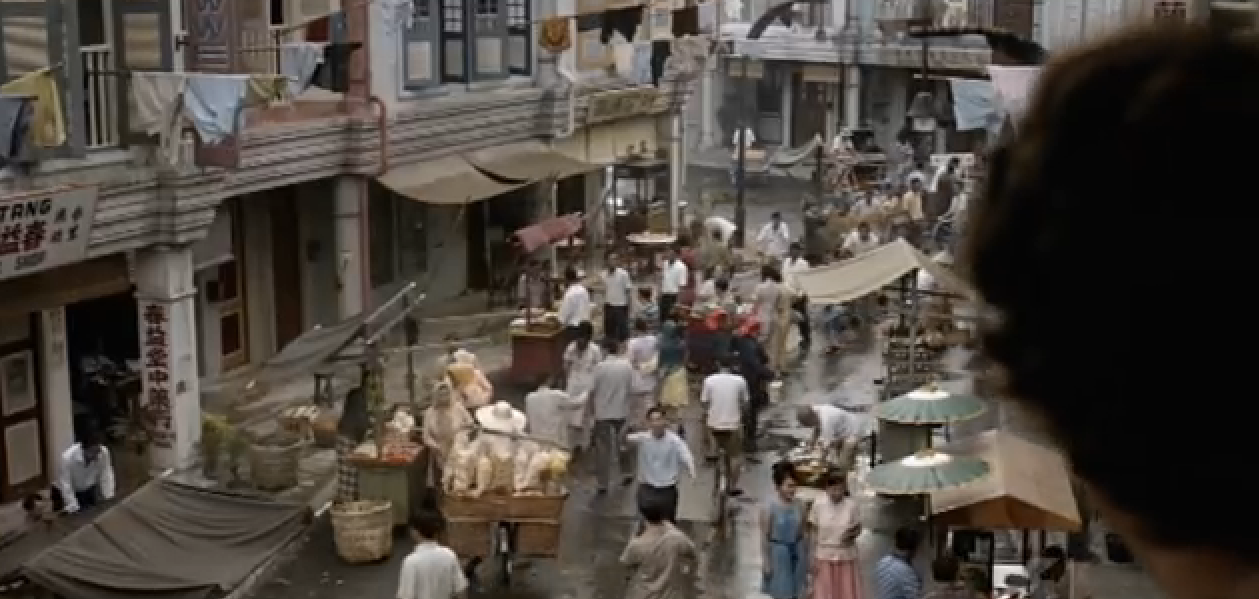
We open with riots on Victoria Street, white people with film cameras, and my excitement that we might be about to see actual Malaysians. A news recording is played over this scene, with the reporter mispronouncing Klang and Geylang which is always hilarious. The voice also confirms deaths of Chinese and Malays, and that a curfew will start at 1800.

We learn that the detective agency is not doing well; so not well, in fact, that Joan is going to brave the riots in order to deliver photos to a client in order to receive payment, risking getting hurt and getting caught in the curfew that is to be enforced as of noon (WHEN DOES THE CURFEW START COME ON GUYS). It was also Winston’s last case, aww! She speaks Singlish to emphasise her point and does kind of okay at it.

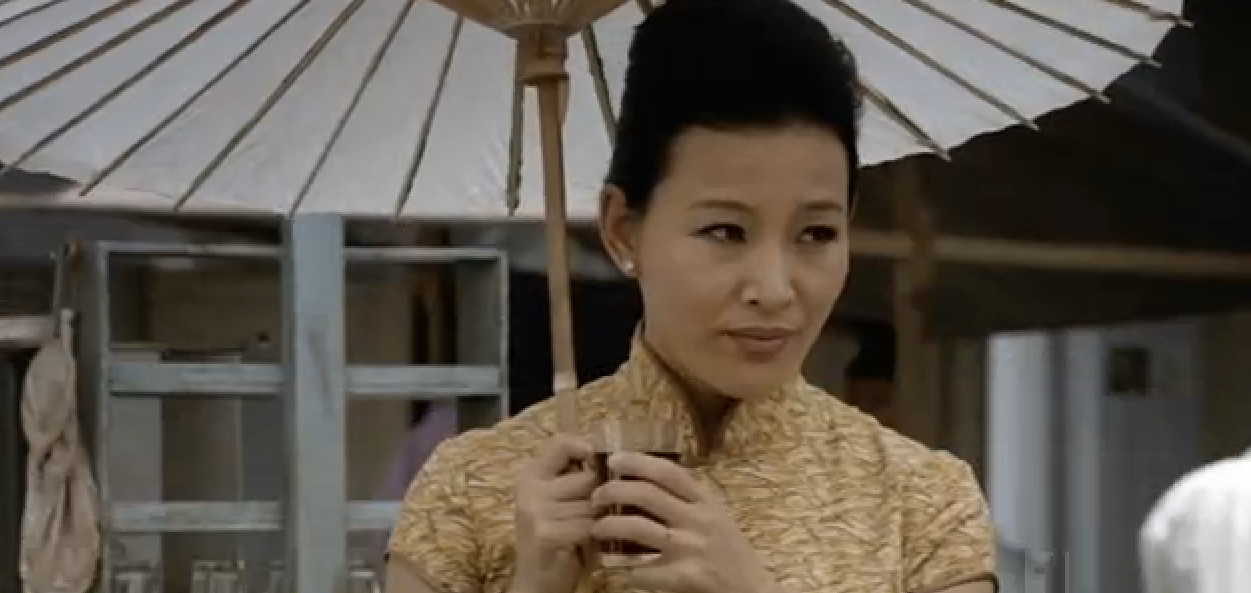
Joan gets as far as she can in a rickshaw before she has to get out and make it two blocks in high heels and carrying her parasol. Though this scene is intercut with shots of Alaric Tay griping adorably, and also shots of Malays rioting and getting beaten up, it is fairly obvious that Joan is going to get caught up in the protest and caught out by the curfew. A Chinese man storms towards her and rips the photos she is carrying out of her hands, and it seems probable this is intentional.
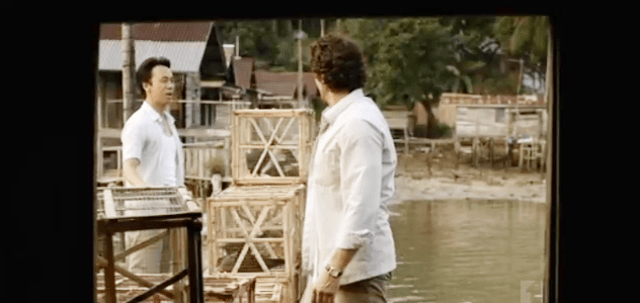
wah wah helo

Don and Alaric Tay and the Secretary of My Heart are talking about the curfew and stressing about Joan. Alaric bitches about his useless partner (Don). We get extensive shots of riots, and rioting, and police, and the dirtiness of the streets, before we cut to the lovely whiteness of the Raffles Hotel.

I can’t believe I didn’t realise it earlier, but all the scenes with the Expats swanning around is Raffles ETA NO WAIT I’M WRONG, as dc points out below but I still think my points stand because the bar scenes with Macca are from Raffles /ETA. OF COURSE IT IS. Let’s talk about Raffles, shall we: the Raffles Hotel was named after Stamford Raffles, the white man responsible for the Colonisation of Singapore, and a variety of other colonialist acts; and has for over a decade been a place where expensive foreign things happen (including foreigners). Foreign writers stayed there and named the Raffles Hotel the “Grand Lady of the Far East,” in case you needed a racist and patronising name for a hotel. In the now it’s still a hotel but also features a shopping arcade which includes Tiffany and Louis Vuitton, to give you some idea of its price range.

Anyway in the glaring whiteness of Raffles, Don is speaking in Malay and asking Claire to “keep the ladies busy with a game of bridge” and telling her not to go outside and how bad it’s gonna get. For once I sympathise with Claire, when she gives him her very best “are you shitting me” look.

Some random English dude whose name it takes me forever to work out because Don has gone to mumblestown warns Don to “stay off the streets” because “people are using the riots to settle old scores.” He waggles his eyebrows meaningfully and I consider giving him a moustache to twirl (ala Genevieve).

In blatant disregard of this warning, Don steals a USA embassy car so he can break curfew. He speaks some okay Malay and the show continues with no subtitles. There were several instances of Mandarin and Malay spoken with no subtitles in this episode, and I think I love it because it assumes the intelligence of the audience to work it out, and also I think indicates that this show acknowledges that despite being primarily an Australian production, it knows its audience is multilingual, that its audience knows the words already and if it doesn’t, it’s smart enough to work it out. Thanks for trusting us, My ABC. I had a momentary worry that the non-translation was because that stuff wasn’t vital and was therefore discarded but I don’t think that’s the case, as with the scene later in this episode where the Secretary of my Heart suggests that Don pose as her chauffeur as she poses as a diplomat, and he nods his head, opens the car door for her and says this adorable “boleh.” That’s adorable and totally adds something! Which is why I’m leaning towards textual intelligence.

Don continues his search for the missing Joan, stopping and discovering her bag with some blood on it. How did he know to stop there? Secretary of My Heart disappoints me by basically phoning in her phone conversation with Don, with the amazing line “I have a really bad feeling about this” which is never a line which should get past any sort of script development ever.

We cut back to the Raffles, where the Malay guards are preventing people coming in trying to escape the riots, and Claire pulls and tugs until they let a Tamil family in. I know this is supposed to be about the development of Claire’s story so this makes me pretty grumpy because yes of course the first actual Indians shown in this series need help from a white person, but also wow, a Tamil family is given refuge in the Raffles by a well-meaning white lady and Malays try to stop them and could this point be any more unsubtle? And also wrong, come on my friends. I hope no one actually thinks that the British colonising Malaysia and Singapore was in any way a good thing, like, yes we can’t change the past and the way both Malaysia and Singapore are now has a lot to do with the British colonisation and nobody get in a tardis or anything because you’re gonna be in so much trouble, but to have this lovely little message of COME SHELTER IN THE RAFFLES particularly when contrasted with all the other controlling white powers are doing in this episode, it’s enough to make me very angry.

So while I’m getting angry about white colonialism, Joan wakes up in some sort of complex and is helped by a photographer before the police storm it, and she escapes. Don runs into a police station and is told he is being silly looking for one single lady, so he yells in AWFUL Mandarin and then Joan just appears and I don’t understand? It is very funny though. I literally can’t work out what he says, he starts with 今天 and ends with 吗 and that’s all I can tell you.

Remaining with Joan’s bag is one last picture from the case she was couriering; the Secretary of My Heart recognises the one person in the photo whose face is fully visible as a wealthy Singaporean Chinese man. I love how she always knows the high flying Singaporeans; it is presumably because she is Peranakan and also awesome.

They find out that the person who ordered the surveillance is in fact the dead wife of the dude in the photos, a Chinese businessman named Lim.

The Secretary of My Heart functions as the pipe in this episode, and with her educated faux-British attempts makes me saaaaad. She’s all “this is real detective work, we’re peeling an onion” and “he lied, you know that?” I laugh.

Don continues to wear his white singlet with an open thin shirt on top of it. I know it’s warm but seriously, I cannot believe he’s still wearing it and also that’s just rude, can’t you dress up to meet any single person on the whole of Singapore HAVE SOME RESPECT MAN.

I claw my eyes out as Claire gives orders in the worst Mandarin I’ve ever heard, it’s pretty bad and I’ve watched Firefly is all I’m saying. I literally have no idea what she says, but Don asks her to help identify who’s in the photo based on the clothes.

Don goes to Macca who is a) drunk and b) helpful, and helps him work out who the Malay photographer is. At his newspaper, Malay photographer declares “you are part of Malaysia’s problem” which, he is not wrong, because expats who shun the other expats and pretend like they’re locals and aren’t contributing to the Colonialism, particularly in this critical period of the 60s, were totally an issue.

My favourite quote of the episode is probably “The Empire’s stuffed and noone’s seen the memo” and I loooove it, simply as an entry point to talk about all the ills of Colonialism and Imperialism and all the things that have been left behind. This is part of why I love the little nods here and there about how Westerners treat Singapore and SEA and how much they are unwanted. Macca is the best giving us this exposition, it’s obvious but he means it and I love it. Macca also reveals that MI6 is filming everything (and using 16mil).

ARIO

We spend some more time in the police station, because Don has been arrested along with Malay photographer, who has been arrested for allegedly setting off some explosions, and Don feels compelled to get him cleared, and in the hopes that clearing him will help him work out who attacked Joan. In the police station we are hanging out with Ario Bayu, who EXCITING SPOILERS is going to be with us for a while as an actual named Malay, so that might be good? Or it might be terrible, only time will tell. (Though Ario is himself an actual Indonesian, which leads us to other problems)

Don and CIA dude walk and chat in the makanan, and CIA dude eats his bowl of noodles as they walk. I’ve never really seen this much walking and noodle eating in my life, is this seriously a thing? Anyone? He confirms the existence of secret MI6 movies that he really wants to get his hands on but isn’t allowed to, because MI6 are babies who don’t share.

sr3-market

We see Don staring into the fan at his house and considering the clues, and I laugh a lot because I thought this scene was going to be ominous and it’s actually not. Don ends up really sweaty and is all shirtless, and this show continues to fan service. Later, Alaric Tay confesses after a small fight with Don that maybe MI6 gets film deliveries once a week, and they wander off to steal it.

I am super sad that I used a cap from the credits in last week’s review because it turns out that cap I used is actually from this episode! It is Don doing crime! I’m totally into this scene, where Alaric Tay is ridiculous-ing for all he’s worth, stopping the van in the road and annoying everyone, and Don steals the film that MI6 has had processed.

The Secretary of My Heart meets up with the CIA dude and flirts with him, telling him she saved him some kacang putih hahaha and letting him think he has a chance for about thirty seconds by telling him she wants to see a film with him. She reveals it’s a film that Don stole from MI6, and his little heart falls though he gets to keep the footage, which he does. “You still owe me though, Sam,” CIA dude says as he crunches kacang putih like he’s watching a poorly edited movie (and the Secretary of My Heart whispers to him, “don’t dirty my floor.”) Someone on twitter points out this footage looks like it’s from WW2, not 1964, but now that I’ve just watched a season of The Hour I’m not so sure I agree anymore. Anyway this scene closes out on riot footage and Don’s smug face and slightly better acting from everyone all round, good work team.

Having saved their new Malay friend (who I hope turns up again in the future!), it’s time to get back to the mystery of the dead wife and who attacked Joan. Claire works out who the woman he’s having an affair with is, and warns Don away. This is all very sinister and then also comes to nothing? Joan sasses Don, and Don goes to visit Lim, the Chinese businessman, with a print out of the Chinese man who assaulted Joan taken from the MI6 footage. Lim, an upper-class Chinese-Singaporean in 1964 with a property so large it has a back yard, a front yard, a long driveway and two storeys, answers his own front door. I mean, I have Chinese-Singaporean friends in Singapore who don’t even answer their own doors now, let alone in 1964, I am just saying. Don confronts him and he brings out the man from the footage, who is all like “yeah tell the lady I’m sorry,” and is then dismissed with a 没事 which I think is interesting given the dude ANSWERED HIS OWN FRONT DOOR even though we have already SEEN HIS AYI. Don refuses to leave until they also resolve who ordered the work to be done, given the dead wife; Lim takes him out into the back lawn to meet the lady with whom he is dallying, who is just sitting around in the back patio waiting for Don? I’m not sure, but she fesses up to having him followed and Lim pays Don some money to keep it all quiet and then Susannah skips off into the distance and I have no idea why any of this happened.

As the two men watch her go, Lim gives words of warning and advice about having affairs with married women, and we cut to Don standing outside the police station watching Claire. I roll my eyes again, because sometimes I think this show is doing better and sometimes it tries to hit me over the head with a sledgehammer.
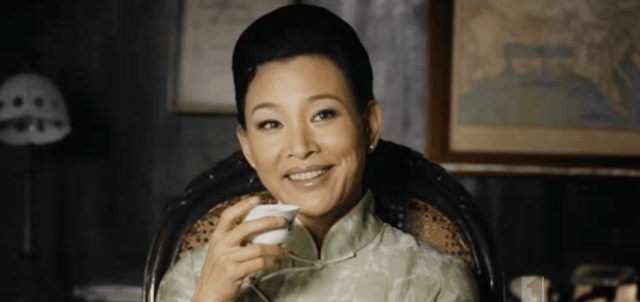
joannnnn

Joan basically floats into the office (an aside, I just discovered that Joan played Guan Yin in a 2010 tv adaptation of Journey to the West and she is adorable in it, and Guan Yin historically does a lot of floating, so we should draw some parallels between Patricia and Guan Yin, I’m just saying), and shows the Secretary of My Heart “our first dirty money.” They reminisce about the first time they were paid in chilli crab, and I was talking about how much I miss chilli crab just yesterday, but this is the sacrifice SEAzns make when they go all properly vegan and stuff. The Secretary of My Heart softly comforts her and Joan just nods sadly and and it’s all lovely. I stand by my claim of last week, the best scenes in this series are the quiet ones, especially the quiet ones that involve Joan.

We end the episode in the bar, where Joan does the Beijingren 八 with her hands to indicate 8 (for 80-20%), offering Alaric Tay that great deal so she gets to steal more of Don’s time for detective-ing, and Alaric gets more of the proceeds from their Import-Export business. I’d take it, Alaric! From behind a beaded curtain, a tiny Chinese girl says “that’s her, isn’t it?” and she’s told to say nothing; so she follows Joan out of the bar and fondles a fob watch, which when opened contains a photo of Joan and Winston. I’m taking bets on whether this girl is secret mistress or secret daughter.

A Miscellany

  • Don spends so much time making sure Joan is safe in this episode. Shipping it? I sure am.
  • I am not shipping CIA dude with Pamelyn, on the grounds that no.
  • Needs moar Alaric Tay, so far he’s really just comedic relief and extra helping hand
  • Good work with the continuity! Don attacked in episode one, resolved in this episode. Nice!
  • Was this episode confusing? I found it super confusing. I can’t believe it’s called ‘Ball of Confusion’ I mean really
  • Hokkien watch: use of ‘ang moh’

Next week: my boyf Song, something something something. Maybe I’ll talk some more about Australians perpetuating colonialism in SEA.