birds of australia with hayley and michael: the galah

Dear No Award; here we are back again with our continuing series on Australia’s birds. Why do I think this is the greatest thing ever? Uh, because I’m a Penguin. This month sees a devastating lack of fights between Michael and Hayley as they agree over the Galah.
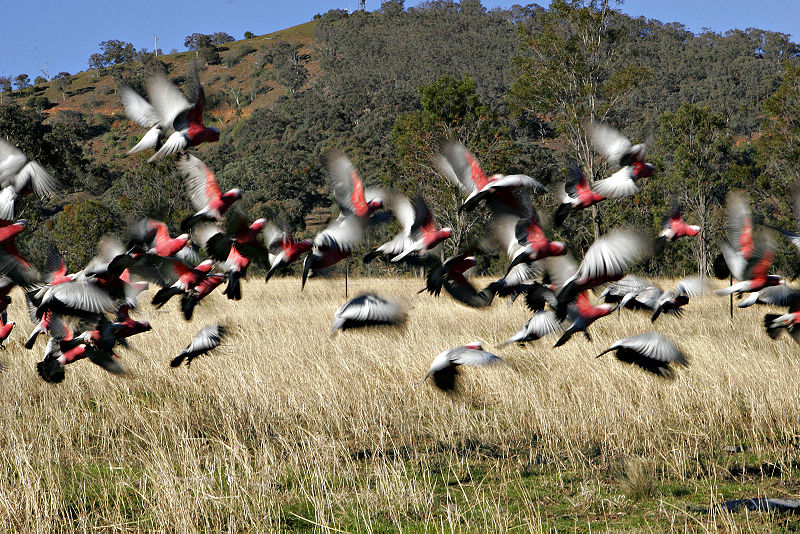
Galahs flying with a motion blur

Michael

For some reason bird names are pretty common as insults – think about it: cuckoo, turkey (as Homer explains), coot, chicken, dodo, even tit (although the insult may have a different etymology than the bird name). Australia has added a couple of classics to the list: drongo and today’s bird of the month: galah.

The galah is one of Australia’s most distinctive birds – a small cockatoo with a bright pink chest and face, grey back and white crest – commonly seen in large flocks throughout most of mainland Australia. The precise reason that they’ve come to be synonymous with foolishness in Australian idiom is unclear – there’s some suggestion that it’s due to the galah’s propensity to migrate south (towards colder weather) during winter, although actual research shows that they’re pretty sedentary birds. More likely it’s down to their noisy, squawky calls and slightly ludicrous colours. Either way, it’s gone global as an ocker insult thanks to Home and Away.

As with our first bird of the month, galahs are one of the rare birds that seems to have benefited from European settlement, with land clearing creating vast swathes of their ideal open habitats and the provision of water for stock dramatically expanding their range (although they remain absent from the very northern tips of the country).  They’ll eat basically everything – fruit, seeds, bugs, grass, grains – whatever’s going. Their sexual politics are a bit confusing – they pair up for life, suggesting a pretty conservative outlook, but there are records of inter-species love, with galahs breeding with sulphur-crested cockatoos, little corellas and Major Mitchell’s cockatoos. Freaky.

The Big Galah by Adam EalesPeople regularly ask me what my favourite bird is and, as impossible as that question is, I’ve often answered the galah. It’s not as spectacular looking as the king parrot or crimson rosella, but there’s just something so unlikely about the pink and grey stylings that galahs get around in – it doesn’t really seem like it should occur in nature. There’s also their playfulness – galahs are well regarded as pets, but even in the wild you see them mucking around and seemingly just having fun. Watch a flock of galahs next time they fly over – they dodge and weave for no real reason, squawk just to hear the sounds of their own voices and seem to be having the time of their lives. Of course I’m anthropomorphising them, but life as a galah just looks like great fun. They’re common around Melbourne and spotting a flock flying over Princes Park on my walk to work gives my spirits a lift – they’re a very cheerful creature.

Their raucous mischievousness is seen by some as charmless – my partner Cindy called them “the dude-bros of the sky” when I told her I was writing this. There’s also their rather unfortunate portrayal in this ACT health campaign, which is terrifically insulting to one of our natural icons. They have been known to get hammered on fermented over-ripe fruit, but they seem like pretty lovable drunks – sure they’d laugh at their own jokes and slur their words a bit, but nobody would mind, they’d all be having too much fun.

I’m giving them 5 feathers – they’re a national treasure.

Hayley

I was hoping that Michael and I would get into our first proper dust up and I would get the chance to call him a flaming galah (because it would make Alf Stewart proud), but here we are again in agreement over a particular bird’s general excellence. And really how could we not be, who on earth doesn’t like the wonderful cheeky clown that is the galah? New test to discover whether your acquaintances are actually androids from the future: ask them if they don’t like galahs.

No matter how glum I may be at any time, spotting a few of these candy-coloured fellows chirruping among themselves on power lines, or fossicking about on a grassy verge at the side of the road is enough to put a smile immediately back onto my po-faced dial. They’re just so sweet.

JJ Harrison http://commons.wikimedia.org/wiki/File:Female_Galah_Outside_Nest.jpgOnce I started thinking about my feelings about them more deeply, however, I started to feel slightly off about the sweeping designation of a ‘galah’ meaning someone who is foolish, stupid, or somehow lacking in various graces. This seems like a horrendous cop-out to the bird in question. There is the fact that parrots are among the most intelligent of all birds, probably only outstripped by the corvids (and even that is an argument likely to produce much teeth-gnashing and invective spewing from bird nerds). In captivity galahs are well known for their highly developed skills in picking up speech – look at this little guy who can whistle, sing, meow and say complete sentences that correlate with his owner’s actions and speech. I hardly think that this is the behaviour of a stupid animal.

And then there is the fact that galahs are some of the most visually striking birds in the country. No, they don’t have the eye-popping flash of rosellas or king parrots, but that kind of bright ostentation is too vulgar for them. Better to dress their wings in grey, crown their crest in dusky white, and have the soft rose flush of their breasts carry the indication of their cheery personalities. They’re like that friend we all have who is happy and always joking and laughing, and that’s what you remember most about them, to the point that when they show up to a fancy party or dinner in super fine duds, tasteful and understated yet perfectly cut and tailored with one bright accessory that completely expresses their quirky, kind personality that your mouth drops open in shock as the realisation steals over you that not only are they the most fun to be around but they’re also the most together person you know and it’s been in front of your face the entire time and aren’t you just a bit of an idiot. What I’m saying is that galahs are total secret GQ motherfuckers and we are all chumps.

Anyone who doesn’t think the galah is a 5 feather bird needs to be catapulted into the sun.

Jeeze Michael, I really hope we disagree next month, all this cordial agreement is giving me indigestion.

Bird: Galah

Michael: 5 feathers

Hayley: 5 feathers
linkspam is feeling better when you say linkspam

I have been completely overwhelmed with my blogging for MQFF (look at my name all over that blog!), so there are no new blog posts yet today, though if you check back later in the week perhaps you will be surprised! Instead, have some things I have read in between movies:

March in March marks the birth of a new kind of activism; an article by Van Badham about a new phenomenon in Australia, and how different sides of politics (and the media) have reacted to it.

Celeste Liddle on being ‘black’ and fair-skin privilege is a whole world of YES EXCELLENT, a great article.

I am an actor, by Rani up at Peril, is a meandering piece about being an Asian in the Australian acting world. (Anecdote and personal aside: The day Rani auditioned for a reoccurring role on Neighbours I flipped my shit)

Having strong feelings about There and Back Again: Or, how I quit programming and returned, an on gender and performativity and femininity by Misty De Meo, a trans woman.

American but also Malaysian and about representation in the mainstream media, The media’s shameful Malaysia Airlines coverage: Gawking at a foreign disaster was an interesting read on the damage that can be done by the media and by our own disinterest.

On the Chinese media, China sees Obama girls, but not Xi’s daughter. My favourite part of this article is pointing out the media’s silence on Xi Mingze being a student at Harvard.

mqff viewing schedule

mqffbannerThe Melbourne Queer Film Festival starts in just TWO HOURS. This year I’m blogging for MQFF, so I’m heavily involved, and you can see my filthy penguin flipperprints over everything (check out the blog).

I love Melbourne’s festivals, as they’re often a great time to get involved in a community, learn more about a subject, or just love Melbourne a little bit more. And MQFF is definitely one of my favourite festivals all year round. And if you’re broke, there’s even $10 buck tix, which I LOVE the concept of.

Tonight is the opening night party, and there are still tickets to that: Any Day Now, starring your favourite and mine, Alan Cumming.  Also I will be wearing a tutu.

And I am super excited about so many films! If you’re still unsure, I wrote a list for Peril of Azn-interest films, and below is my personal list (note: I won’t end up seeing all of these):

G.B.F (Gay Best Friend)  (Saturday 15 March, 20:15): The summary starts “Move over Mean Girls and Heathers, it’s 2014 and there’s a new set of prom queen wannabes and they need a gay best friend;” I don’t need to know anything else.

Quick Change (Saturday 15 March, 16:00): I have seen the first five minutes of this movie and it looks adorable – sadly my screener was having issues and I failed at seeing the rest. This Filipino movie is about Dorina, a trans woman who makes a living selling homemade cosmetics to other trans women. She does a runner when a client has a bad reaction to some of her cosmetics.

Who’s Afraid of Vagina Wolf? (Sunday 16 March, 20:30): This is a comedy and I need the laughs.

OUT in the Line-Up (Sunday 16 March, 15:00): Australian documentary. Queer surfers.

52 Tuesdays (Tuesday 18 March, 18:00): Filmed every tuesday over a year, this film (not a documentary) follows a teen as one of her parents transitions, and I am super into the conceit of this film.

Bad Hair (Wednesday 19 March, 18:00): Not totally sure what this movie is about, but I do know Junior wants to straighten his hair and I’m intrigued.

Will You Still Love Me Tomorrow (Wednesday 19 March, 21:00): Taiwanese movie about discovering one is gay after being established with a family. Allegedly a comedy of errors. This usually wouldn’t be my thing but it’s the only Mandarin-language movie this year.

Noor (Friday 21 March, 18:00): A Pakistani trans man goes on a road trip to find a place where he belongs. Hopefully adorable.

Zoe.Misplaced (Sunday 23 March, 15:00): Melbourne lezzie drama. All good.

I have reviewed Soongava, so I won’t be seeing that again, but it was very interesting.

SEE YOU THERE. Come say hi, I’ll be there most days of the festival.

In Conversation with Jung Chang at The Wheeler Centre

Last night the Wheeler Centre cruelly made me choose between being queer and being Chinese. Not really, of course. I’m Chinese no matter what, and I’m pretty damn queer. But  I had to choose between Alison Bechdel and Jung Chang, and Jung Chang, Chinese biographer, banned on the mainland but so beloved everywhere else, and lacking the connotations of Amy Tan, was always going to win. Jung Chang has written a new  biography of Cixi, Dowager Empress, scourge of China; Empress Dowager Cixi: The Concubine who launched modern China. This biography has been written exclusively using first-hand accounts, and I’m so excited to get my hands on it.

look at this cutie!
look at this cutie!

Jung Chang is an excellent speaker. She has a wealth of adorable stories, a way of turning the most tragic anecdotes into amusing moments, and a lovely way of speaking (and not a little bit of familiarity, with her Chinese words thrown in amongst her accent and her pauses). She tells of being sixteen in 1968, and committing to paper her very first piece of writing, a poem. At the time, being a writer was certainly enough to have one sent down, and that very evening, as she was lying on her bed composing her work, the Red Guards busted in for a random inspection. Desperate to hide her evidence, she tore up the pieces and flushed it down the toilet, and there her writing career stalled for a decade. Everybody laughed, though it’s ostensibly a story of how difficult life was under Mao. Chang just has a way of telling it.

Wild Swans (and her Mao biography) are banned on the Mainland, but Jung Chang herself is not, merely blacklisted. She fought to be able to visit her mother for fourteen days in every year, and while she’s in country (in Chengdu, mostly), she refrains from talking about her work, publicising, and even seeing her friends. Chang shrugged. It is the price of being a writer, she said, and I lack the words to express how this makes me feel, but I’ll try. One of the hardest things for me, when I write about identity (and you know how I love to write about identity), is how much of my family to bring into it; how much of what can hurt me to bring into it. And I love how matter of fact she is of it, how accepting of her situation. This is the fence upon which she sits, and that’s just how it is.

The audience was a delightful mix; I love looking into a queue to see a whole lot of Chinese people, not just older but younger, too, my age or so. Lots of middle-aged to older white people, some others. Sporadic mutters and giggles when the interviewer first pronounced ‘Jung’ as if it were a ‘Y’ sound,* and second repeatedly pronounced Cixi incorrectly (Chang just kept saying Cixi until it sounded okay, and admittedly 慈 is not the most easy of sounds). But then, a sign perhaps of the white audience? Laughter when Chang related of how difficult it was for Cixi to get Chinese people to go overseas, to get a Chinese person to be ambassador to foreign countries. The first Chinese ambassador to the USA was an American. But Chinese people were afraid: afraid of being kidnapped, afraid of being killed. And there were giggles from the audience, as if this isn’t something truly to fear? (Clearly they’ve never been a Chinese person in a Western country)

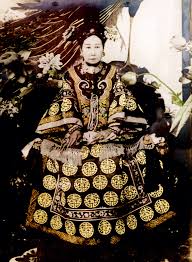
funny story: the first airbrushed photo in chinese history

When asked if Cixi’s history had been influenced by any thing in particular, Chang demurred, explaining the misrepresentations. What she meant to say was, surely, misogyny. Just like Wu Zetian.

When Cixi was young, she had a eunuch lover. Eunuchs were always despised, though Chang suggests they should be figures of sympathy. Cixi instigated a canal cruise for her lover’s birthday: there were dancers, and singing, and revels. This caused an outcry, because EUNUCHS and LADIES MAKING CHOICES, and her lover was put to death, the dancers were sent off to be prostitutes, and Cixi had a breakdown.

I loved the way Chang told of Cixi’s reforms, from the sweeping societal, through to the court etiquette, and how Cixi, who loved curiosities, never rode in a car – because the driver couldn’t bow AND drive at the same time. I also loved that she waved at foreign photographers, because she had heard that foreign monarchs did that (very different from the tradition of being hidden from view all one’s life, as Chinese royals were).

I was most interested to learn about Cixi, but as an endnote, I also learnt about George Morrison, whom Wikipedia tells me was also known as ‘Morrison of Peking’ or ‘Chinese Morrison.’ He came up because a man in the audience asked if Morrison, from Geelong, was in Chang’s new book, noting that he features predominately in many other biographies of Cixi and of the period. “No,” said Chang, after a pause. It wasn’t a ‘trying to remember’ pause – it was an awkward pause, a ‘how do I say no?’ pause. Morrison, says Chang, didn’t speak Chinese. He got a lot of his information from Backhouse, a man who claimed to be Cixi’s lover and who claimed that on her deathbed Cixi told him “never let a woman rule.” It had better not surprise you, reader, to learn that he was a giant liar.

This was a free (but booked out) event at the Wheeler Centre. If you’re in Melbourne, The Wheeler Centre is a great way to see/hear some awesome stuff, for free or for cheap! Get to it.

*!! This tweet from the Wheeler Centre tells me that Jung Chang pronounces her name Yoong! Which is super interesting that she’s chosen a pronunciation that’s so different from the pinyin/romanisation. How non-standard! I apologise for making fun of the interviewer for that.

Secrets & Lies

Secrets & Lies is Australia’s attempt at a Broadchurch/The Killing style of mystery, self-contained but with a focus on the impact of murder on a community.  I enjoy a good (fictional or historical) murder, and I was intrigued by the Brisbane setting and the fact it was picked up for an American remake before it had even aired.  I am far too Gen Y and cool to watch live-to-air TV, plus my house doesn’t have an aerial, so I hit tenplay.  Which I mention just because I approve of legal streaming television in general, and this was a good service with a nice, crisp stream, so well done, Channel 10.

The official blurb:

Secrets & Lies is a gripping six-part series that tells the story of Ben Gundelach (played by Martin Henderson – The Ring, Little Fish, Bride & Prejudice and Devil’s Knot), an everyday family man who finds the body of a young boy and quickly becomes the prime murder suspect. 

My blurb:

Manpain. No sympathetic adult women.  One person of colour, unsympathetic.  The hero has never read a detective novel ever, and is following the How To Look Totally Suss playbook.

Nevertheless, the mystery is interesting and I like the setting, so I’m probably going to keep watching.  And blogging.

I’m also going to keep on pointing out the incredibly white cast, because WOW, that does not look like Brisbane, even the upper middle-class river-side suburbia part of Brisbane.  It’s just so typical of Australian TV that no one even stops to think about diversity.  And if anyone dares to point it out, they’re accused of racism.

And I really hope the writing of the women pick up, because so far they’re pretty two-dimensional.  Don’t go looking for an Antipodean Sarah Lund here, because all the cops with speaking roles are dudes.

But like I said, the mystery is interesting.  I’m kind of hoping that the hero turns out to be the murderer, but I think we’re too deep inside his head for that sort of twist.  I am, however, going to predict that he’s the dead child’s father.  STAY TUNED.

birds of australia with hayley and michael: the emu

Dear No Award; I’m excited to be bringing you a new monthly column here at No Award: Birds of Australia with Hayley and Michael, surely Ornithology’s Margaret and David. I say ‘I’ despite this being a shared blog because my co-host, Liz, is on record as having some bird issues. Please avert your eyes if your issues are like hers, and go bitch about birds on her personal blog!

I’ve got some strong feelings about birds in Australia. We say birds in Australia because this column will not be limited to birds indigenous to Australia; Michael and Hayley will also end up visiting introduced and exotic birds! Yes! Excellent! Each bird will be described, analysed and discussed, rated for gender politics, post-colonialism, awesomeness and whatever else our reviewers feel like, and then given a rating out of five feathers.

Dr Michael Livingston is a professional killjoy, occasional bird-nerd and part-time food blogger. You can find him writing about vego food at Where’s the Beef. Hayley Inch works for a bunch of film festivals. She writes frequently about food at Ballroom Blintz, very sporadically about film at 240 Films, and about many Melbourney things at Broadsheet. She’d be a better birdwatcher if she didn’t get so loud when excited.

Please do not be scared by our first bird, the Emu, which is basically the greatest bird ever after the penguin.

friend troy forlornly trying to feed an emu

Michael says:

It’s fitting that we start this column off with the Emu, probably Australia’s most famous bird (rivalled by what, the Kookaburra? The Lyrebird?).  It adorns the Australian coat of arms and the 50c piece, is the namesake of Australia’s preeminent ornithology journal and even has its own brand of beer. The emu’s appeal is pretty straightforward – it’s two metres tall, flightless, distributed across the entire country (except Tassie) and a common sight for anyone driving through country Australia.  Shockingly, the emu wasn’t even nominated in the recent Australia’s Favourite Bird poll, an oversight I can’t begin to understand.

My second vivid bird-related memory (the first is being hunted by a terrifying pack of ‘domesticated’ vicious geese as a toddler) is of a baffling emu that roamed Brampton Island in the 1980s (for a brief time our family was upwardly mobile and holidayed on tropical islands). You’d see it loitering outside the cabins or roaming the beach, kicking up spray as it sprinted through the sea foam. It’s a sad story looking back – it was probably dumped on the island for novelty value and must have been lonely and confused. But as a kid it just felt unworldly – being a few metres from this odd creature, hearing its weird drumming calls and watching it sprint at incredible speeds  was a hint at how compelling the natural world can be.  Despite seeing hundreds of emus since then, a tiny remnant of that visceral thrill still sparks every time. They’re abundant birds, but there’s nothing common about them.

http://commons.wikimedia.org/wiki/File:Emu,_Jurong_BirdPark.JPG

They’re distinctive, but not particularly attractive birds, with drab brown and black feathers and a splash of blue at the neck. Their wings are tiny and useless, while their legs are strong enough to rip down fences, fend off dingoes and propel them at speeds of up to 50 kilometres per hour. They eat anything and everything – native and introduced plants and fruits, bugs, moths, caterpillars, charcoal, stones – they’ll even eat car keys apparently. The emu’s gender politics are excellent, with the male taking on most of the work of bringing up the young. He spends two months incubating around a dozen beautiful green eggs, surviving only on body fat, dew and any scraps he can reach from the nest and losing a third of his body weight before the chicks hatch. Meanwhile, the female wanders off after laying the eggs and may breed again elsewhere, with another male emu.

So they’re a fascinating, distinctive and surprisingly feminist bird – I’m taking half a mark off because of their cold dead eyes and aggressive posturing and another half a mark purely because of this dreadful song that has been stuck in my head the whole time I’ve been writing this. So four feathers out of five from me.

Hayley says:

Michael has given an excellent overview of this most iconic of Australian birds, but if we’re going to talk emus (pronunciation guide: ee-mews, not ee-moos, for the love of god) we must address the most batshit amazing thing about them: the Emu War, aka that time the Australian government unleashed the might of the military against a species of native fauna, and the fauna WON.

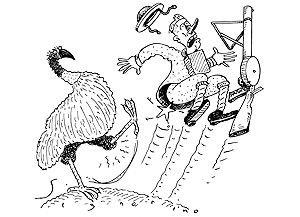
“The Emu Battle – Volley of Questions” Canberra Times Friday, 18 November, 1932, page 3.

So it’s 1932, and bunch of returned WWI soldiers had taken to farming the Campion district in Western Australia. The only problem? EMUS. EMUS EVERYWHERE. Emus eating wheat and knocking down fences, thousands upon thousands of them. What were the diggers to do?

The farmers petitioned the Minister of Defence, Sir George Pearce, with a plan. See, they had military experience and figured that there was only one thing that was going to successfully eradicate their feathered foe: MACHINE GUNS. They figured that if a brace of Lewis machine guns were so good at mowing down soldiers, they would do the same for the emus. Sir George was only too ready to agree, figuring that the birds would make ingenious target practice for the idling Australian military.

The emus weren’t having with any of this colonialist tame-the-land-and-shoot-all-the-native-species bullshit. Once the deployed soldiers actually started having a go at massacring some birds in November 1932 they quickly discovered that the emus were devious strategists, and ambushed mobs would very quickly split into smaller groups and scatter, making them much harder targets to hit than anticipated. Even hitting the emus apparently didn’t faze them; soldiers were gobsmacked at how many bullets an emu could take without bringing the bird down (so emus are clearly well-disguised Terminators).

Major G.P.W. Meredith, military head of the campaign, later claimed that just under 1000 emus died during the brief war, with estimates that a further 2500 birds would have died from injuries, but considering there were 20000 emus in the area it hardly made much difference. The war became a laughing stock in parliament, with Pearce being labelled “the Minister for the Emu War” and prompting this hilarious exchange in the House of Representatives:

Mr Thorby (NSW): “Who is responsible for the farce of hunting emus with machine guns mounted on lorries? Is the Defence Department meeting the cost?

Prime Minister Lyons: “I have been told the Defence Department will not be paying the bill.”

Mr James (NSW): “Is a medal to be struck for this war?”

The Emu War barely lasted a month, and despite repeated calls throughout the next few years from Campion residents to bring back the army to deal with all these goddamn emus, no one in authority was ever game to take them on again. The emu was just too invincible an opponent.

So as you can see, emus are freaking bad-arse and you should afford them with RESPECT. I have to take off half a feather due to them not being the most lethal ratite in the country (that award goes to the southern cassowary, alias a motherfucking dinosaur in bird form), but otherwise the emu receives a highly commendable four and a half feathers out of five.

Bird: Emu
Michael: Four out of Five Feathers
Hayley: Four and a Half Feathers

On awards and self-promotion

It seems like every year, the SF community has a kerfuffle about promoting one’s award-eligible work with the aim of getting it nominated.  There are those who think it’s unbelievably tacky, but there’s also the point that marginalised groups tend to be overlooked if they don’t put themselves out there.

Have some links!

John Scalzi made a series of tweets, which basically boiled down to “Promote away, don’t be a jerk.”

Adam Roberts writes, essentially, “Sure, marginalised groups are easily overlooked, but self-promotion is really tacky and distorts the nomination process, so don’t do it.”

Scalzi politely disagrees so we don’t have to.

For women, this issue came to the fore last year, when Seanan McGuire was accused of excessively promoting herself.  She had made, in fact, two posts about her eligibility for nominations.

Amal el-Mohtar writes further on that subject.

All of this is to say that the Chronos Awards are now accepting nominations, and No Award is eligible for Best Fan Publication.

Additionally, our individual posts are eligible for nomination under Best Fan Writing.  We are particularly proud of these:

(by Liz Barr)

For Your Bookshelf – The Deep by Tom Taylor

For Your Bookshelf – The Ghost Bride by Yangsze Choo

The Sea and Summer

Pacific Rim, welcome to the blog!

(by Stephanie Lai)

The Exotic Place as Other (and notes on Cinder by Marissa Meyer)

Pacific Rim and the Chinese Jaeger program (and what that means in 2013)

Australia’s Jaeger Program, ps racism and history

It’s a shame, mind, that Stephanie’s series of posts on Serangoon Road don’t count as science fiction, fantasy or horror, because they surely deserve all kinds of awards.  Someone should buy her a bottle of vegan wine as compensation.

Clause 6.4 of the Chronos Awards rules states:

6.4 No Award: “No Award” shall appear last on the ballot for all categories.

So, you see, you’re practically obliged to nominate us!  Right?  RIGHT?

Look, our original purpose here was trolling, and we’re not going to let a little thing like “Liz, that’s a terrible joke” stop us.

Nomination rules:

5.1 Eligible nominators and voters: Nominations will be accepted only from natural persons active in fandom, or from full or supporting members of the event hosting the award. Where a nominator may not be known to the Awards subcommittee, the nominator should provide the name of someone known to the subcommittee who can vouch for the nominator’s eligibility.

5.2 Nominations: The nomination may nominate any number of works in any category. However, the nominator may nominate any given work only once in a category. All nominations must include the name of the nominator. Where a nominated mark does not meet the criteria for its nominated category, the committee may move the nomination to the appropriate category; or where a work does not meet any criteria, refuse the nomination.

5.3 Timing of Nominations: Nominations shall be open for a minimum of 30 days. Postal nominations shall be counted as valid based on postmark or receipt, whichever is earliest, if received before the final deadline set by the committee.

I have some feelings about that “must be active in fandom” bit, and “known to the organisers” and all.  But the first time I nominated someone — hey, I think it was Stephanie! — I said, “I am active in fandom, and here is my blog to prove it SO THERE,” only without the SO THERE.  Alternatively, you can become a supporting member — or even a full member!  Please feel free to come to our convention! — of Continuum.  It’s a great convention!  And I’m the membership officer, and shall think loving thoughts as you are entered into my database.)

More information about nominating, and other categories, and a link to a longer list of eligible works, can be found on Continuum’s website.

Fantasy Worlds and Real World Commentary

Emperor Weishu Maorin Guangong Zhian, sixth of the Long Dynasty, of Yanjing, lives in a walled palace. He greets his guests in the Hall of Imperial Greeting; he has beautifully cultivated gardens of flowers and rocks. Those who see him must bow, their heads to the ground, nine times; delicately clothed in silk, fastened with silk frogs. The Master of Presentations is a eunuch. The erhu and the pipa are common instruments; Yanjingyi eat ‘water-reed shoots’ and steamed dumplings with eating sticks. Beside Yanjing lies Gyongxe, a great high plateau, where religions flourish and temples and temple dedicates are most at peace. Premier amongst the religions of Gyongxe is the Living Circle: a religion where one one feels the magic flowing through everything. It is like Qi, says one of the Emperor’s mages. Gyongxe is ruled over by the 298th God-King, implied a reincarnation, who can channel thoughts from gods and other beings.  In Gyongxe they drink butter tea and eat dumplings. Sky burial is an ancient, beloved practice, and though Briar feels disgust as an outsider, he respects their tradition.

It took me 200 pages before I put together what I was reading, because I didn’t want to believe it.

When a rose bush in the carefully sculpted gardens of Emperor Weishu, Eagle of the Heavens, the Leveller of Mountains, wilts with rot, he orders it torn up, the roses set alight, and the gardeners responsible tied up in the middle as the roses burn. His mages are dedicated to him, and his wars, and his closeness to heaven. He is the absolute ruler, and his armies are innumerable, and at their head he is ruthless. Emperor Weishu keeps prisoners; his favourite is Parahan, whose twin sister is Soudamini, who comes from Kombanpur, one of the Realms of the Sun. They speak Banpuri. Parahan is kept with magic chains across his wrists and ankles, and sits on occasion chained to the emperor’s dais.

I love representations of non-white cultures in Fantasy. I’m bored of epic European-based fantasies, reimagings of Arthurian or Greek or Roman or Christian mythos.* So this is great! A world of magic, with these cultural reference points that are familiar to me, that are home to me; or that are completely different but still belonging to someone. It’s great and rich and excellent.

Having taken the countries adjacent to his own, Emperor Weishu, Son of all the Gods, Master of Lions, is moving on to Gyongxe, the spindle of the world. He must have his empire encompass such a point. He has subjugated neighbouring Inxia, and is secretly holding the borders, preventing traders from travelling, and suppressing the Living Circle, this fantasy universe’s calm, meditative religion.

I don’t love Westerners passing judgements on issues they know nothing about; Westerners using our own political situations as the plots for their fantasy worlds; Westerners bringing horrible stereotypes into their fantasy texts, reinforcing these views.

I do not disagree with the heart of it. As an overseas Chinese living in Beijing, I kept my mouth shut on the Tibet issue, learnt the coded key words, and went about my business. I support sovereignty along religious borders, and I definitely have issues with the PRC’s methods of maintaining dominance and control, and the way it’s exterminating real world cultures. I have so many thoughts on Chinese colonialism, and its push into African countries and its railway through Tibet and its suppression of Xinjiang.

But these are complicated issues, with complicated factors and outcomes, and real world impacts. And representation affects that, too.

Borrow our cultures with respect; represent our cultures and our countries with thought and research and interest. Incorporate our fun elements and our bad elements and our mediocre elements. Have fantasy countries that look like China and Tibet and India and Indonesia, and sound and feel like it to us.

I want a less white fantasy landscape. But I don’t want this passing of judgement on a real world issue through a fantasy lens, through a White person’s fantasy lens. I don’t want to see my culture distorted so it is nothing but a stereotype; I don’t want my history disrespected and my culture manipulated so that all is left is a plot point.

I love this author (who I have not named, because she likes to have conversations with her critics and her fangirls like to pile on, but there is all the information here that you need to identify this author and series), and I have read and reread so many of her books. She works hard and works well to build an inclusive universe, that’s not a random European monoculture and is instead full and realistic (across not-ethnicity things, too). And I appreciate that. But this felt like Carthak again: I remember the Emperor Mage, who was so exorbitant and opulent he covered Daine’s bird shit covered clothes with new silk; whose slaves had their tongues removed; who felt he was heaven’s son, and closer to heaven than the gods; who wanted to invade Tortall and all that the protagonists held dear. And it makes me mad and it breaks my heart.

We are more than antagonists in your fantasy world.

(We are more than antagonists in your real world fantasy)

*though Jesus was a black man, Christianity is still primarily a thing associated with the West and with Europe. And of course historically there were black Europeans.

Saturday morning links

Note: Links may not actually be posted until Saturday afternoon

Stuff Stephanie has been doing

Writing!  She has a series of posts about Chinese-Australian identity at Peril, and has written a piece on voluntourism, ethics and actually making a difference for The Toast.

Australia (is terrible)

Australia Day has more violence than any other public holiday!  What this article doesn’t mention is that very few of this violence is directed at white people, which means the current HARD LINE LAURA NORDER stance currently being adopted by New South Wales isn’t going to help in this instance.

This might be time-sensitive, but comedian Aamer Rahman has been retweeting some of the racist hate he gets.

Feminisms

Group dynamics on a female podcast – a bunch of my friends do Verity, an all-women Doctor Who podcast.  Now, I am terrible with podcasts, so I don’t listen to it regularly, but it’s clever and interesting and often very funny.  However, some people (male people) think Team Verity need to be a bit … nicer.

New blog: Intersectionality Times, “a place that hopes to provide a safe space for those of us who are ‘othered’ by mainstream Australian feminism.”

Stealing sexy calendars isn’t Jesus and it isn’t radical – “If your activism involves turning over tables and then leaving them there for minimum wage workers to clean up, please rethink. If your feminism involves “breaking glass ceilings” and leaving other women to sweep up the glass, stop.”  I really couldn’t put it better.

Dear James Delingpole: You are the problem – “Little boys are not universally sociopaths in training: nurturing and love are not exclusively feminine traits. But that’s what they can sometimes become, if, as so many people do, you assume that boys are naturally monstrous, and consequently neglect to teach them the empathy, kindness and respect for others you’ve already decided they’re incapable of learning.”

Media

A Chinese space opera trilogy is coming to the US Anglosphere – this isn’t new news, but I’m reblogging it mostly so I remember.  Also, it looks like some of Liu Cuxin’s short fiction is available in English on Amazon, so note to self, get into that.

I’ve been re-watching Star Trek: Voyager for the first time since … well, since I stopped being a Trekkie, back in the early 2000s.  I’d like to say that I’ve been inspired with meaningful and clever thoughts about the series, but … well, apparently nothing has changed since I was 14.  Except that I’m playing a fun game of, “Did I actually watch this multiple times, or did I just memorise Jim Wright‘s review?”

But in the same universe, Grant Watson has been watching and blogging about the first season of Star Trek: The Next Generation.

Economic injustice

Why your shoes won’t save the world – the problem with “buy one, give one” charity.

Race

Not your Asian sidekick – the fight for diverse identities – an Australian account of the recent hashtag, and why it’s important.

Why I prefer “black” – On identity, race, nationalism and more.  Of note:  I don’t use the term “person/woman of colour” for myself because, from an Aboriginal perspective, this phrase does not carry the same political weight and indeed, to be “of colour” to me is to also be comfortable with people defining my background by those old blood quanta percentages, which I reject.

This is something I try to keep in mind:  although “person of colour” is widely accepted, and generally not considered offensive, it is by no means a universal phrase.  (I had to explain this to an American recently.  It was … challenging.)

Food

How did toast become the latest artisanal food craze?  This article covers a lot of ground, but the answer is basically “intersectionality”.

Also, I am kind of touched by the notion that $4 is a lot to pay for toast.  Bless you, America, but your prices are artificially low.

(It’s not just America.  Mel from Subversive Reader was ranting on Twitter … yesterday?  About $2 baby shirts, and the fact that the fabric alone costs more than that.  As she said, someone isn’t being paid their due, and you can bet it’s not the Australian retail worker at the final point of sale.)

Frozen

Last week, Melbourne experienced a record-breaking heatwave.  I coped by hiding out in an air-conditioned cinema and watching Frozen.  

I had initially planned to give Frozen the old boycott-by-ignoring-and-basically-forgetting-it-existed, because of that animator’s comments about it being sooooooo haaaaaaaaaard to animate women, because they have to have facial expressions but still remain pretty!  I was like, dude, you work for a company that’s fairly well-known for its animated female characters, I’m pretty sure you can figure it out.

However, increasing numbers of my friends were seeing it, and coming away talking it up as totes feminist and progressive.  My curiosity was piqued!  Also, it was really hot.

And I enjoyed it!  I thought it was a decent movie in its own right, but played with Disney tropes in an interesting way.  And if you  had told me that Disney would do a movie about an agoraphobic princess, I wouldn’t have believed you.  AND YET.

Okay, I don’t think Elsa is actually agoraphobic, or has any other condition that maps to contemporary psychology.  But the way her fear of her magic, and hurting people with her magic, manifests is so close to agoraphobia (and other things — Anna hints that she assumed her sister was obsessive-compulsive) that it felt quite right to me.  Likewise, in finally embracing her abilities, she displays a hint of the femme fatale, making her possibly the most knowingly sexual Disney princess queen yet.

Also, Anna is basically me, if I was a Disney princess.  Except that I wouldn’t go haring off after my sister in a snowstorm, wearing a summer dress.  (Sorry, sis.)

With that in mind, here are some interesting and useful Frozen posts:

7 moments that made Frozen the most progressive Disney movie ever – I try to avoid that kind of hyperbole, because it’s nearly always wrong/oversimplified/ALSO WRONG.  But these were good features!

How Ariel became Disney’s bad woman: a look at Frozen and The Little Mermaid – so I completely disagree with this post’s taken on Frozen, but I really love it for reclaiming the feminism of The Little Mermaid.  IT’S COMPLICATED.

(Having said that, as an adult, I now find it quite sad that Ariel is only 16 when she makes the irrevocable decision to change species and get married.  That’s so young!)

Here I Go (Despair of an Alto) – I can’t actually hit a note or hold a tune, but if I could, I’d be an alto.  So this speaks to me on a very profound level.


summer reading: lady friendly australian crime novels

I’ve recently been reading some Australian crime novels! The standout authors for me have been Katherine Howell and Kathryn Fox. I sometimes refer to them as the two katherines because I get them mixed up, I’m sorry my friends. 

Crimes happen, ladies get attacked and sometimes murdered. We’re talking about crime novels, of course ladies get attacked (Not that I approve of this! And neither does my friend Fi, you can read her opinion on this in Women in Boxes). But unlike most crime novels, ladies are saved, misogyny is discussed, we don’t have to read about the assaults in detail, and excellent women do some excellent work.

The feminism in these books is explicit. In Deserving Death (by Katherine Howell), Detective Ella is talking to the ex-housemate of a murder victim. He was asked to leave the house because he kept asking his housemate to date him. Sulkily, he says: “In movies, the guy who’s determined always wins in the end. But it’s not true.”

“That’s because it only works in movies, Ella thought. In real life it’s called stalking.”

I shrieked when I read this line. It’s so unusual to have creepy, horrible behaviour called out in crime novels.

Kathryn Fox’s protagonist, forensic physician Anya, is so woman- and victim-centric it’s a pleasure to read her stories. In Death Mask, Anya explicitly looks at, researches and talks about pack behaviour in male-dominated team sports, what that means at a greater societal level, and how that reflects on treatment towards women. She talks in depth about the burden placed on the victim in assault cases, emotionally and physically, and although going into it I thought I understood, I appreciated this look at it.

Anya also goes in depth into the science behind forensics, and gathering evidence for assault cases, and it’s excellent to not only have this lady-centric science and scientists, but to use science as a way of deflecting the horror of constant lady attacks. I appreciate it.

Katherine Howell spent 15 years as a paramedic; Kathryn Fox was a medical doctor. It shows, and I love it.

I rarely read crime novels, and I started off reading these for work; but I’m genuinely enjoying them and bought a Kathryn Fox novel to give to someone as a Christmas present. If only all crime novels could be this respectful to women and science; I’d probably read them more.

ETA: Liz talks about the whiteness of the Katherine Howell books at her other blog.