miss universe australia and asking permission

Australia, I have some news.

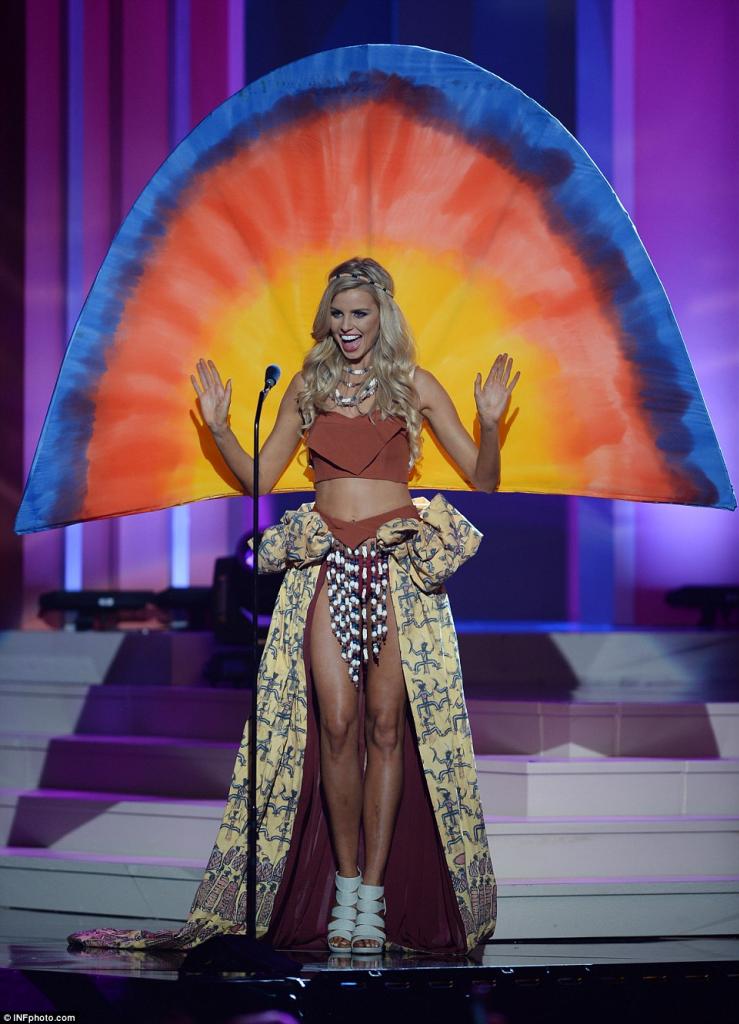
Miss Universe Australia’s National Costume this year was inspired by an “Aboriginal Dreaming sunset”:

Aboriginal Dreaming Sunset.

I was stunned to discover this costume, designed by Victorian designer Caitlin Holstock, an ‘indigenous inspired sunset,’ was granted permission from an elder of the Wurundgeri people.

Tegan Martin, Miss Australia, said “I really, really love this design and I think its [sic] so awesome that we are representing the first people in our country.”

And:

The winning design, which was decided on by the public and Sunrise viewers, featured an ochre-coloured bodice and a long open-front skirt embellished with Aboriginal prints and clay beading.

Holstock, an emerging Victorian designer, was granted permission from the Wurundjeri clan to showcase the prints, originally painted by its last traditional elder William Barak in the 1800s.

“I wanted to bring this design back to Australia’s original roots, and I really drew inspiration from that,” Holstock said.

No Award, this is not at all where I expected this post to go. (I thought I’d link to Genevieve’s annual post and then go on a ramble about cultural appropriation) Don’t get me wrong, it’s still kind of ugly and awkward, but it’s not offensive and culturally appropriative, and includes respect and acknowledgement of our first peoples, and it’s also a little fun. I would like to know what granted permission means in this case, though. Did elder Murrundindi also approve the execution of the dress itself? Or just the use of the original painting (I’m struggling to work out which piece it is) as a print? But this is a great way to interact with Dreamtime things, rather than just stealing stuff and calling it appreciation. This is so unexpected. Australia, I’m momentarily proud of you.

Hold your breath, though. This weekend is Survival Day, so there’s a post for that soon, and we’ll go back to being disappointed in being Australians again.

post-chrimbo post-racial lols

Hello No Award.

Today we would like to talk to you about Australia’s racism, or what we here at No Award refer to as Australia’s post-racial lols.

Here’s a terrible opinion piece at The Australian titled ‘No contraception, no dole’.

IF a person’s sole source of income is the taxpayer, the person, as a condition of benefit, must have contraception. No contraception, no benefit.

This is not an affront to single mothers or absent fathers, or struggling parents. Such a measure will undoubtedly affect strugglers, it undoubtedly will affect Aboriginal and Islander people in great proportions, but the idea that someone can have the taxpayer, as of right, fund the choice to have a child is repugnant.

Are you laughing? I’m laughing. In horror. This opinion piece is repugnant (thanks, pal) and also amazing, in that it accurately pinpoints who will be targeted but uses that classic argument, ‘I’m not racist’ or ‘I’ve got a brown friend who says it’s okay.’

Eugenics is never okay. Saying people who are poor can’t procreate is eugenics. Saying this policy will impact ATSI people and they won’t be able to procreate is eugenics. That it can list things that might contribute to terrible domestic situations and say the answer is contraception, rather than government services, counselling, and support; that’s eugenics. Woooo good SOSE lesson, everyone.

(Do not read the comments)

*

Channel Seven loses legal battle after ‘racist portrayal’ of tribe.

Ignore those quotation marks, as if maybe it wasn’t a racist portrayal but Ch7 sure has lost the legal battle. Because it sure was a racist portrayal.

Raffaele claimed that the Suruwaha believe that children born with birth defects or born to a single mother “are evil spirits and should be killed in the most gruesome way possible”.

“They take these poor little innocent babes out into the jungle to be eaten alive by the wild beasts or jaguars or they bury them alive, this is one of the worst human rights violations in the world,” he said.

In his federal court judgement Justice Buchanan backed Acma’s original report when he said he found the statements made by Noonan and Raffaele “would be likely to provoke or perpetuate intense dislike and serious contempt of and for the Suruwaha tribe and its members on account of their practices and beliefs”.

Here at No Award we talk a lot about representation and culture, and that’s not just because we like media (we love media). It’s because representation matters, as Buchanan J has handily summed up here. Attitudes are influenced by representation, especially when we’re talking about representation of a minority. It’s irresponsible and basically a hate crime to act any other way.

*

Reading Waltzing Matilda in Aboriginal History on Salty Hair:

I’m not really much of a Banjo Paterson fan — he comes across as a sort of discount store Rudyard Kipling, and I’ve never really liked his poetry either. But when you skim through his work it jumps out that Waltzing Matilda is a really, really odd poem. And the idea I can’t get out of my head is that it’s not really about a minor skirmish between white pastoralists at all: it’s about this country’s founding conflict between black and white.

Roll around in Australia’s racist history, my friends. Understand it. Remember it. Know that it’s still here with us, infecting us every day.

Relatedly, you should be following #blackfullafacts, even if you’re not Australian, definitely if you’re not Indigenous Australian. Some of it’s fun knowledge, some of it’s terrible knowledge, all of it’s important knowledge of Indigenous Australians.

We’re never post-racial. We’re racist, quokkas.

Happy New Year.

indigenous literacy day

As a Chinese-Australian, growing up in Perth’s outer suburbs, Steph was privileged to gain an excellent education and a sufficient reading level, that she has used to collect degrees to hang around her neck. Not all Australians have that same advantage, however, and Indigenous Australians are amongst the least able to access education and literacy resources.

The first Wednesday of September is Indigenous Literacy Day, and today is that Wednesday. Last year, Steph and Liz Got Caught Reading (wow, based on those photos, it sure was warmer this time last year!), but this year we are both at work so probably shouldn’t publically admit to being reading right now. But you can!

You can find out all about Indigenous literacy at the Indigenous Literacy Foundation webpage, but here are some key facts:

  • Indigenous homes, particularly those in remote communities, have fewer books, computers and other educational resources than non-Indigenous homes. All of these factors are linked to children’s achievements at school and in the development of English literacy skills. (Bortoli and Cresswell, 2004)
  • The development of English literacy skills is important for the life opportunities of Indigenous children and youth. Literacy provides them with ‘the necessary skills to interact within mainstream society and avail themselves of the broadest range of civic, social, educational and employment possibilities’. (Mellor and Corrigan, 2004)
  • The gap between Indigenous and non-Indigenous students emerges early. Non-Indigenous students far out-perform Indigenous students in benchmark tests for reading, writing and numeracy in Year 3 and Year 5. By Year 7, the gap has widened, particularly for numeracy. (DEET NT 2006)
  • By the age of 15, more than one-third of Australia’s Indigenous students ‘do not have the adequate skills and knowledge in reading literacy to meet real-life challenges and may well be disadvantaged in their lives beyond school’. (PISA cited in Bortoli and Cresswell, 2004, page 11).

That is bullshit, right? Help close the gap by supporting the Indigenous Literacy Foundation and Indigenous Literacy Day. There are lots of events across the country, many bookstores are donating a percentage of takings for the day to the ILF, and if you donate you’ll not only be helping our country and Indigenous Australians but also you’ll probably look more attractive.*

Donate early, donate often. No Award will love you for it. 

Track ILD events on the hashtag #ILD14


Quick Link Roundup

The always excellent Luke Pearson at Eureka Street: Making Indigenous Literacy Day Obsolete

Carla McGrath, this week’s IndigenousX tweeter: Indigenous excellence is personal, it’s individual, and it’s about education

At the Wheeler Centre: It’s Indigenous Literacy Day Tomorrow, a good summary post

At the SMH: Tiwi Islands students take part in writing workshop for Indigenous Literacy Day


*not guaranteed by NA.


the bata shoe museum and the centering of the western experience

I’m in North America at the moment, having a grand old time, visiting museums and eating at vegan restaurants and buying more things than I should. Last week I visited the Bata Shoe Museum in Toronto, which has a lot of shoes, and some interesting curation notes, including the one notation about Australia, which I have in part transcribed for you. Only in part because my photo didn’t really turn out, but you get the gist:

Among the indigenous people of Central Australia a Kurdaicha is a respected elder … the spiritual power to execute a transgressor. With this ability, the Kurdaicha is able to … with a pointing stick and secretly send some of the energy to the transgressor that will kill. The shoes the Kurdaitcha wears are … constructed out of emu feathers and kangaroo hair.

The museum was fun, but it was all like this. A complete disrespect of indigenous people, and non-European histories.

Deerskin slippers made by Wendat women in Canada impressed visitors at the Universal Exhibition in 1855. These deerskin vamps are decorated with very fine moose hair in a floral pattern appealing to the Western market.

Some questions one might ask:

  • Central Australia is pretty big and filled with a number of peoples. Is there any one peoples in particular this tradition belongs to?
  • How did you get these shoes, museum? Did some coloniser steal them?
  • I’m so glad the slippers impressed visitors! WHY ARE WE CENTRING THE WESTERN EXPERIENCE?
  • How did you get these slippers?

I love museums so much. But other problems this museum had: outdated names for indigenous Canadian nations and peoples, and a general lack of specificity around a number of cultures and countries. This is hardly a unique problem; it’s just disappointing. The colonial gaze is prioritised, and the voices of those whose lands we’ve stolen are smushed together and silenced. Great. Good job.

**

Other things at the museum: the family behind me who looked at the lotus flower shoes and said “Are these for a child? These must be for a child” despite the notes on bound feet right there; learning about crinoline fire death; the chestnut crushing clog; and the smuggler’s clog, that looks like it’s stepping in the reverse direction.

book pusher (not a white cis dude edition)

There are books that I recommend to everyone, books that I want everyone in the world to read and love, and I am always interested when people tell me their always-recommends. So I was excited at the recent open thread up at Captain Awkward looking at exactly that; and super disappointed that it was super dudely and super white. I know that’s inevitable, in its way and in the nature of our internet and our (western) society, but still, disappointment. So I made my own open thread.

What are the books that you always recommend to people, that you always want people to love, that you shove at people and wave your hands about and reread constantly? Only rule: the author cannot be a cis white dude. Trans white dude, fine. Cis asian dude, fine. Ladies, all fine. Author doesn’t conform to your gender binary? All good.

Here, I’ll start.

The Pillow Book of Sei Shonagon: the only book I took with me in hardcopy when I moved to Beijing; a book I’ve filled with annotations and which was one of the most formative books on my writing style; a book that filled me with joy the first time I ever read it. I give it as presents and I talk about it a lot, but I never lend out my copy because it says a lot about me. TOO MUCH.

Growing Up Asian in Australia (ed Alice Pung): I wish this book had come to me when I was younger, but even as an adult it resonates and is an amazing reflection on the Asian-Australian experience that should be vital reading for all Australians.

Heartsick for Country (ed Sally Morgan, Tjalaminu Mia & Blaze Kwaymullina): another must read for all Australians. I cry every time I read this book, this reflection on being Indigenous Australian and the connection between Indigenous Australians and their countries, and that feeling of heartsickness at damage to the land, at history, at racism and at everything else. ALL THE CRIES. ALL THE RECOMMENDS. This book always reinflames my desire to be the best Australian I can be, prioritising Indigenous Australians and the land and just adflkadf.

Okay, go. Your turn.

indigenous literacy day and getting caught reading

Today is Indigenous Literacy Day! This is great because it means we are talking about Indigenous Literacy! This is bad because Australia, it means we still need to talk about Indigenous Literacy.

There is a huge gap in English literacy rates between Indigenous and non-Indigenous people in Australia. A disgustingly enormous, we should feel ashamed of ourselves gap. By year 3, the gap in reading, writing and numeracy is already significant, and by the age of 15, “more than one-third of Australia’s Indigenous students ‘do not have the adequate skills and knowledge in reading literacy to meet real-life challenges and may well be disadvantaged in their lives beyond school’.” MORE THAN ONE THIRD. That is so uncool I cannot even. But Indigenous Australians should just pull themselves up by their bootstraps and Australia is totally not racist, amirite?

The Indigenous Literacy Foundation works to alleviate this disadvantage for Indigenous Australians, and Indigenous Literacy Day (every September 4) is one of the ways it gathers public support. So far in 2013, $360 000 has been donated, with 100 000 books supplied in 230 remote communities. But through Indigenous Literacy Day, we can help increase those numbers! And through the rest of the year too.

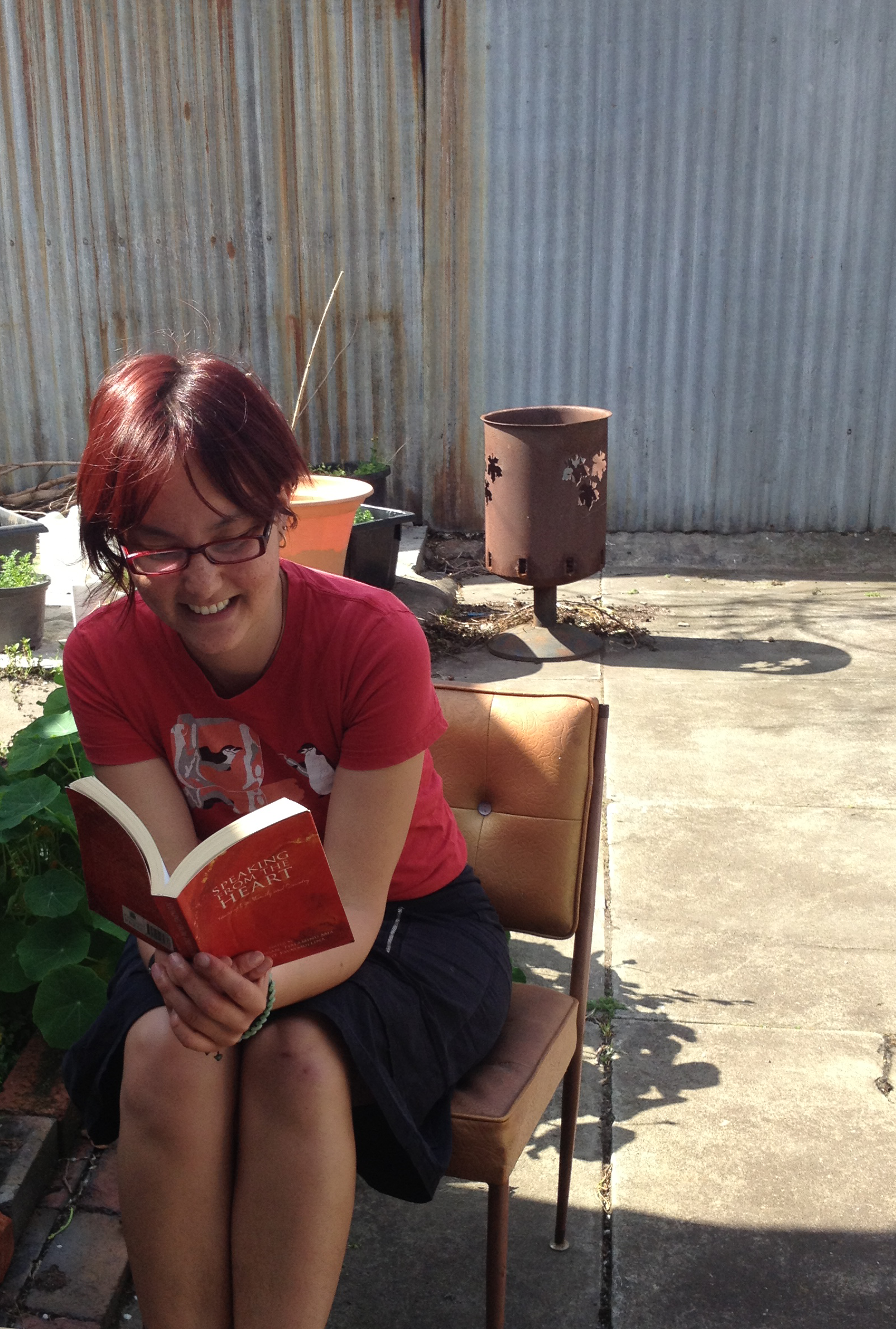
You can directly make a donation to ILF, and you can also get caught reading!  Today Liz and I are making a donation to the Indigenous Literacy Fund and we have been caught reading Speaking from the Heart (by Sally Morgan, Tjalaminu Mia and Blaze Kwaymullina), and To Say Nothing of the Dog by Connie Willis.

liz getting caught reading steph getting caught reading

A number of bookstores around the country are donating a percentage of all sales today to the ILF, so if you’re looking for a new book buy it from one of them today! (My book today will be purchased from Readings Carlton, who are donating 5% of all book sales today)

There is also a great blog post up at the Reconciliation Australia blog if you’d like some more info and stats and things.

My Island Homicide: a book review and writing someone else’s face

This is mostly a book review rather than a 101 on writing someone else’s face, so we’re going book review first, issues town second.

The Book: My Island Homicide by Catherine Titasey (2013, UQP)

[Mild spoilers to follow but nothing about the crime or anything]

My Island Homicide is the first novel by Catherine Titasey, not quite a crime novel set on Thursday Island in the Torres Strait, though I received it under the guise of being a crime novel. I would not describe it as a crime novel, though the crime is there and looms large: it’s more a slice of life, and it’s kind of fun.

There are not that many fiction books about the Torres Strait, and there are even fewer books that end happily (as it were); that have an Islander protagonist; that are this great slice of Torres Strait Life that I wanted to just keep on keeping on. I loved the minutiae in the book. I loved the Sissys getting more and more animals as Jack palmed them off. I loved everyone’s casual acceptance of maydh (a curse), and the mostly natural weaving in of the local Broken English, and I loved loved loved the protag’s mum coming home to Thursday Island and finding herself again.

And I wanted to love it as a book. But it reads weird. It was billed as a mystery (and it is), but it’s also a romance and it’s also a slice of life. On pg 138, almost halfway through the book, there’s suddenly a family mystery! At times it seems as if the pedestrian plodding of the story – not of the plot, but the pace of the book itself – is a reflection of life on Thursday Island, just going with the flow and letting it happen, but at other times it simply felt like uninspired pedestrian writing. I wish that the book had been able to settle into what it wanted to be, rather than hopping back and forth.

My Island Homicide talks about all sorts of issues, but only briefly. It mentions in passing the predominant local crimes (assault and theft) and their causes (alcohol, hunger). It makes a major plot point of the lack of education in the Torres Strait, and how easy it is to pretend like the white man is doing something when really he isn’t. It laughs away DV and assault, and it’s hard to tell when it’s poking fun with versus when it’s poking fun at the things that happen in island life. These are major issues in the Torres Strait and also incredibly damaging stereotypes when seen through non-TSI eyes, and I wish more had been done to flag this as not okay.

There’s a lot of unquestioned behaviour and acts which seem less than ideal. A white person describes the abuse they’re suffering from a black person as ‘racist,’ with no looking at the fact that it’s not possible (due to the equation of privilege + power = racism). There was some super dodgy stuff going on around the young gentleman who was unable to talk (sometimes it was implied he had suffered brain damage, sometimes just that he couldn’t speak and refused to sign) in terms of attitudes.

The book keeps making jokes at the expense of Gen Y, followed by some vegan hate, which didn’t endear it to me. (At one point a member of Gen Y declares they don’t know what Twister the board game is, which, I call nope). This is obviously less critical than the class and social issues in the Torres Strait, but also totally not cool!

Thea’s mother thinks Thea’s under maydh, and though Thea is unsure she goes with it, being treated for the curse and in the end she recovers with two answers: a western medicine answer, and a maydh answer. I love this resolution. Of course there’s a western medicine answer, because western medicine is always trying to quantify non-western traditional methods and outcomes. But there’s a ‘traditional’ outcome and solution too, and we’re never told which one is right in the context of the text. It just is.

It was really nice to read a book set in the Thursday Islands, and to be reading a book that was trying so hard to do justice to the Torres Strait and to this part of Australia’s population and culture. But it wasn’t a great book, and I can’t whole-heartedly recommend it to you. It was fun and easy to read, but it took me about 100 pages before I was actually into it. If I was handed another book by this author I would consider reading it, and I would certainly support what she’s doing (writing about Torres Strait Islander communities) but I wouldn’t leap to read it. Three out of five jiaozi.

If you want to read the book, let me know, there’s a possibility this copy is mine.

People as Food

Milk chocolate. Almond. Burnt honey. Olive. Dark olive. Peanut brown. Nut brown.

I made a list of the ways brown people are described in My Island Homicide. I recoiled at that last one, particularly as it was the last sentence of the novel, used to described Thea’s (the POV character) baby. Note Thea describes herself as light brown. (Her mother is milk chocolate)

Hey you know what we are not? We are not a menu. We are not food items or items for export or exploitation or fetishisation, even after you give birth to us, much like many of these items were (or still are). Coffee and cocoa in particular, with their slave labour connotations and the indigenous exploitation inherent within, makes these comparisons, even when unintentional, totally on the dodgy side.

It is not a compliment to describe brown characters in food terms.

Working with (and Reading) Someone Else’s Culture

This blog post is not a cultural appropriation primer or anything like that, because I don’t have the time nor the patience, and also because many other people have done that work, though maybe not from an Australian point of view. So maybe that’ll come another day.

My Island Homicide is very firmly a book set in the Torres Strait. It is on Thursday Island and Horn Island and a couple of tiny dotted islands in between. Titasey is white; though she is married to a Torres Strait Islander with TSI children, and has lived on Thursday Island for 20 years.

The POV character is a half-Islander, half-Caucasian woman whose family moved away from the Torres Strait and now she’s come back, wanting to live her stereotypical idyllic island lifestyle and maybe along the way she’ll learn some things. This worked for the most part as a frame for explaining things about the culture to an assumed non-Torres Strait audience. Thea learning Broken English was woven with shame (at not knowing it) and embarrassment and also naturally into the text, in a way that didn’t throw me out and that was awesome. Things were explained where explanations worked, but the text didn’t assume the reader was completely lacking in knowledge (except, inexplicably, when it explains that Billabong is a surf company).

You can tell, when you’re reading My Island Homicide, that Titasey is an outsider but has worked to not be an outsider. She presents this culture that isn’t hers as respectfully as she can, and though I wish it’d been better written I really appreciated that.