Pro-environment media Liz was banned from consuming as a child

Now, I love my parents dearly, and they gave me a strong grounding in the humanities and encouraged my intellectual curiosity and desire to read e v e r y t h i n g.  But they were also quite strict, not only in terms of discipline, but in the sense of the media they encouraged me to consume.

As it happens, I agree with them that a young child’s reading should be steered a little, and an older child should be encouraged to recognise discuss the ideas and morals behind a piece of media.

It’s just that my parents were a little bit idiosyncratic.  They belong to a right-wing Catholic tradition which, while strongly anti-capitalist, is coincidentally in lockstep with certain capitalist ideas.  Specifically, the environment.

Guys, I was raised by climate change deniers.

I mean, back then we called it global warming and talked about the hole in the ozone layer, but the point is, my parents didn’t believe in it.  (These days, they’ve conceded that climate change exists, but not that it’s caused by human activity.)

Suffice to say, I’ve been looking forward to the Pope’s Encyclical on the environment with no small amount of curiosity and schadenfreude.  And in honour of that Encyclical (probably not a phrase No Award will get to use very often), here is a list of media I was either forbidden or strongly discouraged from consuming:

Possum Magic by Mem Fox

I had a copy, and I vaguely recall Mum loving it, but Dad was not a fan.  Native animals = STEALTH ENVIRONMENTALISM.

Snugglepot and Cuddlepie by May Gibbs

This Australian classic is problematic in many ways, but what gave my parents pause was the knowledge that Gibbs (1877-1969) was something of a socialist and early environmentalist.
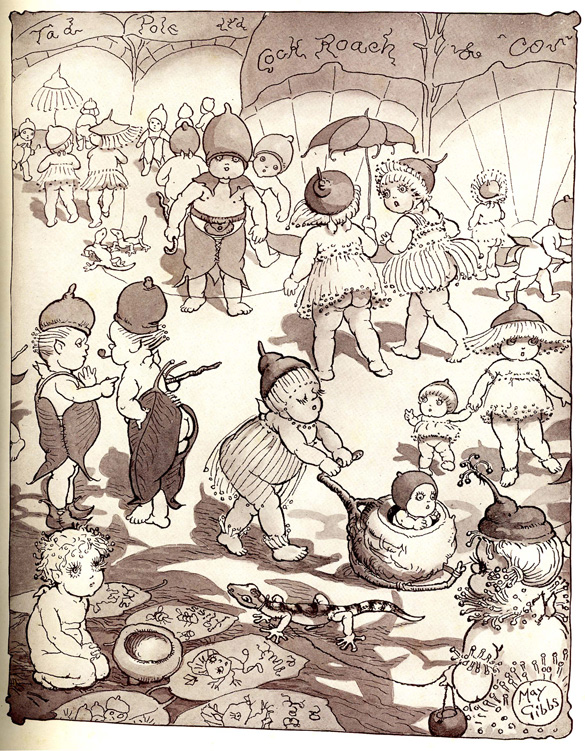
An illustration from Snugglepot and Cuddlepie
I don’t think I appreciated how WEIRD these books were.

They discussed the problem (within earshot of me?  Was I a childhood eavesdropper?) and decided that the books weren’t likely to cause any damage to my long-term development.  Which, indeed, they didn’t.  Only confusion.  So much confusion.

(Steph’s aside: No Award will be publishing a post on the issues with Snugglepot and Cuddlepie in the near future)

Where the Forest Meets the Sea by Jeanie Baker

I think I need to find a copy of this book, because clearly I didn't appreciate the art enough as a child.
I think I need to find a copy of this book, because clearly I didn’t appreciate the art enough as a child.

1988 picture book about a boy visiting his grandfather in Far North Queensland, admiring the beauty of the rainforests, musing on their history as a home to Indigenous peoples, and wondering, “But will the forest still be here when we come back?”

It occurs to me that my parents probably disapproved of this, not just because of its environmental message, but because it’s specifically critiquing the pro-development policies of the immensely corrupt Bjelke-Petersen government, of which my mother was a strong supporter, and which, even now, she still remembers fondly.  (Note: by coincidence, she didn’t actually live in Queensland during the Fitzgerald Inquiry.)

I was an early reader, and grew out of picture books pretty fast.  And by the time I was into chapter books, I was … not precisely self-censoring, but mentally distancing myself from any pro-environment/pro-sustainability plots I came across.  Suspending disbelief, basically: “I know the environment is nonsense, but just as I believe in faster-than-light-travel when I watch Star Trek, I’ll put up with this for now.”  Chapter books I distanced myself from in this way:

My Sister Sif by Ruth Park, already discussed here at No Award.

The Lake at the End of the World by Caroline MacDonald, in which Australia is devastated by chemical bush clearance.  The heroine’s parents had a long scene where they explained that, in their youth, “Conservation became a dirty word” because everyone was getting rich, and by the time people realised the land could no longer support (much) human life, it was too late.

“Typical left wing propaganda,” I didn’t think at the time, not having a well-developed political vocabulary, but that was my nebulous and unformed feelpinion.

These days, I think about that scene a lot, for some reason.  I bought a secondhand copy last year and fully intend to do a No Award post on it one day.

But it wasn’t just books my parents were wary of!  It was television!  And song!

WARNING: Earworms dead ahead!

This is a terrible song, and was therefore much beloved by my year five music class.  My parents didn’t share the affection, and not just because they have ears.  They were very pro-woodchipping on the grounds that timber and paper mill staff are completely incapable of training for any other work, and the entire economy of Tasmania would collapse without the tree destruction industry.

As it happens, the value of the timber industry was vastly distorted by government subsidies, and it employed far fewer people than even the unions realised, but that all came to light later.

Why is Captain Planet so much bigger than the Planeteers?

Good reasons to hate Captain Planet and the Planeteers:

  • the theme song
  • the tokenistic nature of its multi-ethnic group of smiling young people
  • terrible puns
  • Wheeler is the worst
  • what kind of power is heart anyway?

Reasons my parents hated Captain Planet and the Planeteers:

  • it was produced by Ted Turner
  • who was/is(?) married to Jane Fonda
  • something something Hanoi Jane?
  • please note, my parents were children when the Vietnam War ended
  • environmentalism
  • ZOMG PAGANISM
  • there’s an episode about population control
  • Mum is very anti-superhero
  • terrible puns

Reasons I loved it and watched it whenever I could, even though I knew it was terrible:

  • like, two-thirds of the cast were Star Trek: The Next Generation actors
  • I wanted Wheeler and Linka to kiss

Teenage Mutant Ninja Turtles

Okay, this one’s stretching it a bit — my parents didn’t know it often had environmental messages, and neither did I.  It was banned for containing “imitable violence”, ie, martial arts.

I don’t know why my parents were so concerned about this, given that the only television I was interested in imitating at this time was Star Trek: The Next Generation, but there you go.  They also forbade Power Rangers.  If it had been around when I was young, they would have also banned me from Avatar: The Last Airbender and Legend of Korra, too.

The Adventures of Blinky Bill

The original Blinky Bill stories (about a cheeky koala and his friends) were published in 1933, and had mild conservation themes.  The Adventures of Blinky Bill, the animated series of the ’90s, ramped these themes up, the series opening after Blinky’s habitat is destroyed by humans, forcing him and his friends to befriend the Dingos.

Mum and Dad thought it was strange and terrible that modern political issues were being forced into light entertainment.  Something something something Puppies.

FernGully: The Last Rainforest

Such an amazing, terrible movie.

This is an odd one — I wasn’t forbidden to see this (in fact, Dad took my brother and I to the movies, and really enjoyed it!), but I was convinced I’d get in trouble just for asking to see it.  I got the novelisation via a Scholastic book fare, and it came with a poster that I put up behind my door, where I was sure my parents wouldn’t see it.

(A few years later, I did the same with a pair of ATSI art posters I got from school as part of Reconciliation Week. Apparently I was quite secure in my belief that my parents would never enter my room, close the door behind them and then look at the door.)

Anyway, I was really into FernGully at the time it came out, and was quite amazed when I recently learned that (a) it’s known outside Australia and (b) its international audience is largely unaware that it’s set in real Australian places.  IDK, maybe because all the fairies are white and European-looking?

A few days ago, I mentioned the leaked Encyclical to Mum.

“What is it about?” she asked.

“Climate change, and the need to take responsibility for addressing it,” I said.

“Oh.”

Reading the Hugos: The Three-Body Problem by Li Cixin, plus Kevin J Anderson

I loved this book. I inhaled it. I spent two hours sitting on the floor of a cold, empty house, reading it as I waited for a removalist that never came, and I don’t begrudge that time.

And yet, there is a plot-twist so absurd that if it had come from an Anglophone author I would have asked if he was taking writing advice from Rupert Murdoch.  The male protagonist is bland; his family appear for one scene and then vanish, despite numerous developments that would directly affect them; I have doubts about the earth-based worldbuilding, which doesn’t stand up to scrutiny.

But I loved it.

It helps that I read the translated version.  A novel in translation can be challenging to read: phrases that felt natural in its original language become clumsy; the dialogue is nearly always stilted.  2013 saw me reading a lot of Japanese and Scandinavian crime fiction, and I couldn’t shake the feeling that my vision of the text was distorted, like I was wearing semi-opaque lenses.  I couldn’t quite bond with those novels.

With The Three-Body Problem, I appreciated that distance, because it kept reminding me not to judge it by the standards I’d apply to western writing.  That helped me tolerate — and even enjoy — the long expository scenes.  It also meant that when I hit the absurd plot twist, I didn’t write it off as hilariously bad right wing propaganda, the way I would if a western author presented such an idea with a straight face.  I’m not really up on contemporary Chinese politics, so I can’t put his work into a proper context.  I had to take it as it is, and that was refreshing.

(I did recognise one political thread: a debate between aliens about the value of totalitarianism versus democracy when it comes to the long-term survival of a culture.  Basically the only thing I know about current Chinese politics is that that is a heated issue.  Cixin himself doesn’t offer any easy answers.)

Probably part of the reason I loved it is that much of the novel is set during and immediately following the Chinese Cultural Revolution.  Reading reviews, I’m quite surprised at how little American readers seem to know about this period — several even seemed to think the setting was a Communist revolution.

I have an advantage, in that my mother studied Mandarin at university in the late 70s/early 80s, at a time when the department was basically run by Maoists.  I scribbled in her copy of the Little Red Book when I was tiny, and I’ve always been really interested in the Cultural Revolution.

One of Cixin’s themes is that everything can be distorted by politics, including the seemingly immutable facts of the universe, and the Cultural Revolution is a perfect example of how that works.  (This also makes my instinctive desire to put his work into its political context seem all the more ridiculous.)

I’ve heard that the second volume in the trilogy is more character-driven, and I really hope that’s the case, because the male protagonist here was passive and quite dull.  (As opposed to the female lead, but to say more would be a spoiler.)  But I did love The Three-Body Problem — it had lots of things I don’t like, yet it executed them all on such a scale, and with such confidence, that I was drawn in despite myself.  I thoroughly enjoyed reading it, even when I was texting Stephanie to tell her that [SPOILERS] are really [SPOILERS] for a [SPOILER].

At this point, I think The Three-Body Problem is likely to get my first preference in the ballot, and it is absolutely deserving.

Kevin J Anderson’s The Dark Between the Stars, however, is going to go below No Award.  That, too, is deserving.

Obviously Three-Body was going to be a hard act to follow, but The Dark Between the Stars had numerous strikes against it.  I read six chapters (remember, I said I’d give a book three chapters to convince me, so really, I went above and beyond).

I’d complain about Anderson’s two-dimensional female characters, but actually, the men are no better.  I didn’t much care for his depiction of a bitchy, career-driven wife and mother and the husband who kidnaps their son and escapes her.  (It’s not that these things don’t happen, it’s just the complete lack of nuance.)

I had even less time for the clumsy writing, where characters take several chapters to figure out things that were obvious to the reader from the very first scene.  I have no idea what the plot was going to be, or the history of this universe — which I believe is one Anderson has written in before — because the writing was so terrible, my brain just went NOPE and shut down.

An animated gif of an octopus scuttling across the field, the words

That octopus really speaks to me.

Now I’m reading The Outback Stars, which is also terrible, and yet really interesting?  ABORIGINAL RUNES.  But also a completely dysfunctional stores department on a starship, which is (a) interesting; (b) relevant to my peculiar interest in workplace issues; (c) a side of milSF we don’t often get to see.

I mean, that aspect is still terrible (fake rape claims!  All the Japanese officers are either Yakuza or prostitutes!  The space navy is allegedly based on the Australian navy but has US-style rules against fraternisation!), plus I really don’t care for the romance.  And yet I keep reading, because [see (a) through (c)].

Stay tuned for a No Award post about the trilogy.  It’s quite something.

Wednesday reading (on Thursday)

Yesterday was just very busy, okay?  On the upside, the old house is now clean and empty, with the very last round of stuff to be picked up this evening.  I guess I can take time out of reading Free Comic Book Day stuff on Saturday to drop off the keys.

Books Recently Read

The Life and Death of Harold Holt by Tom Frame

This wound up being a bit of a slog, which is what happens when you have a subject who’s basically a decent person who avoided major scandals and kept his private life to himself.  But it didn’t destroy my illusions about Holt being quite a good sort, and made me extra-sad that the Liberal Party has become everything that Menzies and Holt wanted to avoid.

Also read: four out of the five Hugo-nominated short stories.  But you all knew that, because that post was the second-most visited on this blog ever.  (The first: the one where I spoil the ending of the Australian Secrets & Lies.  IDK, it got picked up by an entertainment site or something.)

General consensus on that post seems to be that I’m an easy grader.  And I agree; I think I was trying too hard to not seem like I was rejecting stories just because they were on a slate I strongly disagree with.  So I’m inclined to unearth some of the nominated stories of recent years, read those, and reconsider my choices for this year.

Currently reading…

The Three-Body Problem by Liu Cixin

A nominated novel, of course, and a very good one so far.  I had heard it described as didactic and heavy on the exposition, which are two of my least favourite things ever in fiction — Stephanie, back in our Ann Leckie discussion, was curious to see how I’d cope with Chinese SF — but so far, so good?

But then, I really need some of the scientific exposition Liu supplies — I don’t have much of an education in science at all, and I just can’t get my head around physics whatsoever.  I struggled with the science in Rosemary Kirstein’s The Steerswoman — note to self, make Stephanie read that series so we can talk about it — so the contemporary/near future/recent past stuff is way over my head.

I’ll do a proper post about The Three-Body Problem when I’m finished.

What I’m reading next…

I have the nominated Kevin J Anderson novel checked out from the elibrary.  I don’t expect it will be difficult.  (Not an insult — I love good, solid storytelling.  I breezed through Leviathan Wakes when that was nominated, and loved it.)

I also have The Outback Stars by Sandra McDonald checked out.  I hope it’s good, but Americans writing about Australian Indigenous cultures is always rich with the potential for grossness.  Either way, I’ll probably get a post out of it.  I think Steph is also going to read it, so maybe we can make it substantial.

Liz reads the 2015 Hugo-nominated short stories

I thought that Project: Read As Much As Possible And Vote By Merit would be easier if I didn’t sit around waiting for the voter pack.  Accordingly, I’ve reserved a bunch of the nominated novels at my elibrary of preference.  As for short stories, all but one are available online, and I’ve started reading and organising my preferences.

(I really love preferential voting.  I like to have my senate ballots prepared weeks ahead of an election.  Of course I vote below the line.  SO GREAT.)

The stories!

“On A Spiritual Plain” by Lou Antonelli

It’s not clear whether this version on Antonelli’s blog is the same as that published in Sci Phi Journal #2.  For the sake of my embarrassment squick, I hope not.  The blog version’s dialogue is full of run on sentences, which (aside from being grammatically problematic) makes it a bit hard to read.  I dearly hope it’s a first draft.

Anyway, it’s a story about an alien planet whose magnetic field creates ghosts of the dead, and a human chaplain who has to deal with the first human ghost.

The concept is mildly interesting, the execution mildly frustrating.  An example:

Ymilans believe–as do many Terran religions–that each individual has a spark of an eternal extra-dimensional over-arching consciousness that is imbued in each of them at birth and ultimately returns to a higher dimensional plane when the physical form is no longer viable. I told him we call it the “soul”. They also know–I won’t say believe because the evidence was obvious on Ymilas–that while alive we develop an electromagnetic imprint as a result of the experiences of life that survives after death. I told Dergec an ancient Terran religion had the same belief, and in fact built elaborate pyramids and tombs filled with personal belongings to keep those spirits happy.

I don’t know that the Egyptian concept of the ba had anything whatsoever to do with electromagnetism, but the Ymilan religion — where ancestors remain part of a person’s life after death — has more to do with Chinese beliefs anyway.  Beliefs which are contemporary and actually practised right now in the actual real world, and aren’t in fact alien in any way whatsoever.  That the author doesn’t seem to realise this is … well, it shows a certain carelessness in research, or a lack of general knowledge, or maybe a cultural arrogance?

I found the writing amateurish and the central idea poorly executed.  This is going above No Award, but only because it’s not actually insulting.

“The Parliament of Beasts and Birds” by John C Wright

This is actually insulting.  If Bible-quoting animals debating their place in the world after the extinction of humanity is your idea of a good time, this might be the story for you.  If you thought that The Last Battle was amazing but needed to make its metaphors more obvious, this is definitely for you. If you like interesting, original and insightful fiction, I’m sorry, you will have to move on.

Wright is trying very hard to incorporate Catholic theology into this story, but the result frankly makes me a bit embarrassed to share a religion with him.  It takes a very talented writer to pull off explicitly Christian references in what appears to be a secondary world fantasy setting, and John C Wright is no C S Lewis.

Going below No Award.

(A note: both of these short stories have been posted to blogs but formatted for paper — indents, no paragraph spacing, etc.  Guys, don’t do that.  It’s fine for a book or ereader, but in the context of a website, it’s just hard to read.  And neither story has been worth the eye strain.)

“Totaled” by Kary English

Finally, some formatting I can read!

And this is the best story so far, which is not to say it’s not derivative in concept and execution, and kind of sexist in its portrayal of the sandwich-fetching grad student hated by the heroine.  A scientist working on the preservation of living tissue after death is killed in an accident, her brain is preserved, but she only gets a short afterlife before decay sets in.

The idea’s been done a bunch of times, but this gets a neat ZOMGObamacare twist: preservation is dependent on your monetary worth.  Death panels, guys! It’s weird and specifically American, but hey, this is an American story.

I’m pretty lukewarm overall, but it was readable (in every sense of the word) and largely inoffensive.  I’m probably going to give this my first preference.

“Turncoat” by Steve Rzasa

Look, the integration of human, AI and spaceship is not a new idea.  Anne McCaffrey wrote The Ship Who Sang before I was born; Ann Leckie gave the concept a powerful new twist, oh, just a couple of years ago.

I guess Rzasa deserves some praise for claiming the subgenre for People Who Aren’t Named Ann(e), but it’s just soooooo boring.  A whole paragraph about the protagonist’s hull and weaponry?  *snore*

This feels like the author read Ancillary Justice and went, “Yes, but what this really needs is less ambiguity and a really boring main character.”  It’s competently written, which is sadly high praise for the short story category this year, but that’s all I can say.

This whole “vote by merits” thing is really hard, guys.  Like, I don’t think that this deserves an award.  And yet two-fifths of the category is SO BAD that the overall standard is so low, I can’t in good conscience NOT place it second on my ballot.

The fifth nominated story is “A Single Samurai” by Stephen Diamond, which doesn’t appear to be available online.  That will have to wait for the voter pack.  Until I’ve read it, my ballot currently looks like:

  1. “Totaled”
  2. “Turncoat”
  3. “On A Spiritual Plain”
  4. No Award
  5. “The Parliament of Beasts and Birds”

(I keep typing “The Parliament of Beats and Birds”, which I presume is about DJs and HORRIBLE AVIANS gathering together to work out their place in the universe after the fall of non-DJ humanity.)

Wednesday Reading

I have successfully moved house, and some time this year, the old house will be clean and empty, and I will have functional, fast internet at my new place, and won’t be a massive ball of stress.

In the meantime, just about the only thing I have time for is reading as I wait for buses and take trans between home, work and the old place.  So here is a post, based on a meme popular on my Dreamwidth circle in 2014, that I will try to make a regular thing.

Books Recently Read

Sense and Sensibility by Jane Austen with annotations by David M Shapard

S&S has never been my favourite Austen novel, but a friend was recently dumped by her boyfriend (Kickstarter to set him on fire, btw), and coped by going the full Marianne Dashwood, ie, not coping at all.  And that got me thinking how this is one of Austen’s novels that translates particularly well to the modern day, and wondering how that would be done.  Luckily, I had the annotated edition already on my Kindle.

Anyway, the great thing about S&S is that, while every single literate woman on the planet thinks she is Lizzy Bennet, there’s a bit more variation in the question of whether or not you’re an Elinor or a Marianne.  (I’m an Elinor, obviously.)

What struck me on this read-through is that Mrs Jennings, one of Austen’s most ridiculous characters, is also extremely kind, and part of Marianne’s growth is in realising this and valuing her for it, whereas previously she looked down on Mrs Jennings for being vulgar and overly familiar.

Following the book, I’ve acquired copies of the 1996 movie, the 1971 miniseries and the 2007-ish miniseries.  One day I might even have time to watch them.

Still thinking about a modern S&S, and wondering what and who Colonel Brandon would be in a contemporary Australian setting, I read…

Uncommon Soldier by Chris Masters, an account of the training, duties and general experiences of the contemporary Australian soldier, with particular emphasis on service in Afghanistan.

This was an interesting read, frequently made unnecessarily confusing by getting bogged down in acronym soup.  The earlier chapters, about training, including the professional paths and cultures for recruits, ADFA graduates and Duntroon cadets, was more interesting to me, and easier to follow, than the later chapters based on Masters’ experience as an embedded journalist in Afghanistan.

I definitely learnt a lot more about Australia’s role in Afghanistan, and while I am never going to be comfortable with a situation where civilians are so vulnerable, I came away with the impression that the Australian forces were more professional and culturally sensitive than, say, the US.  But also that Masters — probably because he himself is a white Australian man — wasn’t in a good position to see the times where that was not the case.

For similar reasons, I felt that Masters didn’t spend enough time discussing the experiences of female soldiers and officers, or of any military personnel who weren’t straight, white and male.  (Although homsexuality is legal in the Australian defence forces, he notes that homophobia is rampant, to the point where a commando only came out at his retirement party.)

In short, an informative but disquieting read.

Currently reading…

The Life and Death of Harold Holt by Tom Frame.

Saying “May the Sea Return Him” is all very well, but I realised last week that I don’t actually know very much about Holt as a person or politician, save that he was more progressive than he’s often given credit for, and that his life was less interesting than his death.

I’m only 15% into the book, but Frame makes a good argument for Holt’s life being, in fact, reasonably interesting — his parents divorced, his father married a woman Holt himself was courting — but also very private, with few records remaining.  Of Holt’s politics, it’s too soon to say; like most Australian conservatives of the 1940s, he was primarily concerned with finding a democratic balance between socialism and fascism, and upholding the glory of the British Empire.

On entering Parliament, Holt was 27 years old, the most eligible bachelor in the House of Representatives.  One highlight is his thoughts on women and fashion:

“I don’t like women to dress so conspicuously that they make a man feel hot under the collar to be seen with them but on the other hand, they should not be too inconspicuous.  Women seem to be most charming in summer frocks, plain, cool linens, prints and all that sort of thing. Perhaps it’s the prettier colours that appeal to me.  I like pastel shades very much and all the ‘off’ colours, dusty pinks, blues, greens and so on.  They are more subtle.”

He concluded that most women ‘dress to make their sisters sit up and take notice’.

My thoughts:

1. Thanks, Harold, but I’ll dress as conspicuously or otherwise as I want.

2. More male politicians should share their feelings about pretty colours and pastels.  It’s nice.

3. It’s depressing how refreshing it is to see a bloke point out that women mostly dress for themselves and each other.

What I’m reading next…

It’s Hugo season!  Suffice to say there have been some issues this year, and very little of what I nominated made the short lists.

I’ve been chewing over my voting intentions for a couple of weeks, and while I was initially tempted to vote No Award for any Puppy Slate works, I’ve decided that it would be fairer to read everything I can and vote on the merits.

Accordingly, I’ve resolved to read every short story, at least three chapters of every nominated novel, and at least 25% of every novella.  And I’m going to blog about them here.  Look, we named this blog for maximum confusion/hilarious trolling, it’s practically made for this type of thing.

I’ve borrowed The Three Body Problem from the library, requested the Kevin J Anderson novel, and made a note of where I can get the other nominated novels. Short stories etc can wait for the voting pack.

I’m quite excited to read The Three Body Problem, because I’ve wanted to read it since I first heard it was being translated, and until recently the ebook was going for about AU$30.  But I’m also nervous, because I hear it’s quite didactic, which Stephanie says is a feature of Chinese literature, but also something I don’t much care for.  Fingers crossed!

I’m hoping that I’ll like it enough to rank it above Ancillary Sword, which I enjoyed but found inferior to Ancillary Justice.  I do not like to agree with the Sad/Rabid Puppies on anything, but I did feel like Leckie prioritised exposition about social justice over plot in that book.  Unlike the Puppies, I’m quite pro social justice, I just like a bit of subtlety, or at least originality.

I also just became aware of Sandra McDonald, an American author with an SF series “based on native Australian culture”, according to Amazon.  I like bits and pieces of the blurb, but the potential for a trainwreck is also pretty high.  Again, if I have thoughts, I’ll share them here.

Reasons I am not applying to rent your flat

I am flat hunting.  I need an affordable one-bedroom flat, preferably with fly screens in the windows and space for at least one of my eight bookshelves.  Near public transport, preferably also within cycling distance from the city.  And it has to accept cats.  And — I realise I’m asking a lot — bonus points if it’s not totally grotty.

At first I thought I was being too fussy, but, you know, I have to live in this place.  I’ve had homes so hideous I cringed every time I came home, and I don’t want another one.

On the other hand, it’s a really rough market for renters.  I can’t afford to stay in my beloved inner-north, so I’m shifting to the less gentrified inner-west.  But even there, way too many places are just … imperfect.

And so, to all the landlords out there, here are some of the reasons I haven’t jumped through hoops to inspect your properties:

  • It is clearly haunted.
  • Inspection time coincides with the deadline to lodge important court documents.
  • Why would you even schedule inspections to take place during work hours?  This wasn’t happening last time I was house hunting.
  • This retro kitchen would absolutely be worth missing work for, except for the no pets rule.
    This retro kitchen would absolutely be worth missing work for, except for the no pets rule.
  • Pretty sure a serial killer has been burying bodies beneath the porch.
  • Your real estate agent’s Instagram filter failed to disguise the rust stains in the bath.
  • It is 80 million miles from public transport.
  • It is too small to swing a cat.
  • Look, cat swinging just happens to be one of my hobbies, and I’ll thank you not to judge.
  • Sometimes the cat buries his teeth on my arm, and I swing it around wildly trying to dislodge him.  Nothing weird here at all.
  • I’m quite certain I’ve transcribed search warrants being executed on this property.
  • Fairly confident that’s an unmarked police car in the foreground of the exterior photo.
  • My hipster chic aesthetic doesn’t extend to keeping the washing machine in the living area.
  • Likewise, I don’t like my fridge so much that I want to hang out and watch The X-Files with it.
  • There is a strong possibility that the carpet has mind control powers, and I don’t want to place myself at risk of being psychically possessed by a green shag carpet.
  • I'm into the concertina room divider, but the carpet's like a Rorschach test for your feet.
    I’m into the concertina room divider, but the carpet’s like a Rorschach test for your feet.
  • Nine out of 10 crime scene cleaners rate it their favourite job site in Melbourne.
  • The real estate’s use of the adjective “humble” is worrying.
  • Something about the gang signs spraypainted on the fence is off-putting.
  • I’m yet to embrace the meth house aesthetic.

Tomorrow I’ll be at the Abbotsford Markets, trying to sell some of the contents of those eight bookshelves.  But next weekend, unless I get lucky, I’ll be out there.  Again.  Inspecting unfamiliar houses, smelling unfamiliar smells, and wondering what it takes to find a not-hideous flat in Melbourne.

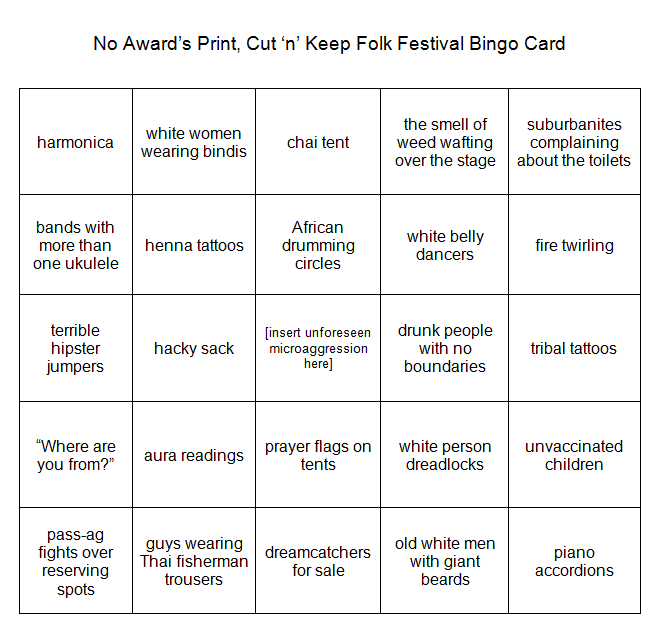
No Award’s Print, Cut ‘n’ Keep Folk Festival Bingo Card

This weekend sees Stephanie heading off to the Port Fairy Folk Festival.  Liz, who would sooner eat her own eyeballs than listen to folk music, is going to stay home and spend some quality time with her cat.

(The cat also hates folk music.  And, for some reason, Radiohead.)

Now, regardless about your feelings towards the music, it can’t be denied that folk festivals attract a certain … demographic.

Hippies.

Bless their peace-loving hearts, but the only thing worse than a hippie is an upper-middle-class suburban hippie wannabe.  Think the Morgendorffers.  Think Homer Simpson’s mother, although she was actually pretty great and who wouldn’t leave Grandpa Simpson?  Yes, all of our examples are cartoons, but that doesn’t change the fact that any folk festival is going to contain at least some of the following:

No Award apologises that this bingo card is presented as an image, and promises to learn to code tables.

Something something lyrics linkspam

What lies beneath: Sydney gets the southern hemisphere’s first body farm Australia

We Need To Talk About Fairy Bread – Please note that Stephanie has chosen to take “you can’t gentrify fairy bread” as a challenge. But also, what counts as gentrification? As a lower-middle-class person from Perth’s dodgy suburbs, is it gentrification if I take my favourite childhood snack and change it up?

The Future’s Been Here Since 1939: Female Fans, Cosplay and Conventions

Favourite pieces from this weeks’ AusPol: Abbott coins “doing an Abbott” to mean making a mistake; on the impacts of Sir Prince Phillip; on Adam Giles and the NT.

New site Future Black, decolonising design in Australia’s built environment.

One for stationery nerds and people with Khe Sanh earworms: The illustrious history of the yellow legal pad

The article title is misleading, but about how talk of Polyamory is white, when Polyamory isn’t. (Surpriiiise)

MAPS of the countries most vulnerable to climate change.

Notes on the Melbourne Free Trams. We were just going to link this with no commentary, but it turns out Steph has some feelings. The entirety of the City of Perth is a Free Transit Zone (FTZ, for those from Perth), and it a) takes in a huge chunk of the tourist attractions, and b) is used a lot by workers who drive to work, and then would ordinarily take taxis or cars between meetings at different ends of the CBD. The FTZ and the ubiquity of the buses, as well as the existence of the Cats (buses that exist solely to do laps of different sections of the CBD), means they do get used. And don’t end up with the overcrowding issue that Melbourne’s CBD trams were already experiencing. I don’t have a solution, I’m just saying.

Attitude round-up

Last year, the ABC axed RampUp, its excellent site for discussion around disability.  A short time later, comedian/writer/disability advocate/all around hero Stella Young passed away.

That quote, ‘the only disability in life is a bad attitude’, the reason that’s bullshit is … No amount of smiling at a flight of stairs has ever made it turn into a ramp. No amount of standing in the middle of a bookshelf and radiating a positive attitude is going to turn all those books into braille. – Stella Young

Now, the ABC is airing New Zealand show Attitude, a series of short documentaries about people with disabilities.  There is also also a crowdfunding project for an Australian version.

Unfortunately, Attitude doesn’t seem interested in prioritising the experiences and views of people with disabilities.  Here’s a round-up of posts about why it’s not great.

The problem with ABC’s new disability series, “Attitude”

Disability voices have to be heard to change attitudes

Disability media and Attitude TV — Carly Findlay discusses her hopes for the Australian version

Attitude series and the power and responsibility of portraying disability on mainstream TV

More favourable:

Graeme Innes, formerly Australia’s Disability Discrimination Commissioner, writes in favour of Attitude.  

I respect Innes a lot, but I strongly resent that Attitude seems to be entirely aimed at an able-bodied audience.

A different kind of attitude

(note: this post talks a lot about the so-called third world, and basically trades disability inspiration porn for poverty inspiration porn)

For my part, the whole concept of “attitude” is fraught.  My rheumatologist constantly praises me for improving my chronic conditions by having a good attitude, and it makes me quite uncomfortable.  It’s easy to exercise and practice self-care when you have a full-time job, a functional bike and access to an affordable public swimming pool.

And it’s distressing to realise that you’re being classified as a Good Patient just because you have these advantages — while, for example, your mother is classified as a Bad Patient because she has no energy to exercise, no access to a pool, and the public rheumatologist who sees her intermittently assumed she was an alcoholic.  (She’s a teetotaller.)

And I don’t even have that great an attitude.  “Yes, I have multiple chronic illnesses.  It’s very dull.  Let’s get on with it.”  That’s me on a good day.  In a bad week, I can and will bore everyone I know with my incessant complaints about being in pain — but my rheumatologist doesn’t see that.

Adam Baldwin/Supanova/GamerGate round-up

Adam Baldwin is an actor, best known for Firefly, who also holds some very conservative opinions, coined the term “GamerGate”, and facilitated the doxxing of game developer Zoe Quinn.  Here’s a handy round-up of his behaviour.

Supanova is one of the very few pop culture expos in Australia. Adam Baldwin will be a guest at the Sydney and Perth events in June. Suffice to say, lots of people are unhappy about this.  There is a petition to revoke his invitation.  (You should sign it!)

People discussing the matter have been doxxed, abused, driven from their preferred social media platforms, and generally treated badly.  (Liz got off lucky with some rather tedious mansplaining.  Nice try, guys, but I work with lawyers.)

Supanova, meanwhile, has engaged in some epic fence-sitting, also some general rudeness, also tried to manipulate a feminist comedian into supporting them. (The original article, published in Fairfax’s Daily Life, has been removed; the link is to an archived version.)

A summary.

The thing is, this isn’t about Baldwin’s politics.  Hell, Star Trek: Voyager‘s Roxanne Dawson quotes Bill O’Reilly on her Twitter, but I wouldn’t say she’d be an inappropriate guest at a nerd convention.  It’s Baldwin’s behaviour, and that of the people he supports, that’s the problem here.

As a small, fat, feminine and female nerd, I would not feel safe at an event as attractive to misogynist bullies as Supanova with Baldwin as a guest.  And I wouldn’t want to give money to a company that engineers that situation.

Baldwin himself is easy to ignore and avoid — I’ve attended a whole lot of Supanovas, and accidentally encountered a guest once. But the men he attracts?  Most are just keyboard warriors, mired in self-hatred, lashing out at women to compensate for their problems.  But as Brianna Wu’s experience would attest, some are dangerous.  And Baldwin feeds them. That’s why I don’t want Adam Baldwin to be a paid guest at Supanova.

Linkspam with you in the comfort of a lounge room in suburbia

The Vine counts down ways women ruin everything.  With bonus puppies!

Peta Credlin has become a lightning-rod for discontent driven by fear

We at No Award are quite intrigued by the fact that, when Julia Gillard was an unpopular prime minister with a tough, unpopular male chief of staff, she was demonised, whereas Tony Abbott is an unpopular prime minister with a tough, unpopular female chief of staff … once again the woman is demonised.

[Disclaimer: If the current Australian government was the subject of a satirical ABC comedy in the style of The Thick of It — and how we wish that were true — Peta Credlin would be Liz’s problematic fave.  She’s not quite Malcolm Tucker in a skirt, but only because she’s not famous for creative swearing.]

Skills shortage for Auslan interpreters

Melbourne Nylex clock turns on, makes mysterious return to life

Nylex Clock/Skipping Girl Sign OTP, y/y?

A Meat Processing Professional Reviews Snowpiercer

Paying to Work: The Perth Film Network and The Action Film Plan

The Perth Film Network’s latest venture, called “The Action Film Project,” is what appears to be either a particularly exploitative form of crowd-funding, or an unethical business scheme masquerading as a golden opportunity for aspiring filmmakers.

Satire and Scandal: Revisiting Frontline

Interesting long reads

Cicada: Solving the Web’s Deepest Mystery

Or, an episode of Elementary and an amazing premise for a YA novel in one!  Link nicked from Natalie Luhrs of Pretty Terrible, but shared here again because it is AMAZING.

Can the Next Generation of Morticians Breathe Life Into the Death Industry?

Welcome to a Liquid Modern Queensland & Why Tony Fitzgerald’s in Despair

A dense but rewarding discussion of corruption and neo-liberalism in Liz’s home state of Queensland.

And if it’s not region-locked for you, Liz totally recommends Chris Marsters’ The Moonlight State, the 1987 Four Corners expose that helped bring down the Bjelke-Petersen government.  It has some gratuitous strip club footage, but is brilliant and valuable nonetheless.

Why People Hate Tess Munster (And Other Happy Fat People)

People at least as deserving of knighthoods as Prince Philip

On Monday, Invasion Day (though you may know it as Australia Day), we woke to the news that Prime Minister Tony Abbott had looked at all the Australians deserving of recognition for their achievements and contributions to the nation … and bestowed a knighthood on Prince Philip, a one-man-argument for a republic.

Liz said, “Huh.”  Then she had breakfast and a cup of tea and checked again, and it was still not a joke.

What’s beautiful about Abbott’s choice is how Australians from all walks of life, across the spectrum of political beliefs and personal backgrounds, have come together to say as one: “What?”  And on such a divisive and fraught day as the anniversary of the European invasion and commencement of attempted genocide, that is a great thing.  Deserving, you might even say, of a knighthood.

On the other hand, it’s a bit of a joke, right?

Accordingly, No Award brings you a short list of people at least as deserving of knighthoods as Sir Mr The Queen:

  • Loki of Asgard
  • Mallory Ortberg
  • Fire Lord Ozai
  • Liz’s cat
  • President Andrew Jackson retracted, on the grounds of indigenous genocide
  • the Sydney seal
  • any of the multiple lifesized fibreglass seals we saw in Geelong over the weekend
  • a bird
  • any bird
  • but maybe especially an emu
  • Roxane Gay
  • First Dog on the Moon
  • the Newcastle shark
  • the semi-colon
  • BLÅHAJ
  • That street musician who wore the penguin suit
  • Taylor Swift
  • your mum
  • Laverne Cox
  • The entire cast of Orange is the New Black
  • Even Taylor Schilling, I guess
  • Clive Palmer’s dinosaurs
  • the raptors in Jurassic Park
  • the ceiling whales at the QLD Museum
  • Ruth Brown for getting the word “seppos” into an American paper

Screencap from Twitter: "I got the word 'seppos' into an American newspaper: [link] Where's my knighthood?

  • Bucky Barnes
  • The Triple J Hottest 100
  • The East-West Link
  • A flat white from Starbucks
  • Tatiana Maslany
  • Spoilers: everyone on this list is played by Tatiana Maslany
  • Weaves’s barista
  • Weaves’s other barista who she goes to when she think the first one will judge her
  • The 7-11 guy who doesn’t judge Weaves’s caffeine intake
  • The Oxford comma
  • The current North American blizzard
  • Iggy Azalea
  • Todd Woodbridge’s Australian Open ad on the trams
  • Microsoft Word
  • Our bosses
  • Queen Victoria’s Geelong marble statues
  • Tony Abbot’s daughters for the saintly way in which they have not murdered him yet
  • Tony Abbott’s wife, same reason
  • Tony Abbott’s queer sister, who has somehow never committed fratricide
  • The ghost of Queen Victoria
  • Can you give a queen a knighthood?
  • Queen Sir Victoria
  • Sir Queen Victoria?
  • I’m into it
  • Ghost Sir Queen Statue Victoria
A statue of Queen Victoria with helmet and plume added in Paint.
No Award Friend @baggers made this for us!
  • That guy who always phones outside office hours and leaves long voicemails whinging about how there’s never anyone around
  • The Eastern Regional Library Service (and its amazing ebook collection)
  • The KFC Double Down Dog
  • The Jimmy Choo ads with John Snow lounging on them on the back of Telstra public pay phones
  • Telstra public pay phones
  • Telstra public pay phones with Wi-Fi
  • Julia Gillard
  • Centrelink
  • Lee Lin Chin
  • Lee Lin Chin’s Twitter account
  • Brenda the Civil Disobedience Penguin
  • Medicare

People even less deserving of knighthoods than Prince Philip

  • #gamergate