literature and identity at the early words

Today I woke up early to go spend some time at the Emerging Writers Festival. I was on the Early Words: Literature and Identity.  The Early Words is a series of panels that have been running at 08:30 this EWF, with breakfast (not vegan) and chats.

I was on this session with the awesome Rosalind McFarlane and Laurie May, both of whom were excellent. I have to mention that Laurie May performed a piece of hers from a few years ago, that she wrote in response to Andrew Bolt and the too white to be aboriginal shit, and she was very disparaging about having written better stuff since then but this piece was amazing. Laurie is at Voices on the Attack in Melbourne on 10 June, and I am going. ARE YOU?

So anyway, this morning’s session was on identity. And this is sort of what I said.

The thing about identity is that it’s in everything. The most objective, well-researched, totally boring article is still, somewhere in there, about identity. And I LOVE IDENTITY. It means understanding oneself, what one knows and what one reinterprets. It’s a constant questioning of a person and their surroundings and their history and their influences.

I’m especially interested in concepts of the other and the normalisation of otherness as identity. That’s about taking someone’s identity and turning it into a point of reference, especially a point of difference.  It’s why I love travelogues and hate them at the same time, because it’s always about one person’s self discovery adventure facilitated by exotic, zen brown people who live life to their fullest because they’re not trapped by the bits and pieces of modern culture. (It’s why I hate hashtag first world problems, by the way. It’s othering and dehumanising and I can get better internet speeds in some developing countries than I can in Australia).EWF artist button 250x250 (1)
But it’s not just about non-fiction; it’s about fiction too. It’s especially prevalent in western fiction, and double especially in science fiction and fantasy.  In SFF, identity can clearly be seen in protagonists and villains; in alien cultures and final frontiers. Novels and films are fictional, but they can still be racist, sexist, hurtful – they’re part of the world, too.

A big element of writing for me is a reflection of the world I see and a reflection of the writing I read; but its also about how I see my world reflected in writing. Everything a person writes fits into their identity somewhere, no matter what that writing is.

Let’s use Tolkien as an example. He never, presumably, lived in a world with hobbits and elves and Gandalf and giant eagles that he could ask favours from. But he was a linguist, And his writing is filled with linguistic experiments and language games and, of course, languages he developed for the hell of it with internally consistent rules. And his Uruk-hai were black and brutal and ugly; and his elves were white and beautiful and ethereal and good. Because he was a product of his times (This is my code for ‘dude was racist’).

And to use a more recent example, Maleficent came out just last month. And passing by on the internet (the Tumblrs) I saw a comment asking what a black man was doing in that movie. It’s true, black people weren’t invented back then. But the real question is, when were dragons invented? (I recommend all people to ask this question of the media they consume)

My identity is pretty firmly embedded in my writing. Even the things that, on the surface, have little to do with my identity still have them in there a little bit. And to help example that, I’m now going to read from a thing I wrote in 2011. It was published in 2012 in an anthology called Steampunked 2: More Lesbian Steampunk Fiction. Now, I’m not an airship captain slash pirate, like the love interest in this story. And I’m certainly not a clerk at the top of the Komtar where airships lash themselves in an alternate universe Malaysia before the race riots. And yet – well. We’ll get to the end and maybe you’ll see what I mean.

[I read the opening of that story. I was shaking even though I wasn’t shaking for the rest of it]

After we all rambled for a bit we split off and each picked a table to chat with. An interesting thing that came out of this discussion for me was how we all defaulted into talking about cultural and ethnic identities. One of the things we had floated before the panel was talking about queer identities. So in my table discussion we had a chat about gender and sexuality, the role of gender binaries in constructing our identities, and then I segued a little bit into what I’m hoping will get explored in this weekend’s triptych of gender and sexuality panels. I think it’s interesting the way we can construct these excellent intricate worlds in SFF and yet still fall back on the same gender binary, or the same assumptions around sexuality. And what does it say that that’s where we stop? How does this representation limit our own identity and the identity constructions of others?

An audience member who works as a therapist talked about working with identities as a therapist. In particular she works with her clients to deconstruct the masks they construct for themselves, the good girl or the rebel, and images like that. I’ve never really considered my identity in this way, so this was great, too! To think about these elements of identity. I would posit that, although there are always Facebook memes and whatever where we identify our identities in this way (introvert, adventurer, and other coded words), we’re not truly ever asked to interrogate these sorts of our identities and where they come from.

Another audience member asked me about how a travelogue can truly be done right. TRAVELOGUES. I love them so much. For me, doing one right, exploring another culture and having a revaluation about oneself can only be “right” when it’s divorced from colonialism and embraces the identities of those with whom one is engaging. It’s the difference between your perfect white face cuddling with a small brown child, or the photo of an Asian man where half his head has been cut off, effectively controlling how the world sees him in a dehumanising way; and centring the experiences of others even as you construct your own. I’m not saying it’s easy and straightforward. It’s not. And as westerners, it’s not something we’re expected to challenge.

Two nights ago I had to do a colonialism check on some photos. The photo we picked was one of a woman and her bike, crossing the road with intent; she was centred in the photo, and the commentary wasn’t ridiculously condescending.

I took the opportunity to mention intersectionality, and was surprised at how many people didn’t know it. It’s an important concept in identity.
No Award at Continuum: Stephanie

This whole No Award thing came about last year when Liz and I were on a panel about Social Justice 101 and people kept asking for links to not-USAmerican SJ things and we struggled to provide them. And here we are, almost a year later! What that means is, Continuum is upon us in just 11 sleeps, and I got my final list of panels ahead of the program’s release yesterday afternoon.

Check out the program and maybe come along! It can be a little exxy if you’re used to cons like Supanova, but it’s high quality and also you can come along on Friday night which is a gold coin donation and give it a go, if that’s your thing and you’re not sure. There’s programming from 3pm until midnight.

I’m proud that you can read that program (note: I didn’t have anything to do with this program) and see a lot of the things in there that I tried to help along last year in terms of program diversity, understanding, conversations and just being really obviously queer and brown.

Liz will be making her own post about her stuff shortly, but here is where you’ll be able to find me (when I’m not in the bar or loitering out by Purple Peanuts for delicious vegan food).

I am moderating Triptych:

I: Moving Beyond the Gender Binary

II: Othered Sexuality

III: Gender Stereotypes in Speculative Fiction

The plan with this series of panels has always been to really open up and discuss a lot of the issues behind the representation of gender and sexuality issues in SFF. They’re combined as a triptych (across the entire weekend – including the first one being held during the gold coin donation opening evening) in part as acknowledgement that these issues are complicated and linked together and difficult to put boundaries on or definitions around. In Moving Beyond the Gender Binary, we’re talking about the ways in which beyond the gender binary is represented, and the ways in which it’s not – aliens coded as male or female, concepts of no gender futures, reaffirmation of the gender binary within the text as the right way. Othered Sexuality is about the lack of real translation or investigation when presenting sexuality in fantasy and science fiction, and the ways in which they all ultimately boil down to looking the same as what we’ve got now. And also you know how I love talking about othering, and the role of assuming the other and that there is an other, and what that means for your fiction in the real world. Gender Stereotypes is looking at the ways in which stereotypes are reinforced or subverted, successfully and not.

I think this is going to be really interesting because often gender and sexuality in SFF is used as short-hand for a lot of things and it’s done really poorly. Current gender and sexuality on my mind is Game of Thrones (brown people are queer you guys), Avatar (I don’t even know why) and the sudden fandom thing about America for a Bisexual Captain. And also it involves a lot of different people! (I will be interested to find out how many of them are brown)

I’ve got two solo presentations. Realistic Climate Dystopias was basically the inspiration for my article at The Toast: A Look at Australia’s Climate Change Dystopia.  So it’ll be a lot like that, but less structured and at 11:00 am so I’ll probably be on my second coffee. Chinese Mythology is exactly what it sounds like, because I thought you all deserve to benefit from my thoughts and research on Dragon and his nine sons, the role of the Jade Emperor in creating culture, the mother of the earth, and the horrifying hells.

I will also be on Created Languages, Borrowed Languages, Stolen Languages, which you will not be surprised to learn was my idea.  Languages in SFF and fantasy are frequently used for denoting the other and the exotic but WHO IS THE OTHER YOU JERKS. Is it cultural appropriation? Who is the assumed audience? What does it mean to feel like one has the right to steal another’s culture through their language? Why is it always so racist? Am I going to get very angry? Of course I am. I have like five pages of notes already. Also Guest of Honour Ambelin Kwaymullina will be on this panel and she has already been sharing with us her thoughts especially in regard to indigenous languages and it has been EXCELLENT and crunchy and you will be super sad if you don’t get in on this. Language is really important, my quokkas.

I am listed on Readings Special Stream: Outside the Anglosphere, but I actually have a going away party to attend and shouldn’t have been scheduled then. The hope is that I’ll be doing that reading earlier.  The point of Outside the Anglosphere is not to read one’s own work but to highlight someone else’s, and that someone has to be, as the title suggests, outside the anglosphere.  I will actually be reading from (and, let’s face it, probably digressing upon) Cixin Liu’s article of a few weeks ago rather than a story.

I’ve got one late-night I’ll be drunk panel: The Magical Hat of Mystery. This is in no way social justice related, though it could become so. We get drunk and answer questions pulled out of a hat and submitted before the panel begins. Other panelists are people I’ve been getting drunk with for over a decade, and when I yell at them they know I don’t mean it.

birds of australia with hayley and michael: the masked lapwing/plover

This month’s bird post is dedicated by me to Liz, because (spoilers) it’s all about hating birds, and I laughed. 

Hayley

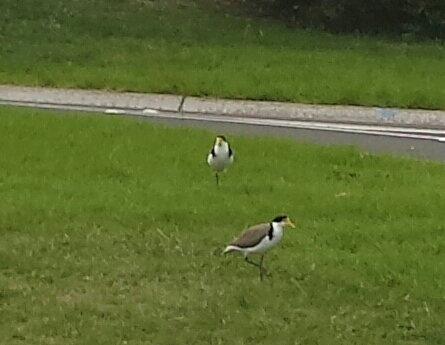
When you are told as a child to keep away from a particular bird because it is aggressive and will attack you with the spurs on its wings if you get too close to it, that information tends to adhere itself to your mind like a pervasive horror story. An aggressive bird with SPURS on its WINGS. And they’re EVERYWHERE – parks, road verges, beaches. I distinctly remember them flocking to the local swimming pool that I swam at multiple times a week, stalking the grassy perimeters and peering malevolently at children with legs nicely suitable for stabbing (or so it seemed to me).

Creeping at Hayley's parental abode
Creeping at Hayley’s parental abode

The masked lapwing, commonly known as the plover and indeed I intend to continue referring to them as plovers as that is how I’ve always known them, and I’m sure Michael will have a lot of indignation to expend on those like me who insist on calling birds common names that are completely incorrect genus designations, WHATEVER MICHAEL SOMETIMES SCIENCE IS JUST TOO OBDURATELY WORDY TO BEAR, is a terror bird in my mind. They are also, as I’ve discovered in researching this piece, a somewhat misrepresented boogeyman of a bird.

It’s been quite anticlimactic to learn that plovers are actually for the most part very wary of humans, despite their mostly blasé attitudes towards living in close quarters with them. Their breeding habits causes them to make their nests on the ground in open spaces, hence why you will see them hanging out in parks, on golf courses, and airports, the latter of which where they become a bird strike risk due to their tenacity in refusing to budge from their nesting area. Plovers have, out of necessity, developed an impressive array of diversionary tactics in luring away potential predators from their nests and chicks, including loud distracting calls, pretending to have only one leg in order to appear as an easier target, and, of course, swooping and attacking with their bright yellow wing spurs.

Yet these violent attacks are generally only last resorts, and more often directed at birds like ravens, and carnivores like domestic cats and dogs. Humans, it seems, very rarely experience the worst of plover attacks, and as much as I googled ‘Australian man savaged by enraged plovers’ I couldn’t find anything worse than folks getting a scare. Plovers are master bluffers, it appears.

Indeed, the more I read about plovers, my fear receded into a feeling of intense pity. While they can survive in close quarters with human habitation, the stresses of ground nesting combined with the dangers of suburban living results in many plover pairs never breeding successfully. Their eggs, which blend into lawn scrub so well, are often trampled by unwary feet, or blasted into nothingness by lawn mowers. Their willingness to live among humans simultaneously protects them from traditional predators, yet opens up so many other threats.

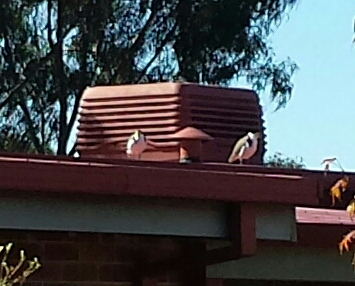
Masked lapwings foolishly hanging on the roof

There are a pair of plovers that habitually hang around the front lawn of the house next door to my parents’. On the recent Easter weekend I went out to watch them (safely, from a distance). Apparently a breeding pair, they pootled about up and down the lawn, long yellow legs betraying their close relation to wading birds, fossicking in the grass for insects and making very occasional calls to each other, but otherwise silent as sentinels. I thought about childhood monsters, and of needlessly demonised animals, and I felt desperately sad.

2 feathers.

Michael

Steph has started us off pretty gently with this series, serving up a couple of lovable icons (galah and emu) for Hayley and me to rave over. You’d think she’d ease us into more controversial waters gently, throwing up something inoffensive we could be a bit less hyperbolic about (I’m thinking one of the honeyeaters perhaps). But no, she’s gone and assigned us Australia’s worst bird, the avian equivalent of The Room or Plan 9 from Outer Space without the camp ironic value.

I’ll acknowledge that I may be slightly biased here. You see I’ve never forgiven the masked lapwing for ruining my shot at a glorious cricketing career. I moved to Caloundra as a 10 year old and signed up for the local cricket team immediately, so I could impress potential school chums with my sporting prowess. As the new kid I was quickly assigned to fine leg – a dull outfield position where you don’t see a lot of action. Unless you’re playing at Russell Barker Memorial Park, where the lapwings conveniently nest near the fine leg boundary and then spend their Saturday mornings bombarding whichever noob has been sent into their territory. Needless to say the opposition scored many a boundary down fine leg way as I ducked and weaved, failing to pay any attention at all to the game going on around me. My sporting reputation never recovered.

So yes, this is personal, but I think I can still make my case. The masked lapwing is an aggressive, violent bird – don’t buy into Hayley’s nonsense about them being more scared of you than you are of them – these birds have leg spurs and they’re not afraid to use them. Read the 241 comments on this thread and tell me they’re harmless. Read some of the tips here: “avoid making eye contact or staring directly at the birds,” and: “don’t run away in a panic as this could encourage them.” These are not nice animals. When they’re not wounding adults and terrifying children, masked lapwings like to try to take down passenger aircraft – they even have their own fact sheet on the Australian Transport Safety Bureau website. These birds want to kill you and your family.

Their awful shrieking call combined with their vicious spurred dive-bombing and frankly monstrous faces are enough to have me rank them pretty low on my personal countdown of Australian birds, but the point that takes them right to the bottom is their breathtaking stupidity. Masked Lapwing chicks can’t fly when they first hatch and have to stumble around foraging for food until they get their wings up to full power. So what do their parents do? Build their nests on traffic islands, in the middle of roundabouts or by a busy airport runway, that’s what. And when I say ‘build their nests’, I mean scrape a tiny divot in the ground and dump some eggs in it. No wonder many pairs never successfully breed. I was going to give them a feather or two for their ability to fake an injury to lure predators away from their nests, but why evolve such a complex skill when you could just develop the ability to make a nest somewhere other than the local dog park? Idiots.

(ed: I found a video of them swooping and making their vicious noise PURELY FOR ACADEMIC INTEREST)

The final tipping point is their common name. These birds *are not plovers*. They are closely related to plovers, but you can tell that they’re not actual plovers because plovers are awesome. Plovers migrate from Siberia to Australia, plovers are cute, plovers do not viciously attack young children who are merely trying to make friends in a new town by joining the local sporting team. The masked lapwing is terrible even for a lapwing, lacking the cool mohawk that gives its European cousin so much cred.

0 feathers.

Bird: Masked Lapwing

Michael: 0 feathers

Hayley: 2 pity feathers

linkspam for a rainy day

Rainy first day of the week links:

Radio National asks: Is Voluntourism the New Colonialism?

Despite the title, this article at the Australian does contain some nuance: Asian Slaves to the Australian Sex Industry

Rani Pramesti at Peril with Chinese Whispers: an artistic response to the context in which I live (disclaimer: Steph is involved in expanding this project)

If you’re in Melbourne, check out the 18C exhibition at Blak Dot Gallery until Sunday 27 April (at which point the works will be submitted to the RDA review).

At Junkee, An Entire Suburb In Sydney is Being Evicted.

The Rover is a new movie starring Guy Pearce, it looks like an Australian Dystopia but maybe it is too white? We shall see.

Steph has an article up at The Toast! A Look at Australia’s Climate Change Dystopia, using CSIRO’s projections. OUR DYSTOPIA IS REAL AND IT IS COMING FOR YOU. Also here at No Award we love Australia-centric (or non-USA-centric) SFF.

Not Australian, still v relevant and interesting:

Diversity is not enough: Race, Power and Publishing by Daniel Jose Older

Spicy, by Priya Alika Elias, on food and culture.

Hannah Gadsby’s OZ, Episode 1: Interrogating the White View of Australian Colonial Art History

You know what we don’t talk enough about here on No Award? ART. Actual art, hanging in galleries! Here is Hayley to fix that problem, with a three part review of Hannah Gadsby’s OZ, which recently aired on Our ABC. Hayley has a degree in art history, and we occasionally play ‘who knows more about art’ at NGV (she usually wins). What with the art, and with the birds, Hayley is gonna have to have her own tag on No Award!  

Recently comedian Hannah Gadsby made a three part series on the history of Australian art for Our ABC. Hannah has a degree in art history (like me!) and has for years been taking jokes to art in the form of her guided tours of the National Gallery of Victoria during the Melbourne International Comedy Festival.

I greatly enjoyed the series, to the point that I started to get fretful about the fact that it didn’t seem as if many got around to watching it. That concerned me, because Gadsby’s series was not just about art. You can take it from the title alone: this a series about the Australia she sees reflected back to us through our popular conception of art history, and the things about Australia that aren’t the dominant narratives within Australian cultural identity. It is an unapologetic exploration of the art of women, indigenous artists, and those who portray ignored Australian perspectives. It’s WELL POLITICAL, and even just in the context of art history it covers a lot of really clever, important stuff that isn’t even touched on in university art history courses (believe me, I know).

Daniel Boyd, We Call Them Pirates Out Here
ed note: THE GREATEST AUSTRALIAN PAINTING OF ALL TIME?! Also known as Daniel Boyd’s We Call Them Pirates Out Here

This episode looks to white Australia’s first artistic expressions in the form of colonial art, what these artists were saying about the new colony, what they weren’t saying, and how various contemporary artists are dealing with reinterpreting these colonial images in their own works.

Australian cultural identity is for the most part very one-note, and doesn’t allow for multiple viewpoints. As Hannah says “If you’re not a white man in a hat, you may struggle to see yourself in the Australian art story.” And if you’re not any of those things, you tend to struggle with feelings of belonging and displacement within Australian society. This is a dichotomy that has been present since colonial settlement, and the art of this period can shed light on how the first settlers viewed Australia, how they wanted the colony portrayed, and how we ended up with these stringent ideas of what constitutes Australia.

The biggest thing to address is how white settler artists viewed the indigenous people who had been living in the country for thousands of years. The “subjective baggage” of first contact art such as that produced by the Port Jackson Painter – one of the first western painters in the first years of the colony of New South Wales, now thought to be the work of several unidentified artists – shows that throughout these visual narratives only one (white) perspective is given, and in elevating these works in the narrative of Australian art, indigenous perspectives are knowingly blotted out.

Balloderree
Balloderree by the Port Jackson Painter

Hannah talks to Daniel Boyd, an indigenous artist who has been the artist in residence at the Natural History Museum in London, where many of the Port Jackson Painter’s works are kept as part of their First Fleet collection. Boyd’s work challenges Western viewpoints in terms of the first contact with indigenous Australians, and the way museums have historically been complicit in the theft of indigenous culture and the dehumanisation of indigenous peoples. His art is also a means of challenging the accuracy of these first colonial works – whose story are they telling?

The work that Boyd has put together at the Natural History Museum, called Tracing the Past, incorporates old boxes that the museum used to store human remains – it’s interesting that it seems that Boyd got a hold of these boxes as the museum was upgrading its curatorial practices, not that the remains were being repatriated back to their communities and descendants. Indeed the Museum still holds Aboriginal and Torres Strait Islander remains in their collection, so there’s a disturbing thing for you to ruminate on. This work is a refusal to allow the Museum and similar institutions forget their complicity in harming indigenous peoples, and opens the conversation in terms of reassessing how museums view their collections, ensuring that there is a dialogue rather than the imposition of a one-sided interpretation.

Boyd also remixes paintings from the white tradition of Australian art. Emmanuel Phillip Fox’s 1902 painting The Landing of Captain Cook at Botany Bay, 1770 becomes We Call Them Pirates Out Here (2006) (at the top of this post), with Cook reimagined as a pirate complete with eyepatch and a skull and crossbones Union flag. I would hope, dear reader, that the subtext is obvious to you. The piece is also a reminder that much of the art produced during the colonial period was a deliberate ploy towards “flogging Australia as a prime piece of real estate.”

Joseph Lycette, The Sugarloaf Mountain, near Newcastle, New South Wales. (boring)

Take the work of Joseph Lycett, a convict painter who created deliberately false images of Australian landscapes in order to increase its appeal as a thriving colony to British settlers. His pictures include white settlers and indigenous people co-existing, although the indigenous people are invariably shown leaving the picture, while the white folk gesture expansively over the vistas, indicating ownership and expansion. The images could then act as evidence to potential settlers that, not to worry! We have this native population in hand, and isn’t it a nice coincidence how European Australia looks?

Gadsby then shifts focus to Tasmania, where she grew up and, as the most concentrated arena for the eradication of indigenous Australians in colonial times, a place that holds particular significance in terms of white settler and indigenous dialogues.

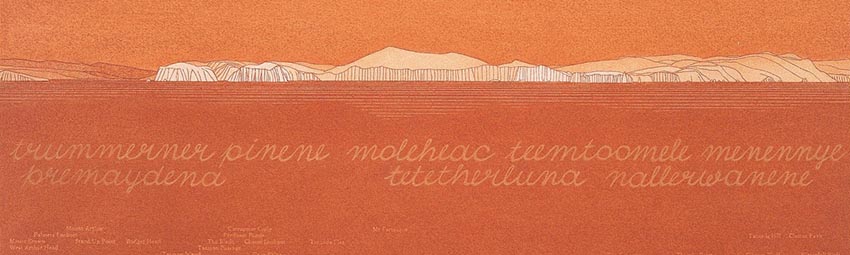
Bea Maddock’s panoramic work that depicts a topographical circumnavigation of Tasmania’s coast, Terra Spiritus… with a darker shade of pale (1993-1998), is an exploration of both English and indigenous geographical names. Particularly haunting is the presence of Aboriginal place names that directly confront the wholesale genocide of Tasmania’s original inhabitants and the theft of their land. “For a Tasmanian, that is a fact that is too easily forgotten.”

Bea Maddock's Terra Spiritus (detail)

John Glover was one of the first free settler artists, and settled in Tasmania. The intriguing thing about his work is that he insisted on painting pastoral scenes of “Aboriginal arcadias of a people untouched by Western civilisation,” some 20 years after the genocide of Tasmania’s indigenous population began. Yet despite his apparent fascination with indigenous people, like Lycett’s work his paintings edit out some very sobering truths that problematises his art. He could not have witnessed the scenes he depicted, and what is shown is idealised imaginings of what indigenous life was like prior to white settlement.

Julie Gough, a Tasmanian Aboriginal artist, offers indigenous insight into how Glover’s paintings can be viewed – they are important for the fact that a white artist depicted Aboriginal life at all, but troubling as he was nostalgic for a period that he did not bear witness to, and also concurrently produced works that depicted farming and the land forging enacted by white settlers. Glover was interested in an indigenous past, but the present depicted in his works is resolutely white.

It’s interesting that when talking of Gough’s own artwork, which directly tackles the uneasy colonial relationship between indigenous peoples and white settlement, Gadsby makes note of the fact that while Glover’s work at the National Gallery of Australia is housed in the mainstream Australian art section, Gough’s work is displayed on a separate level with the specifically designated indigenous art. Is this is a deliberate curatorial decision to avoid these sort of dialogues from occurring among gallery patrons?

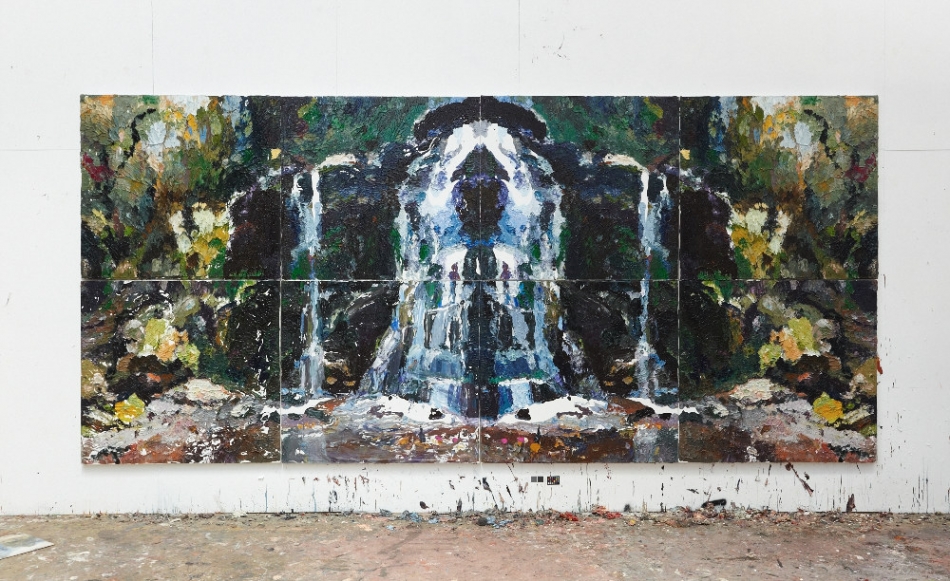
Ben Quilty – as Hannah says possibly Australia’s best known contemporary artist – is obsessed by identity, and how the past shapes an individual’s self-expression. Fairy Bower Rorschach (2012) depicts a beauty spot near Quilty’s home that was also the site of a massacre of indigenous people during colonial times. The wholesale murder of indigenous people is a shameful secret among non-indigenous Australians – we acknowledge on a basic level that killings occurred, but the full extent remains shrouded and unacknowledged. Gadsby makes the pertinent point that when the Port Arthur massacre occurred in 1996, it gained immediate recognition and memorialisation, whereas the hundreds of sites across the nation of indigenous genocide for the most part remain unmarked.

When asked how he reconciles living a privileged life adjacent to a place that was a scene of horror for indigenous people, Quilty baldly replies that he cannot. The spectre of white guilt, the fact that in mainstream Australian education we are still taught that ‘real’ Australian history began when Cook stepped off the Endeavour, is highly troubling to him. Quilty’s piece becomes about being born Australian, loving Australia, yet constantly questioning one’s belonging and the white-washed construction of our history in “a haunted landscape.”

The colonial view of Australia as painted by the likes of Lycett, Glover and their ilk are “devoid of scar tissue.” When we look at colonial art, we need to be consciously thinking of the voices they omit, what values they are espousing, and how we ourselves may have benefitted from a nationhood construction that leaves so many without representation. The past is not only behind us; it is constantly impacting on our present, something that contemporary Australian artists, both indigenous and white, are keenly aware of. Like Gadsby, I’m pleasantly gratified that so many contemporary Australian artists are willing to grapple with these issues and actively interrogate our colonial past.

Ben Quilty's Fairy Bower Rorschach
Ben Quilty’s Fairy Bower Rorschach

Next time! Hannah looks at the history of women artists in Australia, and how they offer an alternate vision of the extremely masculine Australia that our art history narrative has popularly pushed forward. Watch out, blokes in hats, we’re coming for you.

birds of australia with hayley and michael: the galah

Dear No Award; here we are back again with our continuing series on Australia’s birds. Why do I think this is the greatest thing ever? Uh, because I’m a Penguin. This month sees a devastating lack of fights between Michael and Hayley as they agree over the Galah.

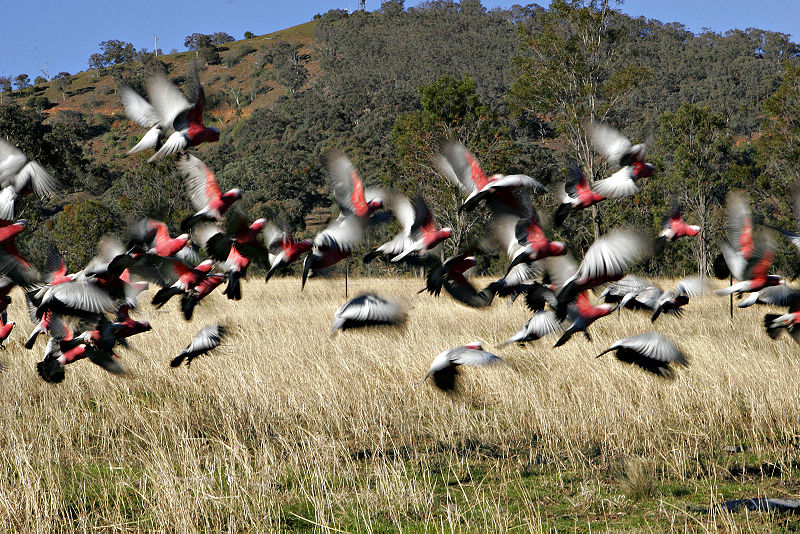
Galahs flying with a motion blur

Michael

For some reason bird names are pretty common as insults – think about it: cuckoo, turkey (as Homer explains), coot, chicken, dodo, even tit (although the insult may have a different etymology than the bird name). Australia has added a couple of classics to the list: drongo and today’s bird of the month: galah.

The galah is one of Australia’s most distinctive birds – a small cockatoo with a bright pink chest and face, grey back and white crest – commonly seen in large flocks throughout most of mainland Australia. The precise reason that they’ve come to be synonymous with foolishness in Australian idiom is unclear – there’s some suggestion that it’s due to the galah’s propensity to migrate south (towards colder weather) during winter, although actual research shows that they’re pretty sedentary birds. More likely it’s down to their noisy, squawky calls and slightly ludicrous colours. Either way, it’s gone global as an ocker insult thanks to Home and Away.

As with our first bird of the month, galahs are one of the rare birds that seems to have benefited from European settlement, with land clearing creating vast swathes of their ideal open habitats and the provision of water for stock dramatically expanding their range (although they remain absent from the very northern tips of the country).  They’ll eat basically everything – fruit, seeds, bugs, grass, grains – whatever’s going. Their sexual politics are a bit confusing – they pair up for life, suggesting a pretty conservative outlook, but there are records of inter-species love, with galahs breeding with sulphur-crested cockatoos, little corellas and Major Mitchell’s cockatoos. Freaky.

The Big Galah by Adam EalesPeople regularly ask me what my favourite bird is and, as impossible as that question is, I’ve often answered the galah. It’s not as spectacular looking as the king parrot or crimson rosella, but there’s just something so unlikely about the pink and grey stylings that galahs get around in – it doesn’t really seem like it should occur in nature. There’s also their playfulness – galahs are well regarded as pets, but even in the wild you see them mucking around and seemingly just having fun. Watch a flock of galahs next time they fly over – they dodge and weave for no real reason, squawk just to hear the sounds of their own voices and seem to be having the time of their lives. Of course I’m anthropomorphising them, but life as a galah just looks like great fun. They’re common around Melbourne and spotting a flock flying over Princes Park on my walk to work gives my spirits a lift – they’re a very cheerful creature.

Their raucous mischievousness is seen by some as charmless – my partner Cindy called them “the dude-bros of the sky” when I told her I was writing this. There’s also their rather unfortunate portrayal in this ACT health campaign, which is terrifically insulting to one of our natural icons. They have been known to get hammered on fermented over-ripe fruit, but they seem like pretty lovable drunks – sure they’d laugh at their own jokes and slur their words a bit, but nobody would mind, they’d all be having too much fun.

I’m giving them 5 feathers – they’re a national treasure.

Hayley

I was hoping that Michael and I would get into our first proper dust up and I would get the chance to call him a flaming galah (because it would make Alf Stewart proud), but here we are again in agreement over a particular bird’s general excellence. And really how could we not be, who on earth doesn’t like the wonderful cheeky clown that is the galah? New test to discover whether your acquaintances are actually androids from the future: ask them if they don’t like galahs.

No matter how glum I may be at any time, spotting a few of these candy-coloured fellows chirruping among themselves on power lines, or fossicking about on a grassy verge at the side of the road is enough to put a smile immediately back onto my po-faced dial. They’re just so sweet.

JJ Harrison http://commons.wikimedia.org/wiki/File:Female_Galah_Outside_Nest.jpgOnce I started thinking about my feelings about them more deeply, however, I started to feel slightly off about the sweeping designation of a ‘galah’ meaning someone who is foolish, stupid, or somehow lacking in various graces. This seems like a horrendous cop-out to the bird in question. There is the fact that parrots are among the most intelligent of all birds, probably only outstripped by the corvids (and even that is an argument likely to produce much teeth-gnashing and invective spewing from bird nerds). In captivity galahs are well known for their highly developed skills in picking up speech – look at this little guy who can whistle, sing, meow and say complete sentences that correlate with his owner’s actions and speech. I hardly think that this is the behaviour of a stupid animal.

And then there is the fact that galahs are some of the most visually striking birds in the country. No, they don’t have the eye-popping flash of rosellas or king parrots, but that kind of bright ostentation is too vulgar for them. Better to dress their wings in grey, crown their crest in dusky white, and have the soft rose flush of their breasts carry the indication of their cheery personalities. They’re like that friend we all have who is happy and always joking and laughing, and that’s what you remember most about them, to the point that when they show up to a fancy party or dinner in super fine duds, tasteful and understated yet perfectly cut and tailored with one bright accessory that completely expresses their quirky, kind personality that your mouth drops open in shock as the realisation steals over you that not only are they the most fun to be around but they’re also the most together person you know and it’s been in front of your face the entire time and aren’t you just a bit of an idiot. What I’m saying is that galahs are total secret GQ motherfuckers and we are all chumps.

Anyone who doesn’t think the galah is a 5 feather bird needs to be catapulted into the sun.

Jeeze Michael, I really hope we disagree next month, all this cordial agreement is giving me indigestion.

Bird: Galah

Michael: 5 feathers

Hayley: 5 feathers

linkspam is feeling better when you say linkspam

I have been completely overwhelmed with my blogging for MQFF (look at my name all over that blog!), so there are no new blog posts yet today, though if you check back later in the week perhaps you will be surprised! Instead, have some things I have read in between movies:

March in March marks the birth of a new kind of activism; an article by Van Badham about a new phenomenon in Australia, and how different sides of politics (and the media) have reacted to it.

Celeste Liddle on being ‘black’ and fair-skin privilege is a whole world of YES EXCELLENT, a great article.

I am an actor, by Rani up at Peril, is a meandering piece about being an Asian in the Australian acting world. (Anecdote and personal aside: The day Rani auditioned for a reoccurring role on Neighbours I flipped my shit)

Having strong feelings about There and Back Again: Or, how I quit programming and returned, an on gender and performativity and femininity by Misty De Meo, a trans woman.

American but also Malaysian and about representation in the mainstream media, The media’s shameful Malaysia Airlines coverage: Gawking at a foreign disaster was an interesting read on the damage that can be done by the media and by our own disinterest.

On the Chinese media, China sees Obama girls, but not Xi’s daughter. My favourite part of this article is pointing out the media’s silence on Xi Mingze being a student at Harvard.

mqff viewing schedule

mqffbannerThe Melbourne Queer Film Festival starts in just TWO HOURS. This year I’m blogging for MQFF, so I’m heavily involved, and you can see my filthy penguin flipperprints over everything (check out the blog).

I love Melbourne’s festivals, as they’re often a great time to get involved in a community, learn more about a subject, or just love Melbourne a little bit more. And MQFF is definitely one of my favourite festivals all year round. And if you’re broke, there’s even $10 buck tix, which I LOVE the concept of.

Tonight is the opening night party, and there are still tickets to that: Any Day Now, starring your favourite and mine, Alan Cumming.  Also I will be wearing a tutu.

And I am super excited about so many films! If you’re still unsure, I wrote a list for Peril of Azn-interest films, and below is my personal list (note: I won’t end up seeing all of these):

G.B.F (Gay Best Friend)  (Saturday 15 March, 20:15): The summary starts “Move over Mean Girls and Heathers, it’s 2014 and there’s a new set of prom queen wannabes and they need a gay best friend;” I don’t need to know anything else.

Quick Change (Saturday 15 March, 16:00): I have seen the first five minutes of this movie and it looks adorable – sadly my screener was having issues and I failed at seeing the rest. This Filipino movie is about Dorina, a trans woman who makes a living selling homemade cosmetics to other trans women. She does a runner when a client has a bad reaction to some of her cosmetics.

Who’s Afraid of Vagina Wolf? (Sunday 16 March, 20:30): This is a comedy and I need the laughs.

OUT in the Line-Up (Sunday 16 March, 15:00): Australian documentary. Queer surfers.

52 Tuesdays (Tuesday 18 March, 18:00): Filmed every tuesday over a year, this film (not a documentary) follows a teen as one of her parents transitions, and I am super into the conceit of this film.

Bad Hair (Wednesday 19 March, 18:00): Not totally sure what this movie is about, but I do know Junior wants to straighten his hair and I’m intrigued.

Will You Still Love Me Tomorrow (Wednesday 19 March, 21:00): Taiwanese movie about discovering one is gay after being established with a family. Allegedly a comedy of errors. This usually wouldn’t be my thing but it’s the only Mandarin-language movie this year.

Noor (Friday 21 March, 18:00): A Pakistani trans man goes on a road trip to find a place where he belongs. Hopefully adorable.

Zoe.Misplaced (Sunday 23 March, 15:00): Melbourne lezzie drama. All good.

I have reviewed Soongava, so I won’t be seeing that again, but it was very interesting.

SEE YOU THERE. Come say hi, I’ll be there most days of the festival.

In Conversation with Jung Chang at The Wheeler Centre

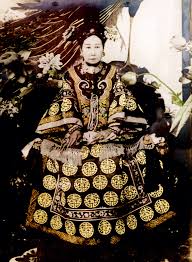
Last night the Wheeler Centre cruelly made me choose between being queer and being Chinese. Not really, of course. I’m Chinese no matter what, and I’m pretty damn queer. But  I had to choose between Alison Bechdel and Jung Chang, and Jung Chang, Chinese biographer, banned on the mainland but so beloved everywhere else, and lacking the connotations of Amy Tan, was always going to win. Jung Chang has written a new  biography of Cixi, Dowager Empress, scourge of China; Empress Dowager Cixi: The Concubine who launched modern China. This biography has been written exclusively using first-hand accounts, and I’m so excited to get my hands on it.

look at this cutie!
look at this cutie!

Jung Chang is an excellent speaker. She has a wealth of adorable stories, a way of turning the most tragic anecdotes into amusing moments, and a lovely way of speaking (and not a little bit of familiarity, with her Chinese words thrown in amongst her accent and her pauses). She tells of being sixteen in 1968, and committing to paper her very first piece of writing, a poem. At the time, being a writer was certainly enough to have one sent down, and that very evening, as she was lying on her bed composing her work, the Red Guards busted in for a random inspection. Desperate to hide her evidence, she tore up the pieces and flushed it down the toilet, and there her writing career stalled for a decade. Everybody laughed, though it’s ostensibly a story of how difficult life was under Mao. Chang just has a way of telling it.

Wild Swans (and her Mao biography) are banned on the Mainland, but Jung Chang herself is not, merely blacklisted. She fought to be able to visit her mother for fourteen days in every year, and while she’s in country (in Chengdu, mostly), she refrains from talking about her work, publicising, and even seeing her friends. Chang shrugged. It is the price of being a writer, she said, and I lack the words to express how this makes me feel, but I’ll try. One of the hardest things for me, when I write about identity (and you know how I love to write about identity), is how much of my family to bring into it; how much of what can hurt me to bring into it. And I love how matter of fact she is of it, how accepting of her situation. This is the fence upon which she sits, and that’s just how it is.

The audience was a delightful mix; I love looking into a queue to see a whole lot of Chinese people, not just older but younger, too, my age or so. Lots of middle-aged to older white people, some others. Sporadic mutters and giggles when the interviewer first pronounced ‘Jung’ as if it were a ‘Y’ sound,* and second repeatedly pronounced Cixi incorrectly (Chang just kept saying Cixi until it sounded okay, and admittedly 慈 is not the most easy of sounds). But then, a sign perhaps of the white audience? Laughter when Chang related of how difficult it was for Cixi to get Chinese people to go overseas, to get a Chinese person to be ambassador to foreign countries. The first Chinese ambassador to the USA was an American. But Chinese people were afraid: afraid of being kidnapped, afraid of being killed. And there were giggles from the audience, as if this isn’t something truly to fear? (Clearly they’ve never been a Chinese person in a Western country)

funny story: the first airbrushed photo in chinese history

When asked if Cixi’s history had been influenced by any thing in particular, Chang demurred, explaining the misrepresentations. What she meant to say was, surely, misogyny. Just like Wu Zetian.

When Cixi was young, she had a eunuch lover. Eunuchs were always despised, though Chang suggests they should be figures of sympathy. Cixi instigated a canal cruise for her lover’s birthday: there were dancers, and singing, and revels. This caused an outcry, because EUNUCHS and LADIES MAKING CHOICES, and her lover was put to death, the dancers were sent off to be prostitutes, and Cixi had a breakdown.

I loved the way Chang told of Cixi’s reforms, from the sweeping societal, through to the court etiquette, and how Cixi, who loved curiosities, never rode in a car – because the driver couldn’t bow AND drive at the same time. I also loved that she waved at foreign photographers, because she had heard that foreign monarchs did that (very different from the tradition of being hidden from view all one’s life, as Chinese royals were).

I was most interested to learn about Cixi, but as an endnote, I also learnt about George Morrison, whom Wikipedia tells me was also known as ‘Morrison of Peking’ or ‘Chinese Morrison.’ He came up because a man in the audience asked if Morrison, from Geelong, was in Chang’s new book, noting that he features predominately in many other biographies of Cixi and of the period. “No,” said Chang, after a pause. It wasn’t a ‘trying to remember’ pause – it was an awkward pause, a ‘how do I say no?’ pause. Morrison, says Chang, didn’t speak Chinese. He got a lot of his information from Backhouse, a man who claimed to be Cixi’s lover and who claimed that on her deathbed Cixi told him “never let a woman rule.” It had better not surprise you, reader, to learn that he was a giant liar.

This was a free (but booked out) event at the Wheeler Centre. If you’re in Melbourne, The Wheeler Centre is a great way to see/hear some awesome stuff, for free or for cheap! Get to it.

*!! This tweet from the Wheeler Centre tells me that Jung Chang pronounces her name Yoong! Which is super interesting that she’s chosen a pronunciation that’s so different from the pinyin/romanisation. How non-standard! I apologise for making fun of the interviewer for that.

birds of australia with hayley and michael: the emu

Dear No Award; I’m excited to be bringing you a new monthly column here at No Award: Birds of Australia with Hayley and Michael, surely Ornithology’s Margaret and David. I say ‘I’ despite this being a shared blog because my co-host, Liz, is on record as having some bird issues. Please avert your eyes if your issues are like hers, and go bitch about birds on her personal blog!

I’ve got some strong feelings about birds in Australia. We say birds in Australia because this column will not be limited to birds indigenous to Australia; Michael and Hayley will also end up visiting introduced and exotic birds! Yes! Excellent! Each bird will be described, analysed and discussed, rated for gender politics, post-colonialism, awesomeness and whatever else our reviewers feel like, and then given a rating out of five feathers.

Dr Michael Livingston is a professional killjoy, occasional bird-nerd and part-time food blogger. You can find him writing about vego food at Where’s the Beef. Hayley Inch works for a bunch of film festivals. She writes frequently about food at Ballroom Blintz, very sporadically about film at 240 Films, and about many Melbourney things at Broadsheet. She’d be a better birdwatcher if she didn’t get so loud when excited.

Please do not be scared by our first bird, the Emu, which is basically the greatest bird ever after the penguin.

friend troy forlornly trying to feed an emu

Michael says:

It’s fitting that we start this column off with the Emu, probably Australia’s most famous bird (rivalled by what, the Kookaburra? The Lyrebird?).  It adorns the Australian coat of arms and the 50c piece, is the namesake of Australia’s preeminent ornithology journal and even has its own brand of beer. The emu’s appeal is pretty straightforward – it’s two metres tall, flightless, distributed across the entire country (except Tassie) and a common sight for anyone driving through country Australia.  Shockingly, the emu wasn’t even nominated in the recent Australia’s Favourite Bird poll, an oversight I can’t begin to understand.

My second vivid bird-related memory (the first is being hunted by a terrifying pack of ‘domesticated’ vicious geese as a toddler) is of a baffling emu that roamed Brampton Island in the 1980s (for a brief time our family was upwardly mobile and holidayed on tropical islands). You’d see it loitering outside the cabins or roaming the beach, kicking up spray as it sprinted through the sea foam. It’s a sad story looking back – it was probably dumped on the island for novelty value and must have been lonely and confused. But as a kid it just felt unworldly – being a few metres from this odd creature, hearing its weird drumming calls and watching it sprint at incredible speeds  was a hint at how compelling the natural world can be.  Despite seeing hundreds of emus since then, a tiny remnant of that visceral thrill still sparks every time. They’re abundant birds, but there’s nothing common about them.

http://commons.wikimedia.org/wiki/File:Emu,_Jurong_BirdPark.JPG

They’re distinctive, but not particularly attractive birds, with drab brown and black feathers and a splash of blue at the neck. Their wings are tiny and useless, while their legs are strong enough to rip down fences, fend off dingoes and propel them at speeds of up to 50 kilometres per hour. They eat anything and everything – native and introduced plants and fruits, bugs, moths, caterpillars, charcoal, stones – they’ll even eat car keys apparently. The emu’s gender politics are excellent, with the male taking on most of the work of bringing up the young. He spends two months incubating around a dozen beautiful green eggs, surviving only on body fat, dew and any scraps he can reach from the nest and losing a third of his body weight before the chicks hatch. Meanwhile, the female wanders off after laying the eggs and may breed again elsewhere, with another male emu.

So they’re a fascinating, distinctive and surprisingly feminist bird – I’m taking half a mark off because of their cold dead eyes and aggressive posturing and another half a mark purely because of this dreadful song that has been stuck in my head the whole time I’ve been writing this. So four feathers out of five from me.

Hayley says:

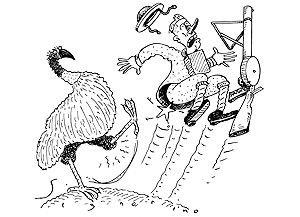
Michael has given an excellent overview of this most iconic of Australian birds, but if we’re going to talk emus (pronunciation guide: ee-mews, not ee-moos, for the love of god) we must address the most batshit amazing thing about them: the Emu War, aka that time the Australian government unleashed the might of the military against a species of native fauna, and the fauna WON.

“The Emu Battle – Volley of Questions” Canberra Times Friday, 18 November, 1932, page 3.

So it’s 1932, and bunch of returned WWI soldiers had taken to farming the Campion district in Western Australia. The only problem? EMUS. EMUS EVERYWHERE. Emus eating wheat and knocking down fences, thousands upon thousands of them. What were the diggers to do?

The farmers petitioned the Minister of Defence, Sir George Pearce, with a plan. See, they had military experience and figured that there was only one thing that was going to successfully eradicate their feathered foe: MACHINE GUNS. They figured that if a brace of Lewis machine guns were so good at mowing down soldiers, they would do the same for the emus. Sir George was only too ready to agree, figuring that the birds would make ingenious target practice for the idling Australian military.

The emus weren’t having with any of this colonialist tame-the-land-and-shoot-all-the-native-species bullshit. Once the deployed soldiers actually started having a go at massacring some birds in November 1932 they quickly discovered that the emus were devious strategists, and ambushed mobs would very quickly split into smaller groups and scatter, making them much harder targets to hit than anticipated. Even hitting the emus apparently didn’t faze them; soldiers were gobsmacked at how many bullets an emu could take without bringing the bird down (so emus are clearly well-disguised Terminators).

Major G.P.W. Meredith, military head of the campaign, later claimed that just under 1000 emus died during the brief war, with estimates that a further 2500 birds would have died from injuries, but considering there were 20000 emus in the area it hardly made much difference. The war became a laughing stock in parliament, with Pearce being labelled “the Minister for the Emu War” and prompting this hilarious exchange in the House of Representatives:

Mr Thorby (NSW): “Who is responsible for the farce of hunting emus with machine guns mounted on lorries? Is the Defence Department meeting the cost?

Prime Minister Lyons: “I have been told the Defence Department will not be paying the bill.”

Mr James (NSW): “Is a medal to be struck for this war?”

The Emu War barely lasted a month, and despite repeated calls throughout the next few years from Campion residents to bring back the army to deal with all these goddamn emus, no one in authority was ever game to take them on again. The emu was just too invincible an opponent.

So as you can see, emus are freaking bad-arse and you should afford them with RESPECT. I have to take off half a feather due to them not being the most lethal ratite in the country (that award goes to the southern cassowary, alias a motherfucking dinosaur in bird form), but otherwise the emu receives a highly commendable four and a half feathers out of five.

Bird: Emu
Michael: Four out of Five Feathers
Hayley: Four and a Half Feathers