Pro-environment media Liz was banned from consuming as a child

Now, I love my parents dearly, and they gave me a strong grounding in the humanities and encouraged my intellectual curiosity and desire to read e v e r y t h i n g.  But they were also quite strict, not only in terms of discipline, but in the sense of the media they encouraged me to consume.

As it happens, I agree with them that a young child’s reading should be steered a little, and an older child should be encouraged to recognise discuss the ideas and morals behind a piece of media.

It’s just that my parents were a little bit idiosyncratic.  They belong to a right-wing Catholic tradition which, while strongly anti-capitalist, is coincidentally in lockstep with certain capitalist ideas.  Specifically, the environment.

Guys, I was raised by climate change deniers.

I mean, back then we called it global warming and talked about the hole in the ozone layer, but the point is, my parents didn’t believe in it.  (These days, they’ve conceded that climate change exists, but not that it’s caused by human activity.)

Suffice to say, I’ve been looking forward to the Pope’s Encyclical on the environment with no small amount of curiosity and schadenfreude.  And in honour of that Encyclical (probably not a phrase No Award will get to use very often), here is a list of media I was either forbidden or strongly discouraged from consuming:

Possum Magic by Mem Fox

I had a copy, and I vaguely recall Mum loving it, but Dad was not a fan.  Native animals = STEALTH ENVIRONMENTALISM.

Snugglepot and Cuddlepie by May Gibbs

This Australian classic is problematic in many ways, but what gave my parents pause was the knowledge that Gibbs (1877-1969) was something of a socialist and early environmentalist.
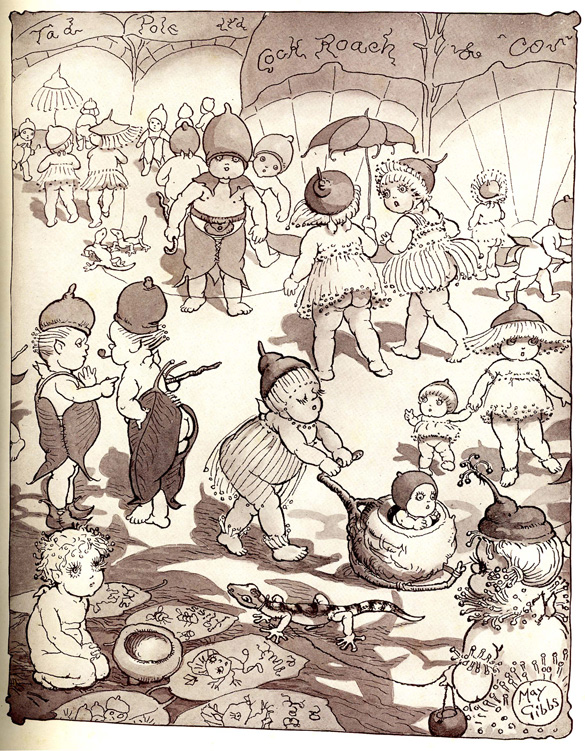
An illustration from Snugglepot and Cuddlepie
I don’t think I appreciated how WEIRD these books were.

They discussed the problem (within earshot of me?  Was I a childhood eavesdropper?) and decided that the books weren’t likely to cause any damage to my long-term development.  Which, indeed, they didn’t.  Only confusion.  So much confusion.

(Steph’s aside: No Award will be publishing a post on the issues with Snugglepot and Cuddlepie in the near future)

Where the Forest Meets the Sea by Jeanie Baker

I think I need to find a copy of this book, because clearly I didn't appreciate the art enough as a child.
I think I need to find a copy of this book, because clearly I didn’t appreciate the art enough as a child.

1988 picture book about a boy visiting his grandfather in Far North Queensland, admiring the beauty of the rainforests, musing on their history as a home to Indigenous peoples, and wondering, “But will the forest still be here when we come back?”

It occurs to me that my parents probably disapproved of this, not just because of its environmental message, but because it’s specifically critiquing the pro-development policies of the immensely corrupt Bjelke-Petersen government, of which my mother was a strong supporter, and which, even now, she still remembers fondly.  (Note: by coincidence, she didn’t actually live in Queensland during the Fitzgerald Inquiry.)

I was an early reader, and grew out of picture books pretty fast.  And by the time I was into chapter books, I was … not precisely self-censoring, but mentally distancing myself from any pro-environment/pro-sustainability plots I came across.  Suspending disbelief, basically: “I know the environment is nonsense, but just as I believe in faster-than-light-travel when I watch Star Trek, I’ll put up with this for now.”  Chapter books I distanced myself from in this way:

My Sister Sif by Ruth Park, already discussed here at No Award.

The Lake at the End of the World by Caroline MacDonald, in which Australia is devastated by chemical bush clearance.  The heroine’s parents had a long scene where they explained that, in their youth, “Conservation became a dirty word” because everyone was getting rich, and by the time people realised the land could no longer support (much) human life, it was too late.

“Typical left wing propaganda,” I didn’t think at the time, not having a well-developed political vocabulary, but that was my nebulous and unformed feelpinion.

These days, I think about that scene a lot, for some reason.  I bought a secondhand copy last year and fully intend to do a No Award post on it one day.

But it wasn’t just books my parents were wary of!  It was television!  And song!

WARNING: Earworms dead ahead!

This is a terrible song, and was therefore much beloved by my year five music class.  My parents didn’t share the affection, and not just because they have ears.  They were very pro-woodchipping on the grounds that timber and paper mill staff are completely incapable of training for any other work, and the entire economy of Tasmania would collapse without the tree destruction industry.

As it happens, the value of the timber industry was vastly distorted by government subsidies, and it employed far fewer people than even the unions realised, but that all came to light later.

Why is Captain Planet so much bigger than the Planeteers?

Good reasons to hate Captain Planet and the Planeteers:

  • the theme song
  • the tokenistic nature of its multi-ethnic group of smiling young people
  • terrible puns
  • Wheeler is the worst
  • what kind of power is heart anyway?

Reasons my parents hated Captain Planet and the Planeteers:

  • it was produced by Ted Turner
  • who was/is(?) married to Jane Fonda
  • something something Hanoi Jane?
  • please note, my parents were children when the Vietnam War ended
  • environmentalism
  • ZOMG PAGANISM
  • there’s an episode about population control
  • Mum is very anti-superhero
  • terrible puns

Reasons I loved it and watched it whenever I could, even though I knew it was terrible:

  • like, two-thirds of the cast were Star Trek: The Next Generation actors
  • I wanted Wheeler and Linka to kiss

Teenage Mutant Ninja Turtles

Okay, this one’s stretching it a bit — my parents didn’t know it often had environmental messages, and neither did I.  It was banned for containing “imitable violence”, ie, martial arts.

I don’t know why my parents were so concerned about this, given that the only television I was interested in imitating at this time was Star Trek: The Next Generation, but there you go.  They also forbade Power Rangers.  If it had been around when I was young, they would have also banned me from Avatar: The Last Airbender and Legend of Korra, too.

The Adventures of Blinky Bill

The original Blinky Bill stories (about a cheeky koala and his friends) were published in 1933, and had mild conservation themes.  The Adventures of Blinky Bill, the animated series of the ’90s, ramped these themes up, the series opening after Blinky’s habitat is destroyed by humans, forcing him and his friends to befriend the Dingos.

Mum and Dad thought it was strange and terrible that modern political issues were being forced into light entertainment.  Something something something Puppies.

FernGully: The Last Rainforest

Such an amazing, terrible movie.

This is an odd one — I wasn’t forbidden to see this (in fact, Dad took my brother and I to the movies, and really enjoyed it!), but I was convinced I’d get in trouble just for asking to see it.  I got the novelisation via a Scholastic book fare, and it came with a poster that I put up behind my door, where I was sure my parents wouldn’t see it.

(A few years later, I did the same with a pair of ATSI art posters I got from school as part of Reconciliation Week. Apparently I was quite secure in my belief that my parents would never enter my room, close the door behind them and then look at the door.)

Anyway, I was really into FernGully at the time it came out, and was quite amazed when I recently learned that (a) it’s known outside Australia and (b) its international audience is largely unaware that it’s set in real Australian places.  IDK, maybe because all the fairies are white and European-looking?

A few days ago, I mentioned the leaked Encyclical to Mum.

“What is it about?” she asked.

“Climate change, and the need to take responsibility for addressing it,” I said.

“Oh.”
Mad Max: Appropriation Road

Here at No Award, we’re enjoying Mad Max: Fury Road. We’re inventing an AU (it’s called Mad Max: Fury Roadhouse, and it’s hilarious), we’re reading meta, we’re getting angry about world building on Tumblr. We’re taking it seriously as a commentary on our dystopic future, we’re getting grumpy about the lack of Indigenous faces, and we’re fighting with people on the internet. We’re having a lot of fun.

There are a whole bunch of posts we’re planning to make. Something something racism and the whiteness of Mad Max and the erasure of what it means to be not-white in Australia by American commenters. Something something the terribleness and inconsistency of the world building (“fang it” isn’t creative, it’s like saying something is going to the pool room!). But today we’re looking at a post from The Conversation and introducing the Tiny Mood Stephanies.

We love The Conversation here at No Award. It’s such an excellent, thoughtful, left-ish Australian national website. So many great articles! So much Australianness! Hooray!

So it’s with great interest that we encountered Stanza and deliver – the filmic poetry of Mad Max: Fury Road.

Okay, sure. Last week friend of No Award Genevieve Valentine wrote a post: The feminine desert of Mad Max: Fury Road, and we’re so into it. We want to know more about your thoughts of how great this movie is! We have been lit students and history students and we love movies and analysing this stuff! Yes! Great fun!

Continue reading “Mad Max: Appropriation Road”

unusually devoted, isn't she? for an ex-wife

stephanie + liz question things: miss fisher’s murder mysteries

Many years ago, the Phryne Fisher books were Steph’s travel reading. She’d pick them up in the airport and read them on the plane, back and forth across Australia. She’d end every flight with a book full of bookmarks and, sadly for you all, no No Award to vent her anger upon, until finally she gave up and refused to read any more.

Liz, meanwhile, spent several years hate-reading Kerry Greenwood’s books, both the Phryne Fisher series and the contemporary Corinna Chapman series set in a twee Melbourne bakery.  Why?  Well, when you work in bakeries and bookstores, you have a lot of time to read terrible novels about how gluten-free bread should be banned.  Plus, she was under-employed and therefore broke, meaning that her main source of entertainment was (a) reading library books and (b) making fun of them on the internet.

Liz spent so much time ranting on LiveJournal about Greenwood’s terrible writing that one of Greenwood’s contemporary novels featured a villain … who used … LiveJournal.

Liz regrets nothing.  If you are going to have an omniscient narrator tell the reader at length about how brilliant and competent your heroine is, she should at least be reasonably okay at being a detective.

Steph and Liz recently started watching Miss Fisher’s Murder Mysteries. They’re set in Melbourne, where all of No Award is based! We can play Spot the Australian! (Spoilers: They’re all Australians, except for Miriam Margolyes, and she became an Australian citizen a couple of years ago.) It’s pretty! Steph spends the credits charlestoning around the house! The clothes are fun and magnificent!

There are still some issues.

Please note that this post will contain spoilers for both the television series and the books. Continue reading “stephanie + liz question things: miss fisher’s murder mysteries”

Best Australian Kids’ Show Themes

Best Australian Kids’ Show Themes DEFINITIVE RANKING IN ORDER, WORST TO BEST, NO ARGUMENTS

MULLIGRUBS

A terrible song, bookended by the nightmare face of all Australian childhoods. Mulligrubs me. Mulligrubs you. Come and be a Mulligrubs too

GENIE FROM DOWNUNDER

Please try not to ask too many questions about why the Genie from Down Under and his son are white and not Indigenous Australian, since if an Australian Genie is released from an opal they should surely be Indigenous? I mean, who am I to ask these totally relevant questions. This theme tune is ranked worse than the next one because it’s so terribly out of tune and flat and poorly sung. Rhys Muldoon, we expect better of a Play School presenter.

AGRO

What a dull, lifeless bathmat of a song. Perfect.

BLINKY BILL

So long, so boring. Plus every quokka knows that Blinky Bill is a bit of a wanker.

OCEAN GIRL

Time for some meditation.

THE BOOK PLACE

Such a creepy worm, but I’m happily bopping along right now.

MINTY

I remember the show but somehow not this totally perfect dance track theme song.

LIFTOFF

REAL FRIENDS ARE UNDER THE SKIN!? And of course minus points for EC the creepy doll. How did this song get so high on this list?!

Mr Squiggle

Excuse me whilst your judge goes off to have a bit of a cry.

SHIP TO SHORE

It’s so jaunty! DOOP DOOP DOOP DU-DOOP-DU-DOOP-DOOP. ALSO THERE’S A CLUB REMIX

ROUND THE TWIST

HAVE YOU EVER EVER FELT LIKE THIS Ominous and therefore everything you need from an Australian childhood. PS now available on Netflix, much to our joy. No Award will shortly be engaging in a rewatch and review, so stay tuned.

JOHNSON AND FRIENDS

How am I supposed to get anything done when my heart is full of such joy?

THE FERALS

A call to arms.

PLAY SCHOOL

Only the anthem of an entire lifetime, of three entire generations. Read this Junkee visit to the set of Play School, watch this video of Noni and Simon performing Humpty the Opera, remember the lyrics you used in primary school that were totally dirty and terrible and yet somehow still hilarious now at 32. Attempt not to cry at a large complement of past and present presenters and the audience of the Logies singing the song, after thanking the stars of Play School (the toys – including Diddle! And Morris!). Play School was always going to be the very last thing you found on this list, No Award. Because Play School was always going to be the best of these theme songs. NO ARGUMENTS.

*not documented, Humphrey B Bear because I couldn’t find something from the 90s only some sort of hideous modern animation, Cheez TV, Feral TV. The Silver Brumby (not in the list because I literally can’t remember this song).

Australians remember Captain America

“Tell the truth, we all thought it was another silly rumour.  Bad enough the Yanks sit out the first three years of war, but then, right when it’s getting hairy, they go out and spend money on a super soldier project?  Well, we knew they were [CENSORED], but who’d have believed it?”
– Bruce Leonards, Private, 7th Division of the Second Australian Imperial Force, WWII

“Just bloody typical, isn’t it?”
– Police Inspector Charles Price

Two white men in US military police uniforms pose for the cameras. They look outrageously arrogant, conforming to stereotypes about Americans.
American MPs pose outside the Central Hotel, Brisbane, Australia. Early 1942.

“It seemed rather silly to spend all that money when our boys were dying in Burma and New Guinea.  But that’s Americans for you.  Well, he was rather handsome, I’ll give them that.  Didn’t he die?”
– Beryl Montgomery, Australian Army Nursing Service

“Bad enough that Brisbane was practically an armed camp — girls falling over themselves to go to nightclubs with American soldiers, couldn’t say no to a bit of chocolate and a pair of nylons — then the Yanks went and put a silly costume on a male model.  Bet the girls will be going silly for him, next, too.”
– Leading Aircraftman Keith Avard, Royal Australian Air Force

[No Award notes that the legendary appeal of American soldiers to Australian women had as much to do with their coming from a culture where women were, you know, considered worth talking to, as their material advantages.]

[The Waifs – Bridal Train]

[Also, what’s up with this thing where YouTube doesn’t let us get the old embed code anymore?  DOES THE NEW ONE WORK FOR ANYONE AT ALL?]

Using no less than three primary documents, discuss the effect of the Captain America mythos on the Australian experience of World War II.  
– year twelve Modern History exam question, Bongoola State High School, Queensland, 1997

“Of course they needed to build a super soldier.  Everyone knows the US Armed Forces were [CENSORED].”
– Private Clyde Cotterill

Nazi propaganda leaflets aimed at Australian troops in El Alamain.

“What a [censored]. Those seppos need us more than we need them. We don’t need a super soldier when we have true blue Aussies.”
– Billy Sampson, farmer (father of Private William Sampson)

Angered by the slurs cast towards Captain America and the Howling Commandos, American soldiers Harold Hicks, William Edward Arford and Terje Brekka began an all out brawl that drew in all American naval staff, all New Zealand naval staff, and a number of Australian boys present in the National Hotel at the time. Although initially uninvolved, Stanley Reginald Hooper (26) and Ned Rako Kelly (21), Maori soldiers unwinding in the bar, were soon drawn into the brawl, and were the only fatalities. The Coroner at the time ruled these deaths as caused by self-defence, but later testimony by Australians and New Zealanders present reveals the ongoing antipathy towards the Americans over constant boasting of the role of the Howling Commandos, and the lack of stamina of the Antipodean boys…
– excerpt, Captain America and the Boys and Girls of Australia, David Tiller, Penguin Books, 1966

Patriotic window display, Melbourne.

“We used to love the boys coming through, but they’ve all come up skiting since this all went down. Really, the Battle of Perth was inevitable.”
– Helena Cook, Pub Owner, Fremantle

“MacArthur was already neglecting Australian and New Zealand troops. We knew, without a doubt, that once they started producing super soldiers, we were right out of it. No chance of a look in after that.”
– Captain Charles Hardy, 9th Division, 2nd Australian Imperial Force

Australian Prime Minister John Howard again refused to apologise for experiments conducted on young Aboriginal men in the 1950s in an attempt to reproduce America’s super-soldier serum.

“These terrible experiments are in the past,” said the Prime Minister.  “It’s time for Australia to move on.” 

Until 1995, the Australian and British governments denied that Project Albion existed.  Four men died and eight suffered permanent disability as a result of the experiments.
Transcript, ABC News, 12 April 2000

“Saw him on a newsreel.  Big bloke, eh?  Reckon he’d go in for Aussie rules?  Melbourne could use a player like him.  Provided we ever get the MCG back from the Marines.”
– Betty Fraser, nurse, Melbourne, 1944 (as remembered by her daughter, Adele Brunton, in 2012)

[Historical note: for part of WWII, the US Marines were housed at the Melbourne Cricket Ground.]

Colebatch argues that American unions were so inspired by Captain America that they refused to strike during the war.  Australian dock workers, he suggests, lacking such a powerfully patriotic motivator, fell prey to the manipulation of Communists, fifth columnists and traitors.  What we needed was not just a superhero, but a conservative superhero.

Colebatch writes of Steve Rogers as a sepia-toned historical figure.  The fact that Captain America is alive and well, exposing SHIELD corruption and talking up universal health care, is as insignificant as any of the other facts he mangles.
– J. M. Caudwell, review of Australia’s Secret War: How Unions Sabotaged Our Troops in World War II in The New Left, October 2014.

“Bloody Yanks.”
– Private Jim White

post-chrimbo post-racial lols

Hello No Award.

Today we would like to talk to you about Australia’s racism, or what we here at No Award refer to as Australia’s post-racial lols.

Here’s a terrible opinion piece at The Australian titled ‘No contraception, no dole’.

IF a person’s sole source of income is the taxpayer, the person, as a condition of benefit, must have contraception. No contraception, no benefit.

This is not an affront to single mothers or absent fathers, or struggling parents. Such a measure will undoubtedly affect strugglers, it undoubtedly will affect Aboriginal and Islander people in great proportions, but the idea that someone can have the taxpayer, as of right, fund the choice to have a child is repugnant.

Are you laughing? I’m laughing. In horror. This opinion piece is repugnant (thanks, pal) and also amazing, in that it accurately pinpoints who will be targeted but uses that classic argument, ‘I’m not racist’ or ‘I’ve got a brown friend who says it’s okay.’

Eugenics is never okay. Saying people who are poor can’t procreate is eugenics. Saying this policy will impact ATSI people and they won’t be able to procreate is eugenics. That it can list things that might contribute to terrible domestic situations and say the answer is contraception, rather than government services, counselling, and support; that’s eugenics. Woooo good SOSE lesson, everyone.

(Do not read the comments)

*

Channel Seven loses legal battle after ‘racist portrayal’ of tribe.

Ignore those quotation marks, as if maybe it wasn’t a racist portrayal but Ch7 sure has lost the legal battle. Because it sure was a racist portrayal.

Raffaele claimed that the Suruwaha believe that children born with birth defects or born to a single mother “are evil spirits and should be killed in the most gruesome way possible”.

“They take these poor little innocent babes out into the jungle to be eaten alive by the wild beasts or jaguars or they bury them alive, this is one of the worst human rights violations in the world,” he said.

In his federal court judgement Justice Buchanan backed Acma’s original report when he said he found the statements made by Noonan and Raffaele “would be likely to provoke or perpetuate intense dislike and serious contempt of and for the Suruwaha tribe and its members on account of their practices and beliefs”.

Here at No Award we talk a lot about representation and culture, and that’s not just because we like media (we love media). It’s because representation matters, as Buchanan J has handily summed up here. Attitudes are influenced by representation, especially when we’re talking about representation of a minority. It’s irresponsible and basically a hate crime to act any other way.

*

Reading Waltzing Matilda in Aboriginal History on Salty Hair:

I’m not really much of a Banjo Paterson fan — he comes across as a sort of discount store Rudyard Kipling, and I’ve never really liked his poetry either. But when you skim through his work it jumps out that Waltzing Matilda is a really, really odd poem. And the idea I can’t get out of my head is that it’s not really about a minor skirmish between white pastoralists at all: it’s about this country’s founding conflict between black and white.

Roll around in Australia’s racist history, my friends. Understand it. Remember it. Know that it’s still here with us, infecting us every day.

Relatedly, you should be following #blackfullafacts, even if you’re not Australian, definitely if you’re not Indigenous Australian. Some of it’s fun knowledge, some of it’s terrible knowledge, all of it’s important knowledge of Indigenous Australians.

We’re never post-racial. We’re racist, quokkas.

Happy New Year.

play school? more like YES GIMME

Hi No Award. Steph, in conjunction with No Award contributor Ash, want you to listen to some things this morning. We’re not saying it’s important that Play School have some influence on your life as an Australian, but as children we loved it, and as an adult Steph adores Jay Laga’aia.

Prepare to clutch your shirt in joy at the Play School theme

The saddest song ever: Benita sings 5 Little Ducks, which worries Ash:

Five Little Ducks (no video, sorry)

Barbara sings about the creepiest cat:

Noni sings Five Grey Elephants; Stephanie wants to be a puppeteer (age 4)

The Ning Nang Nong is a lot creepier than Steph remembers (stand by for another post on this important ecological feature)

Galumphing Frogs (children all over Australia sing about the noise frogs make when you step on them)

Noni reads Go the Fuck to Sleep

Not a song, but very important. Noni, beloved of many members of Gen Y (and Team No Award) due to her years on Play School, a and well-known potty-mouth, was commissioned by Text Publishing to do a reading of this classic, and it’s so perfect. Her face still brings comfort and the knowledge that something amazing is about to happen.

And to round us out, the GREATEST THING EVER: Simon and Noni and Humpty and Max and Morris in Humpty Dumpty the Opera. Steph doesn’t remember this at all, unlike the other pieces, but prepare to want to watch it twice.

Secrets & Lies & WHAT I CANNOT EVEN

A few weeks ago I blogged about Secrets & Lies, an Australian crime drama set in Brisbane.  I summed up the first episode thusly:

Manpain. No sympathetic adult women.  One person of colour, unsympathetic.  The hero has never read a detective novel ever, and is following the How To Look Totally Suss playbook. Nevertheless, the mystery is interesting and I like the setting, so I’m probably going to keep watching.

I thought this series ran for 10 episodes, but it turns out that, no, that’s just the US remake.  The Australian series only goes for six episodes — which means it’s done, it’s finished, and I’m about to spoil it for you.

Are you ready?

Because chances are, this is the ending for the US version as well.

Sure?

Okay.  The hero’s young daughter did it.

It’s not made clear how old Eva is meant to be, but “between eight and 12” is the range.  She wears her hair in two pigtails, is devoted to her dad, and is the only female character who is both sympathetic to him and not sleeping with him.  (Thank God.)  She’s an adorable moppet, so of course she killed a five-year-old boy to drive his mum from their street.  Of course.

Now, the thing about crime fiction in any medium is that if you’re going to go dark — and child-murderers is very dark — you need to make the story worthwhile.  You can’t just chuck it in as a shocking twist that also conveniently punishes the kid’s mother for not loving the hero enough.  The actress was incredibly good at portraying both Adorable Moppet and Child Sociopath, but the writing didn’t justify it.

Of course, I really wanted the hero, Ben Gundelach, to be guilty.  I wanted this whole thing to be his unreliable narrative of denial mixed with guilt mixed with actualfax murderous intent, because that was the only way his characterisation would make any sense.  Because in the wake of finding the body of the child, Thom, he goes on a rampage of lying to police, hiding evidence, accusing neighbours, assaulting grown men, assaulting teenage boys, and more.  In the final episode, he breaks into the home of the bereaved mother armed with a shovel.

His behaviour was actually scary!  And sending out all sorts of red flags in terms of potential for violence and irrational rage.  Yet the narrative was all, “Well, you know how hard it is for men when they’re accused of murder…”

Now, I don’t need characters to be squeaky clean.  One of the most tragic and compelling moments in Forbrydelsen, aka The Killing is when Theis Birk Larsen, the father of the murdered girl at the centre of the plot, has his cronies abduct a teacher from her school and torture him into confessing.  It’s absolutely clear how Thies’s behaviour is driven by guilt and fear — but we’re not meant to cheer him on.  And at the end of the series, he goes to jail.

Secrets & Lies wanted us to be on Ben’s side.  And I just can’t do that.  And in real life, even white, middle-class male homeowners are charged with assault when they punch a teenage boy, even if the outcome is usually just a good behaviour bond and a fine.

So at the centre of this story, we have a deeply unpleasant hero, who isn’t even especially competent.  And he’s surrounded by women who should be really interesting female characters … except we’re meant to hate them.  A quick round up:

Christy, his wife.  As the series opens, she has just told him she’s leaving him.  But it’s not his fault he had an affair with Jess, the woman across the road and fathered her son!  (Yeah, I was totally right with that prediction, by the way.)  He only did it because Christy had had an abortion, and even though he said he was totally okay with it, he wasn’t!  And she is career-driven and terse, not vulnerable and sexually available like Jess!

Tasha, his teenage daughter.  She’s on the cusp of adulthood and independence, and is almost certainly sexually active, and she doesn’t buy her father’s bullshit for a second!  HOW DARE SHE?

Eva, the adorable moppet who loves her dad and blames women (Christy and Jess) for breaking up the family.  And she’s really sorry she killed Thom, because it caused her father manpain.

Jess, the Gundelachs’ neighbour, mother of Thom, occasional lover of Ben.  She’s perfect in every way — I mean, pretty much a doormat — until the second-last episode, when Ben discovers that she has bipolar disorder (!) and is occasionally paranoid (!!) and violent (!!!).  And she had an earlier daughter, who died of SIDS, and everyone knows that’s just code for “my mum’s a crazy bitch who killed me to death”.

After this SHOCKING REVELATION, Jess spends the rest of the series Being Crazy, rolling her eyes and laughing inappropriately and making false rape accusations against Ben.  I’d have ragequit on the spot, but with 19 minutes left of the entire series, I was in too deep.

They’re the main female characters.  There’s also Jess’s Sister, Who Doesn’t Take Ben Seriously For Some Reason, and the Bitchy, Slutshaming Older Neighbour, and the Neighbour Who Totally Hides That Her Husband Is A Paedophile.

All of these people are white, because this is set in a magical alternate Brisbane with no people of colour.  In six hours of TV, we had exactly two non-white characters:  a guy who appeared in one scene, was pissy to Ben for little things like NOT DOING HIS JOB and vanished; and an extra, who didn’t actually speak.  Both were in the first episode.  After that, it’s just a sea of white.  Even the taxi drivers are white, which is … demographically unlikely.

(Other ways this is set in a magical alternate universe version of Brisbane:  a week or so before Christmas, a character wears a puffy jacket because it’s raining.  Someone lives in Brisbane and OWNS a puffy jacket.  In the week between Christmas and NYE, people are wearing long pants.  It’s weird, is what I’m saying.)

In short, the series was a strange and off-putting exercise in accidentally demonstrating male privilege.  It wasn’t particularly well-written.  The mystery didn’t hang together cohesively.  The hero was repulsive.

The biggest mystery about the whole thing is that ABC (the American network, not Our ABC) were already producing a remake before this had even aired.  Have they thrown out the scripts and started again from scratch? Certainly they’ve made the characters’ names more Anglo-Saxon and less Western-European-Ethnic — “Gundelach” has become “Garner” and Corniell, the police detective, has become “Cornell”.  But said detective has ALSO been genderflipped, and is now played by Juliette Lewis, which intrigues me, and also goes a long way towards fixing the Women Problem.  (There’s also an African-American character, who I think is Cornell’s offsider or similar, but it doesn’t look like a big part.)

I wanted this to be successful, but also actually good.  It was neither, and I’m disappointed.

On the other hand, this is actually a good time for Australian TV.  This weekend sees the premiere of The Gods of Wheat Street, a magic-realist (!) series about an Aboriginal family (!!).  My hopes are high, people.  Showrunner Jon Bell has worked on Redfern Now, which is a hell of a better pedigree than Secrets & Lies had.

Secrets & Lies

Secrets & Lies is Australia’s attempt at a Broadchurch/The Killing style of mystery, self-contained but with a focus on the impact of murder on a community.  I enjoy a good (fictional or historical) murder, and I was intrigued by the Brisbane setting and the fact it was picked up for an American remake before it had even aired.  I am far too Gen Y and cool to watch live-to-air TV, plus my house doesn’t have an aerial, so I hit tenplay.  Which I mention just because I approve of legal streaming television in general, and this was a good service with a nice, crisp stream, so well done, Channel 10.

The official blurb:

Secrets & Lies is a gripping six-part series that tells the story of Ben Gundelach (played by Martin Henderson – The Ring, Little Fish, Bride & Prejudice and Devil’s Knot), an everyday family man who finds the body of a young boy and quickly becomes the prime murder suspect. 

My blurb:

Manpain. No sympathetic adult women.  One person of colour, unsympathetic.  The hero has never read a detective novel ever, and is following the How To Look Totally Suss playbook.

Nevertheless, the mystery is interesting and I like the setting, so I’m probably going to keep watching.  And blogging.

I’m also going to keep on pointing out the incredibly white cast, because WOW, that does not look like Brisbane, even the upper middle-class river-side suburbia part of Brisbane.  It’s just so typical of Australian TV that no one even stops to think about diversity.  And if anyone dares to point it out, they’re accused of racism.

And I really hope the writing of the women pick up, because so far they’re pretty two-dimensional.  Don’t go looking for an Antipodean Sarah Lund here, because all the cops with speaking roles are dudes.

But like I said, the mystery is interesting.  I’m kind of hoping that the hero turns out to be the murderer, but I think we’re too deep inside his head for that sort of twist.  I am, however, going to predict that he’s the dead child’s father.  STAY TUNED.

Saturday morning links

Note: Links may not actually be posted until Saturday afternoon

Stuff Stephanie has been doing

Writing!  She has a series of posts about Chinese-Australian identity at Peril, and has written a piece on voluntourism, ethics and actually making a difference for The Toast.

Australia (is terrible)

Australia Day has more violence than any other public holiday!  What this article doesn’t mention is that very few of this violence is directed at white people, which means the current HARD LINE LAURA NORDER stance currently being adopted by New South Wales isn’t going to help in this instance.

This might be time-sensitive, but comedian Aamer Rahman has been retweeting some of the racist hate he gets.

Feminisms

Group dynamics on a female podcast – a bunch of my friends do Verity, an all-women Doctor Who podcast.  Now, I am terrible with podcasts, so I don’t listen to it regularly, but it’s clever and interesting and often very funny.  However, some people (male people) think Team Verity need to be a bit … nicer.

New blog: Intersectionality Times, “a place that hopes to provide a safe space for those of us who are ‘othered’ by mainstream Australian feminism.”

Stealing sexy calendars isn’t Jesus and it isn’t radical – “If your activism involves turning over tables and then leaving them there for minimum wage workers to clean up, please rethink. If your feminism involves “breaking glass ceilings” and leaving other women to sweep up the glass, stop.”  I really couldn’t put it better.

Dear James Delingpole: You are the problem – “Little boys are not universally sociopaths in training: nurturing and love are not exclusively feminine traits. But that’s what they can sometimes become, if, as so many people do, you assume that boys are naturally monstrous, and consequently neglect to teach them the empathy, kindness and respect for others you’ve already decided they’re incapable of learning.”

Media

A Chinese space opera trilogy is coming to the US Anglosphere – this isn’t new news, but I’m reblogging it mostly so I remember.  Also, it looks like some of Liu Cuxin’s short fiction is available in English on Amazon, so note to self, get into that.

I’ve been re-watching Star Trek: Voyager for the first time since … well, since I stopped being a Trekkie, back in the early 2000s.  I’d like to say that I’ve been inspired with meaningful and clever thoughts about the series, but … well, apparently nothing has changed since I was 14.  Except that I’m playing a fun game of, “Did I actually watch this multiple times, or did I just memorise Jim Wright‘s review?”

But in the same universe, Grant Watson has been watching and blogging about the first season of Star Trek: The Next Generation.

Economic injustice

Why your shoes won’t save the world – the problem with “buy one, give one” charity.

Race

Not your Asian sidekick – the fight for diverse identities – an Australian account of the recent hashtag, and why it’s important.

Why I prefer “black” – On identity, race, nationalism and more.  Of note:  I don’t use the term “person/woman of colour” for myself because, from an Aboriginal perspective, this phrase does not carry the same political weight and indeed, to be “of colour” to me is to also be comfortable with people defining my background by those old blood quanta percentages, which I reject.

This is something I try to keep in mind:  although “person of colour” is widely accepted, and generally not considered offensive, it is by no means a universal phrase.  (I had to explain this to an American recently.  It was … challenging.)

Food

How did toast become the latest artisanal food craze?  This article covers a lot of ground, but the answer is basically “intersectionality”.

Also, I am kind of touched by the notion that $4 is a lot to pay for toast.  Bless you, America, but your prices are artificially low.

(It’s not just America.  Mel from Subversive Reader was ranting on Twitter … yesterday?  About $2 baby shirts, and the fact that the fabric alone costs more than that.  As she said, someone isn’t being paid their due, and you can bet it’s not the Australian retail worker at the final point of sale.)

Frozen

Last week, Melbourne experienced a record-breaking heatwave.  I coped by hiding out in an air-conditioned cinema and watching Frozen.  

I had initially planned to give Frozen the old boycott-by-ignoring-and-basically-forgetting-it-existed, because of that animator’s comments about it being sooooooo haaaaaaaaaard to animate women, because they have to have facial expressions but still remain pretty!  I was like, dude, you work for a company that’s fairly well-known for its animated female characters, I’m pretty sure you can figure it out.

However, increasing numbers of my friends were seeing it, and coming away talking it up as totes feminist and progressive.  My curiosity was piqued!  Also, it was really hot.

And I enjoyed it!  I thought it was a decent movie in its own right, but played with Disney tropes in an interesting way.  And if you  had told me that Disney would do a movie about an agoraphobic princess, I wouldn’t have believed you.  AND YET.

Okay, I don’t think Elsa is actually agoraphobic, or has any other condition that maps to contemporary psychology.  But the way her fear of her magic, and hurting people with her magic, manifests is so close to agoraphobia (and other things — Anna hints that she assumed her sister was obsessive-compulsive) that it felt quite right to me.  Likewise, in finally embracing her abilities, she displays a hint of the femme fatale, making her possibly the most knowingly sexual Disney princess queen yet.

Also, Anna is basically me, if I was a Disney princess.  Except that I wouldn’t go haring off after my sister in a snowstorm, wearing a summer dress.  (Sorry, sis.)

With that in mind, here are some interesting and useful Frozen posts:

7 moments that made Frozen the most progressive Disney movie ever – I try to avoid that kind of hyperbole, because it’s nearly always wrong/oversimplified/ALSO WRONG.  But these were good features!

How Ariel became Disney’s bad woman: a look at Frozen and The Little Mermaid – so I completely disagree with this post’s taken on Frozen, but I really love it for reclaiming the feminism of The Little Mermaid.  IT’S COMPLICATED.

(Having said that, as an adult, I now find it quite sad that Ariel is only 16 when she makes the irrevocable decision to change species and get married.  That’s so young!)

Here I Go (Despair of an Alto) – I can’t actually hit a note or hold a tune, but if I could, I’d be an alto.  So this speaks to me on a very profound level.