motorcycle cop is a sweet nothing

When Steph is sad, she watches a Henson production. When Steph is happy, she watches a Henson production. When Steph sings, she sings a Henson song. There’s some Muppets in her life, is what we’re saying.

There’s a new trailer for Muppets! It’s not a movie (ps, Walter is the worst new Muppet of the last twenty years, pass it on).


And so Steph, lifelong devotee at the altar of Henson, brings you her most useful Muppet quotes.

When you need to give someone something:

“This is for you” in Clueless Morgan’s clueless voice is one of the greatest gifts I have ever been given. That and “But it’s not even his birthday.” Also this is the greatest Muppet movie ever, I will fight you.

When you need to ask questions or approve of things:

“How are you fixin’ to pay?” “Very popular choice” and “You are all. weirdos.” HELP I LOVE IT.

When giving directions:

When fessing up to something:

“I cannot tell a lie, I ate the whole thing!” GREAT MOMENTS IN ELVIS HISTORY.

When you need to deny something:

“Mother always taught me never eat singing food.”

When you’re announcing things:

“BUSINESS.” “It is the AMERICAN WAY.”

When you need to scold a person:

“Light the lamp not the rat.” And sadly I cannot find “Thank you for making me a part of this” but it is SO USEFUL.

When things stop working:

“Dead Tom’s dead! Long John shot ‘im!”

When you need something from someone:

China Through the Looking Glass

Ms Genevieve wrote a red carpet rundown about the 2015 Met Gala, and it’s great and you should read it (she has many excellent photos of excellent Chinese women there being fierce). Usually her rundowns are sufficient for me and I don’t need to talk further, but this year’s theme was “China Through the Looking Glass,” and I don’t think it will surprise you to know that I have opinions that need to be discussed in depth.

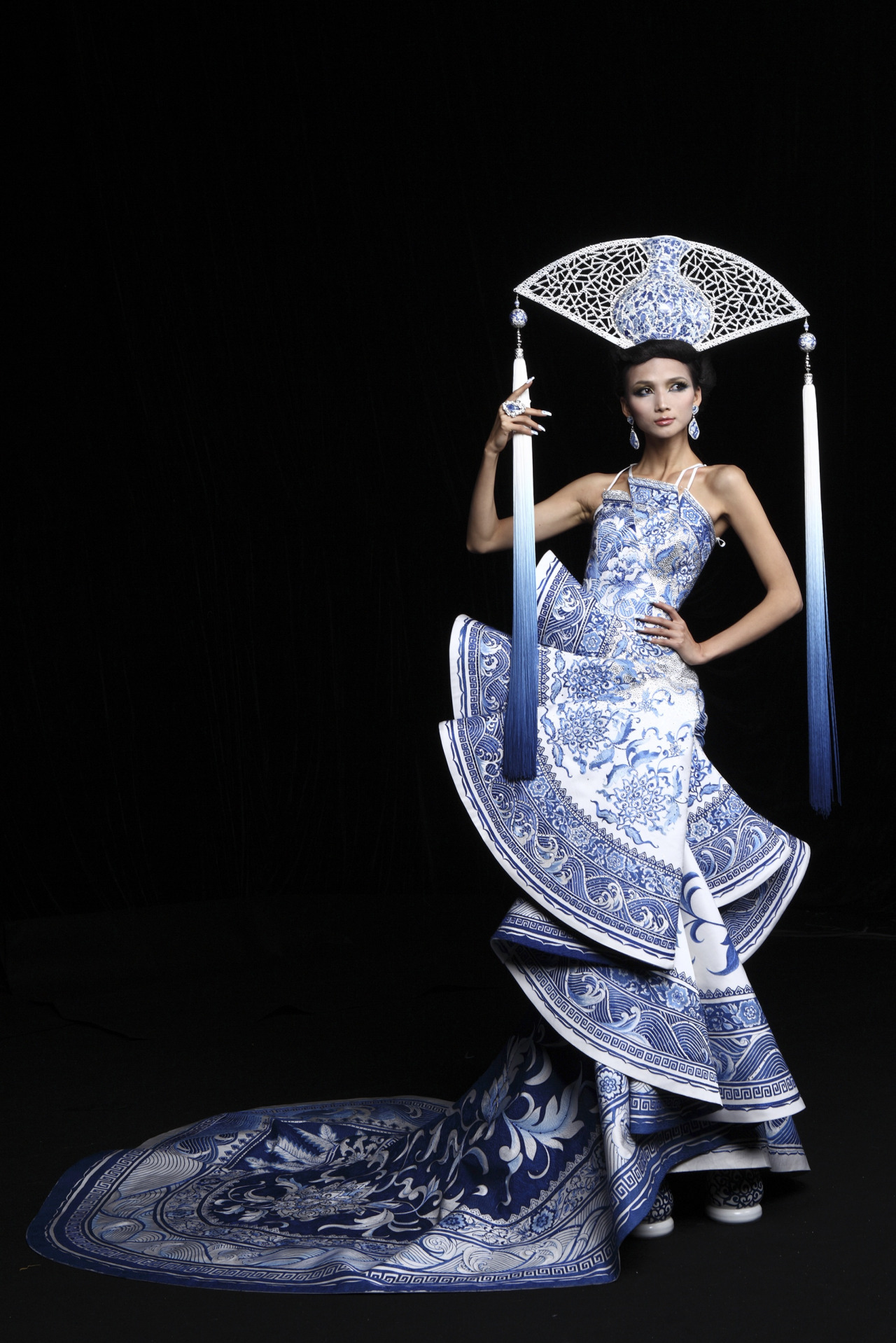
First of all, if you didn’t already know about Guo Pei, feast your eyes upon her beloved, amazing work. She is China’s premier haute couture designer. She is stunning and talented and I would probably kill a white man for the chance to wear some of her designs. Sometimes when I’m putting together outfits I’m picturing her 2010 One Thousand and Two Arabian Nights Collection in my head as I do it. We should all aspire to One Thousand and Two Arabian Nights.

Chinese woman in a dress designed to evoke blue porcelain

In an interview with Maosuit in 2012, Guo Pei noted:

Often fashion industry executives come to China or visit my studio and are shocked to see the level of fashion in China. One French fashion expert came to visit my studio and was completely surprised to see haute couture in China. He didn’t think it could exist outside Europe. 

Given that atrocity, I’m super glad that Rihanna chose to wear her, and that now lots of people around the world are looking into her work. That’s great! That’s a great outcome from the Met Gala and the theme. What a shame an amazing Chinese couturier can’t get a leg up in the Western fashion world.

(Incidentally, in 2010 she was compared to Charles James, and the NYT suggested she had in fact surpassed Paris designers.)

Anyway.

Let’s talk poppies.

Opium is so fraught in China, particularly in regards to China’s history with Britain and various other Allies. The two Opium Wars occurred due to the colonialist need of Britain and other European countries to force their substandard manufacturing upon China in the 1800s. The history of opium in China is so fraught that an official delegation from the UK in 2010, that included PM David Cameron, was asked not to wear poppies for Remembrance Day because they were a “symbol of China’s humiliation at the hands of Europe.” And then they wore them anyway. (Of course they did)

I guess it shouldn’t surprise us then that, given fashion’s great history of cultural delicacy, a number of people wore dresses (or, in the case of Cara Delevingne, fake tattoos) covered in poppies. To be fair, it’s hardly their fault; an email from Vogue Social Editor Chloe Malle about the theme for China: Through the Looking Glass” mentioned that the official dress code was “China White Tie” and she wasn’t sure how people would interpret that. “China white” is at times a slang name for a type of opiate. So it’s subtle, obviously, and not at all a continuing demonstration of the cultural imperialism of the West. Not at all.

chloe sevigny in a mess of a dress made of traditional silks

And beyond poppies. Here’s the thing about Chloe Sevigny’s dress: each individual component is fine, and can be linked to a specific period in Chinese fashion history, for the most part (that front slit is a choice, I guess). Each of these eras of history had some amazing fashion! Why, then, one would choose to combine eleven trillion dynasties into one outfit is astounding.

The top is clearly half a top. Please witness our Lady of Delight Fan Bing Bing in The Empress of China for an example.

Fang Bing Bing in Empress of China in a red Tang dress

The bottom of Chloe’s dress is clearly attempting to be a cheongsam. Its variations don’t usually include a front slit. It’s not out of the realms of possibility, except that under layer clearly demonstrates it’s a side slit. The under layer is also overly long – traditionally the petticoat is only to above the knee. See one of my favourite ads from the 30s:

advertisement for cigarettes

(Don’t do cigarettes, kids) This outfit is see-through and yet entirely still accurate. It’s fitted correctly. Its slit is to the thigh but on the side. It’s tight but moves. You can see the hit of petticoat under there.

And Chloe’s biggest issue is the fit. Cheongsams are exactly tailored, and to wear one that is so long it’s crinkling unattractively on the feet is not really on. And the wrinkles. Cheongsams are kind of hard to wear, why bother wearing one if you’re not going to wear it properly?

Speaking of Our Lady of Beauty and The Most Money of Anyone Else in Chinese Media (she is currently the highest paid actress in the world):

fan bing bing in an amazing bu creation of yellow and green

Christopher Bu often dresses Fan Bing Bing. Would that he dressed all of us, but we wouldn’t be able to do him justice. Specifically I want to note him because he does some of my favourite work with combining traditional elements of Chinese fashion and design with more modern (read: Western) elements, and I adore his embroidery work. You should also be checking out his stuff.

old white lady in pyjamasA note about pyjamas:

Pyjamas make you a Shanghai Auntie, and they’re not the greatest way to evoke China. However what they are is a great joke, because a) everybody has a pair, and b) in 2010, before the World Expo, the Chinese government worked hard to eradicate public pyjama wearing across Shanghai.

Pyjamas were endorsed by Deng Xiao Ping during Opening Up, and became a fashion statement adopted from the West. It was a nice way to imitate the West, which was a big part of Opening Up. Pyjamas were also a matter of convenience – in tiny state housing, why change to dash across the road? Wear your pyjamas. So in terms of attention to theme and weird imperialistic thievery that leads to inappropriate use, this is actually incredibly on point!

And now they’re being worn to the Met! So actually anyone can wear their pyjamas. I endorse it.

You may notice I’ve only mentioned two Chinese designers here! That’s because there weren’t really that many.

Names such as Guo Pei, Christopher Bu and Bao Bao Wan may not trip off the tongue just yet, but they are the vanguard of a new invasion of Chinese fashion designers who don’t resort to the detailing of Chinese traditional dress.

And even the Guardian, which has an article asking where all the Chinese designers were, managed to make it awkward and othering, which makes everyone want to find out more about Chinese designers! Because even as they’re awesome, they’re still exotic, I guess.

(The quote above, incidentally, fails to note that these designers still do amazing traditional detailing, and Bu is known for it.)

Here, let’s palate cleanse with my other favourite Guo Pei creation.

Chinese lady consumed by a black and red dress

prepping for our well-powered dystopia

Last week Elon Musk, probably secretly a cyborg and/or Iron Man (ETA have just been told his secret identity is ElonMan), revealed Tesla’s new battery storage system, the PowerWall. In brief, in combination with a 2kWh or a 5kWh PV system (super common sizes in Australia), means cheap, long term, accessible renewable energy at an individual level. One of the problems with PV has been an inability to store enough to get through the night, when there’s no sun out recharging the PV, and it’s a peak energy usage time. A great battery would change that, allowing charging and storage to happen through the day.

Renew Economy thinks it doesn’t mean the end of coal, and the removal of houses from the grid, but it certainly changes shit up.

PV panels. It's so beautiful.

In Australia, it definitely makes PV incredibly affordable (when the battery gets here), and makes PV super competitive, what with all the sun we have. And it changes the payback period, which has long been one of the bigger concerns around installing solar power. Origin recently calculated wasted roof space across Australia, and comes in at 5.3 million homes and businesses wasting their roof space, which doesn’t even take into account other spots to put PV (or roofs on which to put gardens, but this is a solar discussion, quokkas!). Basically it’s all our dystopia dreams come true, and I wish I’d known about it last week before I handed in my latest story (more on that when it comes out, but there’s PV and Australia’s dystopia involved).

The Conversation has a great article about the ‘winners and losers’ in this situation; what’s especially great about it is how it clearly highlights that sometimes distribution companies might not allow installation to happen because there are too many systems installed in certain areas, and if that doesn’t sound like a perfect BigPower conspiracy I don’t know what does.

Related, there’s a floating solar-powered waste water treatment plant under construction in South Australia, which is going to be awesome.

And at wired, a solar powered plane. Yes. Give it to me.

Reading the Hugos: The Three-Body Problem by Li Cixin, plus Kevin J Anderson

I loved this book. I inhaled it. I spent two hours sitting on the floor of a cold, empty house, reading it as I waited for a removalist that never came, and I don’t begrudge that time.

And yet, there is a plot-twist so absurd that if it had come from an Anglophone author I would have asked if he was taking writing advice from Rupert Murdoch.  The male protagonist is bland; his family appear for one scene and then vanish, despite numerous developments that would directly affect them; I have doubts about the earth-based worldbuilding, which doesn’t stand up to scrutiny.

But I loved it.

It helps that I read the translated version.  A novel in translation can be challenging to read: phrases that felt natural in its original language become clumsy; the dialogue is nearly always stilted.  2013 saw me reading a lot of Japanese and Scandinavian crime fiction, and I couldn’t shake the feeling that my vision of the text was distorted, like I was wearing semi-opaque lenses.  I couldn’t quite bond with those novels.

With The Three-Body Problem, I appreciated that distance, because it kept reminding me not to judge it by the standards I’d apply to western writing.  That helped me tolerate — and even enjoy — the long expository scenes.  It also meant that when I hit the absurd plot twist, I didn’t write it off as hilariously bad right wing propaganda, the way I would if a western author presented such an idea with a straight face.  I’m not really up on contemporary Chinese politics, so I can’t put his work into a proper context.  I had to take it as it is, and that was refreshing.

(I did recognise one political thread: a debate between aliens about the value of totalitarianism versus democracy when it comes to the long-term survival of a culture.  Basically the only thing I know about current Chinese politics is that that is a heated issue.  Cixin himself doesn’t offer any easy answers.)

Probably part of the reason I loved it is that much of the novel is set during and immediately following the Chinese Cultural Revolution.  Reading reviews, I’m quite surprised at how little American readers seem to know about this period — several even seemed to think the setting was a Communist revolution.

I have an advantage, in that my mother studied Mandarin at university in the late 70s/early 80s, at a time when the department was basically run by Maoists.  I scribbled in her copy of the Little Red Book when I was tiny, and I’ve always been really interested in the Cultural Revolution.

One of Cixin’s themes is that everything can be distorted by politics, including the seemingly immutable facts of the universe, and the Cultural Revolution is a perfect example of how that works.  (This also makes my instinctive desire to put his work into its political context seem all the more ridiculous.)

I’ve heard that the second volume in the trilogy is more character-driven, and I really hope that’s the case, because the male protagonist here was passive and quite dull.  (As opposed to the female lead, but to say more would be a spoiler.)  But I did love The Three-Body Problem — it had lots of things I don’t like, yet it executed them all on such a scale, and with such confidence, that I was drawn in despite myself.  I thoroughly enjoyed reading it, even when I was texting Stephanie to tell her that [SPOILERS] are really [SPOILERS] for a [SPOILER].

At this point, I think The Three-Body Problem is likely to get my first preference in the ballot, and it is absolutely deserving.

Kevin J Anderson’s The Dark Between the Stars, however, is going to go below No Award.  That, too, is deserving.

Obviously Three-Body was going to be a hard act to follow, but The Dark Between the Stars had numerous strikes against it.  I read six chapters (remember, I said I’d give a book three chapters to convince me, so really, I went above and beyond).

I’d complain about Anderson’s two-dimensional female characters, but actually, the men are no better.  I didn’t much care for his depiction of a bitchy, career-driven wife and mother and the husband who kidnaps their son and escapes her.  (It’s not that these things don’t happen, it’s just the complete lack of nuance.)

I had even less time for the clumsy writing, where characters take several chapters to figure out things that were obvious to the reader from the very first scene.  I have no idea what the plot was going to be, or the history of this universe — which I believe is one Anderson has written in before — because the writing was so terrible, my brain just went NOPE and shut down.

An animated gif of an octopus scuttling across the field, the words

That octopus really speaks to me.

Now I’m reading The Outback Stars, which is also terrible, and yet really interesting?  ABORIGINAL RUNES.  But also a completely dysfunctional stores department on a starship, which is (a) interesting; (b) relevant to my peculiar interest in workplace issues; (c) a side of milSF we don’t often get to see.

I mean, that aspect is still terrible (fake rape claims!  All the Japanese officers are either Yakuza or prostitutes!  The space navy is allegedly based on the Australian navy but has US-style rules against fraternisation!), plus I really don’t care for the romance.  And yet I keep reading, because [see (a) through (c)].

Stay tuned for a No Award post about the trilogy.  It’s quite something.

a selfish rabble

It makes Steph really happy that the selfish rabble of Australians and people around the rest of the world exists. We’re condemning the forced closure of remote communities. May 1 was an international day of protest and action. I was at the Melbourne protest, and we shut down Melbourne during peak hour on a Football Friday.

I got into fights with white men. Exclusively white men, which tells you a lot. Their arguments essentially devolved into two key elements. “You’re losing your audience. You gotta let people get home.” Mad chookas to the chick behind me who followed up my argument, after he got stuck on ‘you gotta let people get home,’ with “People are losing their homes, mate.”

“Peaceful protest does nothing. You have to fight their militia with a militia. You have to militarise.” Also, I note, a white man.

Police look on as protesters stage a sit down protest outside of Flinders Street Station. Photograph: Scott Barbour/Getty Images

It was crowded, and we blocked traffic. It was definitely an inconvenience.

Someone from WAR read out what Bolt had written; that it’d be great if we’d done it on a quieter street, making less inconvenience. Which completely misses the point.

I’d like to note, though, that every time someone yelled ‘make room’ for a person with assistive mobility tech, we made room for that person to get through to Flinders Street; often that way was led by a protester clearing space for them.

I loved the guy from Country West of Melbourne who said, “Let me read you something my Great Grandmother wrote me. ‘ALWAYS WAS, ALWAYS WILL BE, ABORIGINAL LAND.'”

There was a passion and a power and a vibe, and please keep on.

There’s a reason why I continue being part of this selfish rabble. It’s not at all to be selfish – surely it is easy to see that this is not selfishness, but selflessness. I am a latecomer to this land – born on stolen land in the 80s, to latecomers to the land. We have plenty of unviable communities remotely, rurally; and at least Indigenous Communities have a cultural connection, have a continuing relationship to the land, and aren’t built on stolen promises and stolen lives and stolen children. If I can fight for my right to vote, or to be allowed to work in this country, both things people had to fight for decades ago for me to do them now, I can damn well fight for the right of Indigenous Australians to live on the land that wasn’t stolen from them.

Some links:

The live blog from The Guardian

At Buzzfeed

At the ABC

A piece on the latest raid at Heirisson Island from a NZ station

You can find more stuff at #sosblakaustralia and by following @sosblakaustralia

Wednesday reading (on Thursday)

Yesterday was just very busy, okay?  On the upside, the old house is now clean and empty, with the very last round of stuff to be picked up this evening.  I guess I can take time out of reading Free Comic Book Day stuff on Saturday to drop off the keys.

Books Recently Read

The Life and Death of Harold Holt by Tom Frame

This wound up being a bit of a slog, which is what happens when you have a subject who’s basically a decent person who avoided major scandals and kept his private life to himself.  But it didn’t destroy my illusions about Holt being quite a good sort, and made me extra-sad that the Liberal Party has become everything that Menzies and Holt wanted to avoid.

Also read: four out of the five Hugo-nominated short stories.  But you all knew that, because that post was the second-most visited on this blog ever.  (The first: the one where I spoil the ending of the Australian Secrets & Lies.  IDK, it got picked up by an entertainment site or something.)

General consensus on that post seems to be that I’m an easy grader.  And I agree; I think I was trying too hard to not seem like I was rejecting stories just because they were on a slate I strongly disagree with.  So I’m inclined to unearth some of the nominated stories of recent years, read those, and reconsider my choices for this year.

Currently reading…

The Three-Body Problem by Liu Cixin

A nominated novel, of course, and a very good one so far.  I had heard it described as didactic and heavy on the exposition, which are two of my least favourite things ever in fiction — Stephanie, back in our Ann Leckie discussion, was curious to see how I’d cope with Chinese SF — but so far, so good?

But then, I really need some of the scientific exposition Liu supplies — I don’t have much of an education in science at all, and I just can’t get my head around physics whatsoever.  I struggled with the science in Rosemary Kirstein’s The Steerswoman — note to self, make Stephanie read that series so we can talk about it — so the contemporary/near future/recent past stuff is way over my head.

I’ll do a proper post about The Three-Body Problem when I’m finished.

What I’m reading next…

I have the nominated Kevin J Anderson novel checked out from the elibrary.  I don’t expect it will be difficult.  (Not an insult — I love good, solid storytelling.  I breezed through Leviathan Wakes when that was nominated, and loved it.)

I also have The Outback Stars by Sandra McDonald checked out.  I hope it’s good, but Americans writing about Australian Indigenous cultures is always rich with the potential for grossness.  Either way, I’ll probably get a post out of it.  I think Steph is also going to read it, so maybe we can make it substantial.

Liz reads the 2015 Hugo-nominated short stories

I thought that Project: Read As Much As Possible And Vote By Merit would be easier if I didn’t sit around waiting for the voter pack.  Accordingly, I’ve reserved a bunch of the nominated novels at my elibrary of preference.  As for short stories, all but one are available online, and I’ve started reading and organising my preferences.

(I really love preferential voting.  I like to have my senate ballots prepared weeks ahead of an election.  Of course I vote below the line.  SO GREAT.)

The stories!

“On A Spiritual Plain” by Lou Antonelli

It’s not clear whether this version on Antonelli’s blog is the same as that published in Sci Phi Journal #2.  For the sake of my embarrassment squick, I hope not.  The blog version’s dialogue is full of run on sentences, which (aside from being grammatically problematic) makes it a bit hard to read.  I dearly hope it’s a first draft.

Anyway, it’s a story about an alien planet whose magnetic field creates ghosts of the dead, and a human chaplain who has to deal with the first human ghost.

The concept is mildly interesting, the execution mildly frustrating.  An example:

Ymilans believe–as do many Terran religions–that each individual has a spark of an eternal extra-dimensional over-arching consciousness that is imbued in each of them at birth and ultimately returns to a higher dimensional plane when the physical form is no longer viable. I told him we call it the “soul”. They also know–I won’t say believe because the evidence was obvious on Ymilas–that while alive we develop an electromagnetic imprint as a result of the experiences of life that survives after death. I told Dergec an ancient Terran religion had the same belief, and in fact built elaborate pyramids and tombs filled with personal belongings to keep those spirits happy.

I don’t know that the Egyptian concept of the ba had anything whatsoever to do with electromagnetism, but the Ymilan religion — where ancestors remain part of a person’s life after death — has more to do with Chinese beliefs anyway.  Beliefs which are contemporary and actually practised right now in the actual real world, and aren’t in fact alien in any way whatsoever.  That the author doesn’t seem to realise this is … well, it shows a certain carelessness in research, or a lack of general knowledge, or maybe a cultural arrogance?

I found the writing amateurish and the central idea poorly executed.  This is going above No Award, but only because it’s not actually insulting.

“The Parliament of Beasts and Birds” by John C Wright

This is actually insulting.  If Bible-quoting animals debating their place in the world after the extinction of humanity is your idea of a good time, this might be the story for you.  If you thought that The Last Battle was amazing but needed to make its metaphors more obvious, this is definitely for you. If you like interesting, original and insightful fiction, I’m sorry, you will have to move on.

Wright is trying very hard to incorporate Catholic theology into this story, but the result frankly makes me a bit embarrassed to share a religion with him.  It takes a very talented writer to pull off explicitly Christian references in what appears to be a secondary world fantasy setting, and John C Wright is no C S Lewis.

Going below No Award.

(A note: both of these short stories have been posted to blogs but formatted for paper — indents, no paragraph spacing, etc.  Guys, don’t do that.  It’s fine for a book or ereader, but in the context of a website, it’s just hard to read.  And neither story has been worth the eye strain.)

“Totaled” by Kary English

Finally, some formatting I can read!

And this is the best story so far, which is not to say it’s not derivative in concept and execution, and kind of sexist in its portrayal of the sandwich-fetching grad student hated by the heroine.  A scientist working on the preservation of living tissue after death is killed in an accident, her brain is preserved, but she only gets a short afterlife before decay sets in.

The idea’s been done a bunch of times, but this gets a neat ZOMGObamacare twist: preservation is dependent on your monetary worth.  Death panels, guys! It’s weird and specifically American, but hey, this is an American story.

I’m pretty lukewarm overall, but it was readable (in every sense of the word) and largely inoffensive.  I’m probably going to give this my first preference.

“Turncoat” by Steve Rzasa

Look, the integration of human, AI and spaceship is not a new idea.  Anne McCaffrey wrote The Ship Who Sang before I was born; Ann Leckie gave the concept a powerful new twist, oh, just a couple of years ago.

I guess Rzasa deserves some praise for claiming the subgenre for People Who Aren’t Named Ann(e), but it’s just soooooo boring.  A whole paragraph about the protagonist’s hull and weaponry?  *snore*

This feels like the author read Ancillary Justice and went, “Yes, but what this really needs is less ambiguity and a really boring main character.”  It’s competently written, which is sadly high praise for the short story category this year, but that’s all I can say.

This whole “vote by merits” thing is really hard, guys.  Like, I don’t think that this deserves an award.  And yet two-fifths of the category is SO BAD that the overall standard is so low, I can’t in good conscience NOT place it second on my ballot.

The fifth nominated story is “A Single Samurai” by Stephen Diamond, which doesn’t appear to be available online.  That will have to wait for the voter pack.  Until I’ve read it, my ballot currently looks like:

  1. “Totaled”
  2. “Turncoat”
  3. “On A Spiritual Plain”
  4. No Award
  5. “The Parliament of Beasts and Birds”

(I keep typing “The Parliament of Beats and Birds”, which I presume is about DJs and HORRIBLE AVIANS gathering together to work out their place in the universe after the fall of non-DJ humanity.)

birds of australia: rainbow lorikeet

This month in Birds of Australia with Hayley and Michael, we bring you Michael being wrong.

Hayley Says

Look, I want it straight from the beginning that I love parrots. Parrots are my favourite species of bird alongside owls and ordinarily I adore all varieties of these extremely clever, colourful and cute birds.

But rainbow lorikeets are destructive, brightly coloured emissaries from BIRD HELL.

rainbow lorikeet sitting in a tree. image by michael.
contemplating the destruction it hath wrought

“Oh but they’re so beautiful Hayley, with all their flashy bright colours, like a casino or carnival sideshow alley, two other things that distract me with visuals while committing untold evil right under my nose.” NO, WRONG, WHY DID YOU EVER LISTEN TO KEATS WHEN HE SAID BEAUTY EQUALED TRUTH, KEATS DIDN’T KNOW SHIT ABOUT BIRDS AND WAS FULL OF LIIIIIIIIIES.

I am here to prove to you that rainbow lorikeets are nasty, bullying, loud, messy, feral birds that you should never let near your person, your garden, your city, your life. Order of the day is: rainbow lorikeets are bastards.

Rainbow lorikeets are highly territorial about their breeding areas, and will aggressively attack other birds to drive them away, and not just smaller birds like noisy miners, but large birds like magpies. I’m not sure if you’re aware of the dangerous nature of the Australian magpie, but they are not to be trifled with, and the fact that flocks of lorikeets regularly succeed in driving off nesting magpies proves that lorikeets are FUCKING TERRIFYING.

What is most terrifying about lorikeets is when they become established in a non-native environment. A release of lorikeets in Perth in the 1960s (rumoured to have originated from the University of WA, ACADEMICS YOU SHOULD KNOW BETTER) has resulted in a feral population that has officially been declared pests. Settling in the metro area, giant flocks of lorikeets now travel daily, using the highways to navigate, and descend upon the orchards and vineyards of the Swan Valley stripping them of their fruit, which has resulted in the Western Australian government instigating culls of the bird. They also compete with many native WA species for nesting hollows, muscling out species such as the purple-crowned lorikeet and Carnaby’s black cockatoo, the latter of which is endangered. There are also introduced populations of lorikeets in Auckland, New Zealand, which also precipitated a government enforced cull, and in Hong Kong. Rainbow lorikeets could descend upon your city AT ANY MOMENT.

And as if that wasn’t bad enough, rainbow lorikeets are noise polluters. You will know when a flock of lorries are in the neighbourhood because the noise is WINDOW SHATTERINGLY LOUD AND OBNOXIOUS. How anyone can enjoy these shrill, piercing shrieks I have no idea. Walking under flocks of them rustling about in trees I have to clasp my hands over my ears so as not to go immediately deaf. Also if flocks take up residence in your neighbourhood, along with noise-cancelling headphones make sure you get shoes you don’t mind been ruined by MOUNTAINS OF LORRY SHIT.

I should at least give rainbow lorikeets some grudging credit for adapting so well to urban environments, but there’s one way this adaptation is actually killing them – idiot humans feeding them food that is bad for their little guts and giving them bacterial bowel infections. So if you wind up somewhere where rainbow lorikeet feeding is an attraction, don’t participate, don’t leave bread or honey or artificial nectar out for them in your own garden, it is all a very bad idea. Especially because they’ll just swarm in making a horrid noise, poop everywhere, muscle out all the other birds and ruin your fruit trees.

One feather.


Michael Says

As I’m sure you’ve realised by now, I like to cultivate an identity as a bit of a bird nerd – constantly carting my binoculars around with me, correcting people who talk about birds (“They’re silver gulls. There’s actually no such bird as a seagull.” etc) and spoiling holidays by insisting on taking a detour past a swamp or a sewerage pond. It’s all part of my shtick. And key to any self-respecting bird-nerds shtick is a disdain for the showy and obvious birds, the common and colourful birds. “Sure, sure, that rainbow bee-eater is lovely,” I’m meant to say, “but look at the subtle stippling on that brown thornbill. Now that’s beautiful!”

Well pish posh to that. I guess I better hand in my twitchin’ licence and my binoculars, because I am an absolute sucker for gaudy, colourful birds – the more extravagant the better. There’s a certain embarrassing pride that comes from knowing your thornbills from your weebills (full disclosure: I misidentify these birds about 70% of the time), but nothing beats a ludicrously colourful parrot screeching aggressively in your face. Nothing.

A brightly coloured lorikeet sitting on a branch
Rainbow Lorikeet by Fir0002 via flickr

I know, I know – mean ol’ rainbow lorikeets are the bullies of the parrot world, driving other species out of nesting hollows and officially achieving ‘pest’ status in WA, but like Rory Gilmore confronted with Jess’ broodingly attractive awfulness, I just don’t care. I’ll take beauty every time. And look, rainbow lorikeets are ridiculously, astoundingly beautiful. LOOK!

They’re so common around Australian cities that we forget how remarkable they are – we barely even glance up as they cut across the sky like little groups of flying jewels. Ask an overseas visitor what they think of them and I guarantee you they love the goddamn hell out of them. The only reason SOME PEOPLE don’t is because they’ve stopped really looking at them, or have generally lost the ability to feel joy. As Miss Piggy famously said, “Beauty is in the eye of the beholder and it may be necessary from time to time to give a stupid or misinformed beholder a black eye.”

It’s worth remembering that the current oversized population of rainbow lorikeets is a slightly odd aberration – up until the 1960s, rainbow lorikeets were almost never seen in Victoria and were scarce around Sydney. For some reason, the population blew up in the 1970s and 80s and they spread throughout the Eastern states – it’s all a bit mysterious, although increasing urban growth of native flowering plants, feeding stations and even Currumbin Sanctuary have been blamed.

They’re now firmly a bird of the urban environment, feeding on an array of flowers but also on fruit, seeds, insects and, in a horrifying recent development, raw meat. They nest in hollows, which they aggressively stake out, putting pressure on meeker parrot species who are bullied out of nesting sites (although it’s hard to feel sorry for the much bigger Australian Ringnecks, who really just need to toughen up a bit). And yes, they’re considered pests by some people. Particularly by farmers in WA, who complain that the birds destroy their precious orchards. It’s worth remembering though, that farmers will complain about anything – if we listened to farmers, Western Australia wouldn’t have any Australian ringnecks left to worry about because the farmers would have shot them all). If we listened to farmers, we’d be shooting flying foxes left, right and centre (oh wait, we already are).

Look, the point is: farmers love nothing more than complaining (except maybe shooting native animals), so I’m not going to listen to their whining about one of the most beautiful birds in the world. Get over it farmers! Who eats fruit anyway? Rainbow lorikeets bring colour and joy to the drabness of the city, bring beauty to our otherwise grey urban existences and scare the shit out of our cat when they fly, screeching, just a few metres above our balcony. I bloody love them, and so should you.

Five feathers.

rainbow lorikeet by michael

Bird: Rainbow Lorikeet

Hayley: One feather

Michael: Five feathers

linkspam goes out to the one i love

CEPHALOPOD SELFIES

No Award has very mixed feelings about Anzac Day and how it’s gone from a reminder of a time we totally fucked it to a Nationalistic orgy of war mongering and celebration. But maybe we can all agree that the commercialisation of the death of many Australians in a war is not a great thing? Woolworths debacle: Minister for Veterans Affairs attacks Anzac ad campaign; Poppies for Profit. And some other articles: Anzac Day a jarring experience for migrant Australians at Eureka Street; Fresh Failure at Overland. Also Liz wrote for Spook! Lest we forget to cough up some coin: How the ANZAC spirit became a cash cow.

Good times (not good times): Detention centre guards totally racist and into anti-Halal and Reclaim Australia shenanigans. Also you know it’s a bad day when Steph learns a new racist slur.

Aussie pulp fiction of the 40s and 50s. AMAZING.

Don’t make bicyclists more visible. Make drivers stop hitting them. At WaPo.

Friend of No Award Fei is involved in a comic about science! Science Adventures with Rabbit and Cat. Check it out!

Steph really hopes you read her review of reviews of Howard’s Menzies book. She didn’t want to read the whole book, so she reviewed reviews instead! Also with a drinking game, and Liz’s love of Holt.

Jess Ainscough, Belle Gibson and the New Purity Movement: How Nutritionism and Pseudoscience Overtook the Fundamentalist Focus on Bodily Integrity and Acceptable Femininity  It’s possible that Rebecca is drawing a bit of a long bow, comparing the Cult of Wellness to the Cult of Sexual Purity … you know what?  Liz changed her mind as she typed that.  Carry on.

On a related note, Liz’s coworker told her on Monday that drinking chilled water will give her cancer.  Snopes is here to reassure you that isn’t even slightly true.

(Said coworker also believes that a thick coating of tea tannins on unwashed porcelain is better for your health than vaccines, so, y’know.)

Important London fatberg update: 10 tonne fatberg removed from Chelsea sewer.

# Lighten Up, on skin colour and privilege in comics/illustration. A great comic that Steph is in love with.

A survey of non-US fans re: the Hugo Awards.

Very UK-centric, but the cold truth about our thirst for bottled water. As Australians, there are very few places where you should be choosing bottled water over tap water. A quick google gives us some Australian city or drinking fountain maps: Melbourne, Wangaratta, Perth.  And a 5 minute cartoon on nurdles and plastic waste.

Wednesday Reading

I have successfully moved house, and some time this year, the old house will be clean and empty, and I will have functional, fast internet at my new place, and won’t be a massive ball of stress.

In the meantime, just about the only thing I have time for is reading as I wait for buses and take trans between home, work and the old place.  So here is a post, based on a meme popular on my Dreamwidth circle in 2014, that I will try to make a regular thing.

Books Recently Read

Sense and Sensibility by Jane Austen with annotations by David M Shapard

S&S has never been my favourite Austen novel, but a friend was recently dumped by her boyfriend (Kickstarter to set him on fire, btw), and coped by going the full Marianne Dashwood, ie, not coping at all.  And that got me thinking how this is one of Austen’s novels that translates particularly well to the modern day, and wondering how that would be done.  Luckily, I had the annotated edition already on my Kindle.

Anyway, the great thing about S&S is that, while every single literate woman on the planet thinks she is Lizzy Bennet, there’s a bit more variation in the question of whether or not you’re an Elinor or a Marianne.  (I’m an Elinor, obviously.)

What struck me on this read-through is that Mrs Jennings, one of Austen’s most ridiculous characters, is also extremely kind, and part of Marianne’s growth is in realising this and valuing her for it, whereas previously she looked down on Mrs Jennings for being vulgar and overly familiar.

Following the book, I’ve acquired copies of the 1996 movie, the 1971 miniseries and the 2007-ish miniseries.  One day I might even have time to watch them.

Still thinking about a modern S&S, and wondering what and who Colonel Brandon would be in a contemporary Australian setting, I read…

Uncommon Soldier by Chris Masters, an account of the training, duties and general experiences of the contemporary Australian soldier, with particular emphasis on service in Afghanistan.

This was an interesting read, frequently made unnecessarily confusing by getting bogged down in acronym soup.  The earlier chapters, about training, including the professional paths and cultures for recruits, ADFA graduates and Duntroon cadets, was more interesting to me, and easier to follow, than the later chapters based on Masters’ experience as an embedded journalist in Afghanistan.

I definitely learnt a lot more about Australia’s role in Afghanistan, and while I am never going to be comfortable with a situation where civilians are so vulnerable, I came away with the impression that the Australian forces were more professional and culturally sensitive than, say, the US.  But also that Masters — probably because he himself is a white Australian man — wasn’t in a good position to see the times where that was not the case.

For similar reasons, I felt that Masters didn’t spend enough time discussing the experiences of female soldiers and officers, or of any military personnel who weren’t straight, white and male.  (Although homsexuality is legal in the Australian defence forces, he notes that homophobia is rampant, to the point where a commando only came out at his retirement party.)

In short, an informative but disquieting read.

Currently reading…

The Life and Death of Harold Holt by Tom Frame.

Saying “May the Sea Return Him” is all very well, but I realised last week that I don’t actually know very much about Holt as a person or politician, save that he was more progressive than he’s often given credit for, and that his life was less interesting than his death.

I’m only 15% into the book, but Frame makes a good argument for Holt’s life being, in fact, reasonably interesting — his parents divorced, his father married a woman Holt himself was courting — but also very private, with few records remaining.  Of Holt’s politics, it’s too soon to say; like most Australian conservatives of the 1940s, he was primarily concerned with finding a democratic balance between socialism and fascism, and upholding the glory of the British Empire.

On entering Parliament, Holt was 27 years old, the most eligible bachelor in the House of Representatives.  One highlight is his thoughts on women and fashion:

“I don’t like women to dress so conspicuously that they make a man feel hot under the collar to be seen with them but on the other hand, they should not be too inconspicuous.  Women seem to be most charming in summer frocks, plain, cool linens, prints and all that sort of thing. Perhaps it’s the prettier colours that appeal to me.  I like pastel shades very much and all the ‘off’ colours, dusty pinks, blues, greens and so on.  They are more subtle.”

He concluded that most women ‘dress to make their sisters sit up and take notice’.

My thoughts:

1. Thanks, Harold, but I’ll dress as conspicuously or otherwise as I want.

2. More male politicians should share their feelings about pretty colours and pastels.  It’s nice.

3. It’s depressing how refreshing it is to see a bloke point out that women mostly dress for themselves and each other.

What I’m reading next…

It’s Hugo season!  Suffice to say there have been some issues this year, and very little of what I nominated made the short lists.

I’ve been chewing over my voting intentions for a couple of weeks, and while I was initially tempted to vote No Award for any Puppy Slate works, I’ve decided that it would be fairer to read everything I can and vote on the merits.

Accordingly, I’ve resolved to read every short story, at least three chapters of every nominated novel, and at least 25% of every novella.  And I’m going to blog about them here.  Look, we named this blog for maximum confusion/hilarious trolling, it’s practically made for this type of thing.

I’ve borrowed The Three Body Problem from the library, requested the Kevin J Anderson novel, and made a note of where I can get the other nominated novels. Short stories etc can wait for the voting pack.

I’m quite excited to read The Three Body Problem, because I’ve wanted to read it since I first heard it was being translated, and until recently the ebook was going for about AU$30.  But I’m also nervous, because I hear it’s quite didactic, which Stephanie says is a feature of Chinese literature, but also something I don’t much care for.  Fingers crossed!

I’m hoping that I’ll like it enough to rank it above Ancillary Sword, which I enjoyed but found inferior to Ancillary Justice.  I do not like to agree with the Sad/Rabid Puppies on anything, but I did feel like Leckie prioritised exposition about social justice over plot in that book.  Unlike the Puppies, I’m quite pro social justice, I just like a bit of subtlety, or at least originality.

I also just became aware of Sandra McDonald, an American author with an SF series “based on native Australian culture”, according to Amazon.  I like bits and pieces of the blurb, but the potential for a trainwreck is also pretty high.  Again, if I have thoughts, I’ll share them here.