There are books that I recommend to everyone, books that I want everyone in the world to read and love, and I am always interested when people tell me their always-recommends. So I was excited at the recent open thread up at Captain Awkward looking at exactly that; and super disappointed that it was super dudely and super white. I know that’s inevitable, in its way and in the nature of our internet and our (western) society, but still, disappointment. So I made my own open thread.
What are the books that you always recommend to people, that you always want people to love, that you shove at people and wave your hands about and reread constantly? Only rule: the author cannot be a cis white dude. Trans white dude, fine. Cis asian dude, fine. Ladies, all fine. Author doesn’t conform to your gender binary? All good.
Here, I’ll start.
The Pillow Book of Sei Shonagon: the only book I took with me in hardcopy when I moved to Beijing; a book I’ve filled with annotations and which was one of the most formative books on my writing style; a book that filled me with joy the first time I ever read it. I give it as presents and I talk about it a lot, but I never lend out my copy because it says a lot about me. TOO MUCH.
Growing Up Asian in Australia (ed Alice Pung): I wish this book had come to me when I was younger, but even as an adult it resonates and is an amazing reflection on the Asian-Australian experience that should be vital reading for all Australians.
Heartsick for Country (ed Sally Morgan, Tjalaminu Mia & Blaze Kwaymullina): another must read for all Australians. I cry every time I read this book, this reflection on being Indigenous Australian and the connection between Indigenous Australians and their countries, and that feeling of heartsickness at damage to the land, at history, at racism and at everything else. ALL THE CRIES. ALL THE RECOMMENDS. This book always reinflames my desire to be the best Australian I can be, prioritising Indigenous Australians and the land and just adflkadf.
I’m pretty sure I promised Stephanie that I would review The Deep ASAP, so that she can borrow the graphic novels off me. But I’m tired, I’m arthritic, I have a cold. So here’s a whole bunch of things.
Further to previous posts
1. In my second Dance Academy post, I said some nice things about Ben Tickle, to wit, that I was unfair to dismiss him as a creepy and annoying Nice Guy.
As of last week’s episode, I hereby take that back, and every other nice thing I said about him as well. SO THERE.
(I also learnt that Stephanie herself could have featured in the advertising, but people thought she was too busy and didn’t need the extra stress. When will we learn: Stephanie always needs the extra stress.)
(Not really.)
Anyway, I still maintain that there’s an uncomfortable white saviour narrative at work in the Greens’ visual presentation, but the Greens were doing better than I had realised. And I am really happy that Bandt kept his seat (and sorry that my local Greens candidate, Tim Read, didn’t beat the Libs into second place behind Labor.)
(Living in the second safest Labor seat in the country, you take what you can get.)
Yes, there was an election
And the capitalistic, socially conservative Liberal Party won. They claim they have a mandate, even though the swing away from the ALP generally went to new parties such as Palmer United, and even though it looks like three Senate seats will go to extreme fringe parties: the libertarian Australian Liberals, the Sports Party and the Motoring Enthusiasts Party.
There has been a lot of classism about the Twitters with regards to the Motoring Party’s new senator. I’m kind of hoping he turns out to be a brilliant leader, just to shut that up. But as his Facebook revealed that he’s a 9/11 truther and a misogynist, I’m not holding my breath.
As usual after a conservative win, there has been a lot of gnashing of teeth and threats to move to Canada (where Quebec is banning “prominent” religious symbols that coincidentally are mostly used by minorities) and New Zealand (which already has a conservative government and shite economy). I like Stephanie’s response best:
This country will have to be pried from my dead, cold, queer asian hands. It’s mine and I’m staying right here and kicking everything over until I’ve got my fingerprints all over the furniture and everything is just the way I like it.
Now that it’s almost over, we’re down to dissecting the campaign.
I, for one, was quite troubled by the Liberals’ strategy of silencing their candidates of colour so as to avoid gaffes and difficult questions. This was the case in my own electorate, where candidate Shilpa Hegde did not participate in any public forums or interviews with citizen journalists. Nor was she seen out campaigning.
As a Commie leftie pinko, I should be glad to see the Liberals mis-step, even if they still win the election, but I think this is a pretty shitty approach. It’s not enough to have people of colour as your candidates, you have to let them be candidates. Allegedly, or so I read in the mainstream press (probably a Fairfax paper, but I couldn’t tell you when or which one because I’ve been site-hopping to avoid their paywall), the strategy was conceived after Jaymes Diaz famously stuffed up an interview. If they’re so worried about candidates looking stupid, though, they would have put a lid on Fiona Scott before she could tell the world that refugees cause traffic jams. Funny how it’s only the non-white candidates who were told to shut up.
And as a person who quite likes democracy, thanks, I’m pretty horrified that the Liberal Democrats got into the Senate by setting up front parties to funnel preferences their way. (They also got votes because people apparently mistook them for the actual Liberal Party. Sadly, we cannot legislate for reading comprehension.) I’ve also been less than impressed with the backroom deals done for preferences, although that had the advantage of destroying the Wikileaks Party, and wow, what a tragedy that was. Really.
The ABC’s Antony Green has an interesting article here, looking at the history of such developments, and ways we can better regulate Senate nominations without undermining democracy and shutting out smaller parties all together.
Then there was WorldCon
And the annual recriminations that follow.
Things for which there should be no recriminations whatsoever: the excellent Tansy Rayner Roberts won the Hugo Award for Best Fan Writer, making her the first Australian woman to win a Hugo. And I can’t think of anyone more deserving.
Chicks Unravel Time, to which I contributed, did not win the Hugo for Best Related Work, but I’m told that Writing Excuses, the podcast which won, is excellent. I’m mostly glad that CUT didn’t, say, lose by one vote, because I couldn’t spare the money for a supporting membership with voting rights.
(Every month, it was like, “Hmm, well, it’s only $50 … but my mobile bill is coming up, and that’s going to be $70. Next month!” Self, mobile bills are a monthly curse.)
This brings up the first round of recriminations and “what’s wrong with WorldCon” debates, “It’s too expensive.” Which, sorry, Lolmericans, I know $250 for a five-day con seems like a lot to you guys, but here in Australia, we pay that much for a three-day con. Aussiecon 4, back in 2010, was close to $400. (Luckily — or not — my mother was getting married that weekend, so I could only attend for a couple of days. Oh yeah, her divorce is being finalised next Monday, so congratulations Mum!)
I realise that going from “The supporting membership was too much” to “LOL, only $250 for attending!” isn’t exactly logical, but priorities. (And also, international travel has really done a number on my credit card.)
There was talk a couple of months ago of introducing a cheaper voting membership, but apparently that’s not practical with the (amazing and brilliant) electronic pack of nominated works. May I humbly and cheaply suggest that I would buy a voting membership without the voting pack? I mean, I’d rather have the pack, especially since I don’t usually get access to the short stories and novellas otherwise, but it’s a sacrifice I’d be willing to make in those times when I have to choose between voting in the Hugo Awards and paying my bills.
And if your con is significantly more expensive than others, and you’re widely perceived as being less friendly and less fun, these are things you should maybe be looking at. I enjoyed AussieCon 4, but I wouldn’t say it was a fun experience (except for the times L M Myles and I spent in the bar, or making fun of terrible Doctor Who panels), and it wasn’t as friendly and open as other Australian cons I’ve seen attended. Which is, okay, Continuum.
HAVING SAID ALL THIS, I am really hoping I can get to LonCon next year, and Nine Worlds the weekend before. Lots of people I know and love are going, and it’s London, and … stuff.
Some links to WorldCon discussions:
Three Gray Fandoms – Ursula Vernon on her three fandoms, and how only one is unwelcoming to young people.
WorldCon has some Happy Things Plus Some Problems – an overview of LoneStarCon’s successes and failures. Includes an account of a wheelchair-using panellist who was unable to access the daises on which the others sat. A quote: “That’s not cool. It was an oversight in a huge, fan-run convention, so it’s not worth a rage-fueled rage.”
I have to say, I did have a rage-fueled rage about it, because this should be basic Conrunning 101. Which brings me to…
Disability, Diversity, Dignity – a further discussion of the issue. The panellist herself pops up in the comments, along with a committee member who, I have to say, does not cover herself in glory.
There are more posts over at RadishReviews — I’m cheating because I haven’t had time to read them all yet, and I’m trying to rest my mouse hand so I can play Mass Effect 2 later. Hashtag arthritislyfe.
Finally, opera
Hey, I was surprised too.
See, I don’t know much about opera, but Barbara Hambly’s Die Upon A Kiss (part of her Benjamin January series, about a free man of colour in 1830s New Orleans who teaches music and FIGHTS CRIME) is set in the opera season, and is very much concerned with the cultural differences between French and American opera fans, and also a controversial performance of Otello. (Controversial ‘cos … well, it’s the South. And Othello is quite famously black. Except when — anyway, even a white actor in blackface was too much for some historical racists.)
Every time I read that book, I think, “Opera is really interesting. I should learn more about it and maybe, like, see some and find out if I like it.”
And then the opera community goes and does something stupid, like the Melbourne run of Nixon in China where all the Chinese characters are white people in yellowface. Or, as I discovered yesterday, Queensland Opera’s Otello, with an all-white cast.
Apparently, or so QOpera said on Twitter when people began asking very pointed questions, modern thinking is that the power of Otello comes from the psychology, and race is a secondary concern. And also, they did it in South Africa with a white Othello and black cast, so what’s the problem with an all-white version?
Yyyyyyyyyyyyyyyyyyyyyyyyyyyyyyyyeah. You want to make the traditional SF fandom and community look good? Go look at opera.
Today is Indigenous Literacy Day! This is great because it means we are talking about Indigenous Literacy! This is bad because Australia, it means we still need to talk about Indigenous Literacy.
There is a huge gap in English literacy rates between Indigenous and non-Indigenous people in Australia. A disgustingly enormous, we should feel ashamed of ourselves gap. By year 3, the gap in reading, writing and numeracy is already significant, and by the age of 15, “more than one-third of Australia’s Indigenous students ‘do not have the adequate skills and knowledge in reading literacy to meet real-life challenges and may well be disadvantaged in their lives beyond school’.” MORE THAN ONE THIRD. That is so uncool I cannot even. But Indigenous Australians should just pull themselves up by their bootstraps and Australia is totally not racist, amirite?
The Indigenous Literacy Foundation works to alleviate this disadvantage for Indigenous Australians, and Indigenous Literacy Day (every September 4) is one of the ways it gathers public support. So far in 2013, $360 000 has been donated, with 100 000 books supplied in 230 remote communities. But through Indigenous Literacy Day, we can help increase those numbers! And through the rest of the year too.
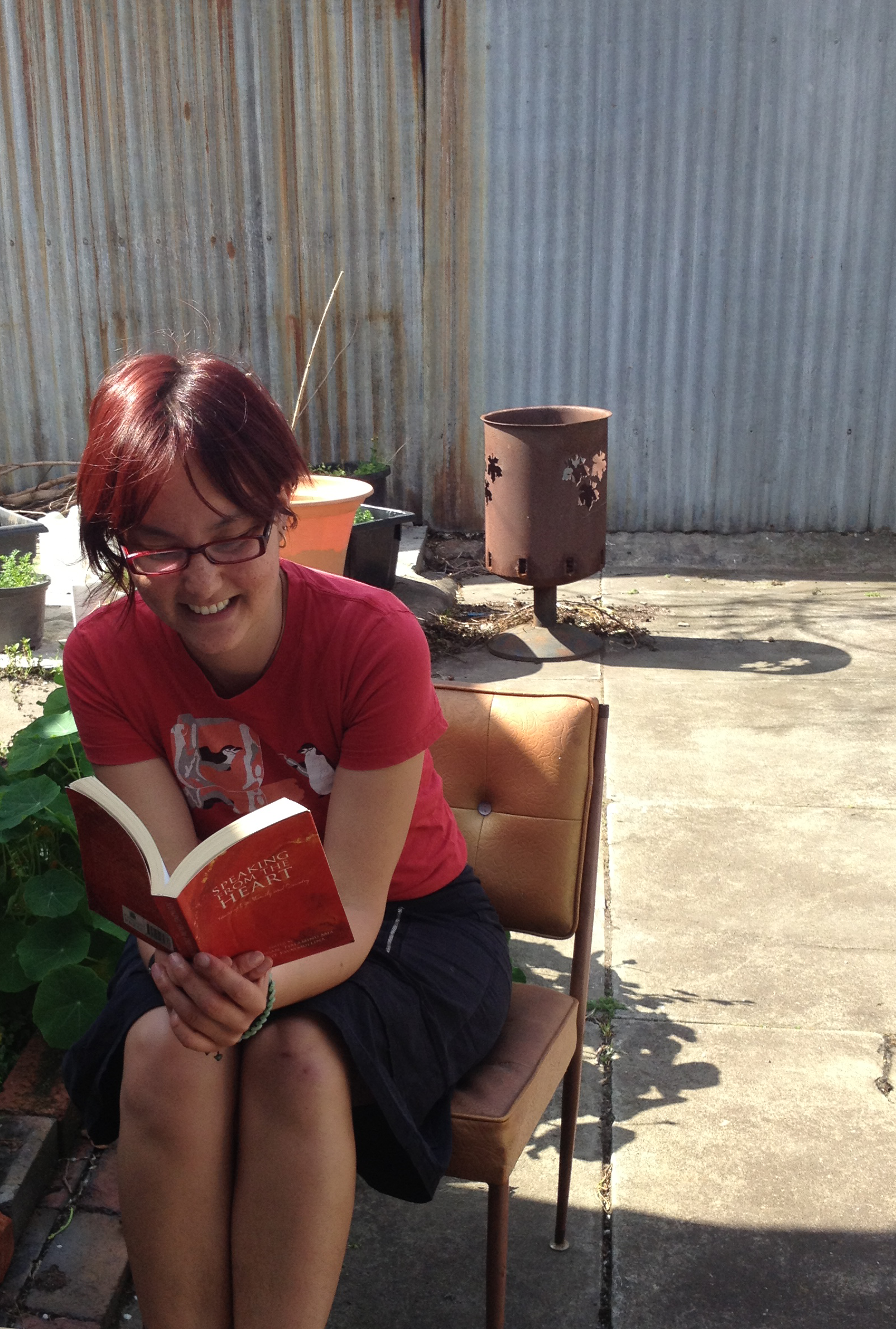
You can directly make a donation to ILF, and you can also get caught reading! Today Liz and I are making a donation to the Indigenous Literacy Fund and we have been caught reading Speaking from the Heart (by Sally Morgan, Tjalaminu Mia and Blaze Kwaymullina), and To Say Nothing of the Dog by Connie Willis.
A number of bookstores around the country are donating a percentage of all sales today to the ILF, so if you’re looking for a new book buy it from one of them today! (My book today will be purchased from Readings Carlton, who are donating 5% of all book sales today)
There is also a great blog post up at the Reconciliation Australia blog if you’d like some more info and stats and things.
Las week Mamamia chose to blog about Miley Cyrus twerking, but I know you’ll be surprised to know that they didn’t touch on the racial aspect at all. Or will you be surprised? Maybe you didn’t notice the racial aspect yourself. We’re Australian, right? How can we be expected to know the nuances of USAmerican Feminism’s racism if it’s silent about its racism?
This is a valid question! How CAN we, Australians of an intersectional nature, be expected to know about the nuances of racism in feminism? Uh, by learning it, my friends. By recognising our own and how it’s reflected in our media. By recognising that USAmerican feminism and social justice is an imperfect fit for Australia in so many ways, not least of all because of its racism and its USCentrism.
Betty Mamzelle has written an excellent article on the racial implications of Miley’s twerking, covering all sorts of aspects including expected knowledge, commodification of black bodies, representation and sexuality. Solidarity is for Miley Cyrus: The Racial Implications of her VMA Performance. It is very USA, obviously, and it is an illuminating read in many ways if you are unaware of how racial sexualism and its politics works. And the theories within it are applicable to Australian racial politics!
As Australians I don’t think we need to be experts in the racial politics of other countries; but as Australians heavily influenced by USA media and more importantly heavily influenced by USA social justice blogging and articles, I think it behooves us to understand exactly what it is that we’re consuming. It also behooves us to more critically examinewhy it is that we are consuming it. (there are three links in that sentence for your further reading)
Remember when the Jackson Jive thing happened on Hey Hey It’s Saturday? A totally racist thing of blackface, for sure, and then dismissed as a USA thing that we couldn’t have known. Aside from the massive prevalence of US narratives in Australia from the period in which blackface was a huge thing, blackface is an Australian thing, too, something Australian history chooses to forget as it picks and chooses and copies from White American Feminism. I recommend reading White Australia has a blackface history by Maxine Clarke at Overland for some backgrounding; it was an important piece to me in 2009 and is still an important piece to me now on this issue.
Look, there is a limit to the USAmerican-ness of our Australian Feminism. Did you know that Australian intersectional commentators (myself included) were also expected to know that Jackson Jive = a shuck and jive reference = intentional reference to shucking and jiving? We were. And how could we? There is only so much USCentrism we can suck down. And this is not new. The Amazing Chally has long been at the forefront (for me) of Australia is not the USA and we don’t need their White Lady Feminism
By the way if you missed #solidarityisforwhitewomen on twitter, well, I’m sorry, I meant to post about it but it just didn’t happen. At some point I’d like to talk about how this applies to Australia and the ways in which it doesn’t, but for now you can read (USA narratives) Why “solidarity” is bullshit at Bitch and Solidarity is for white women (but it doesn’t have to be) by Betty Mamzelle.
Some links:
On being black and not existing (2011) by LJ User little_seahorses, on being Indigenous and growing up in a racist country where academics assert they don’t exist.
Nowhere near good enough (2009) by Chally on the continuing removal of Indigenous children from their families, and how this continuation of the Stolen Generation is Australia’s ongoing racism at work.
When racism becomes a white person’s issue (2013) by Ruby Hamad on how one step for one is a step for all, but only when that one is a white lady (with reference to USAmerican TV)
It’s election season in Australia. It feels like certain parties have been campaigning since the last election, but no, that happy time is actually upon us for real. And what a campaign it’s been. The highlight for me has been watching the Wikileaks Party collapse into a completely predictable morass of hypocrisy, but really, if it’s a minor party — or a major one, come to that — acting like amateurs you’re after, this is the election campaign for you.
Because it’s impossible to waste your vote in Australia, I’ve always given my first preference to the Greens, on the grounds that a big enough far-left presence will facilitate (or, you know, force) compromise in the major parties. But I’ve otherwise considered myself an ALP supporter.
Exciting fact: nothing will have me throwing my wholehearted support behind the Greens like instituting a horrible refugee policy that involves shipping asylum seekers to Papua New Guinea and ensuring there is no possibility of their ever stepping foot in Australia.
This is shitty both to asylum seekers, and to the people of Papua New Guinea, who already deal with corrupt government, corporations trying to exploit their mineral wealth, high levels of violence, a complex system of land ownership that restricts it to members of kinship groups, and more.
(Let’s be real, though, a lot of PNG’s problems stem from that time it was Australia’s colony. Like, our actual colony. We gave it up in, what, ’74, ’75? Very shortly before my birth. So it’s really cute that now Australia is both exploiting it and using its dysfunction as scare tactic.)
I was quite angry about that, so I read the policies of every single party that had posted them, and decided I liked the Greens best. (Digression: The Palmer United Party’s policies were weirdly preoccupied with stopping Japan from buying up Australia’s mineral wealth. But Japan is not Australia’s biggest export market for minerals. That would be … seriously, you mixed up China and Japan in your policies?)
In fact, ABC’s Vote Compass tells me I’m just a degree to the right of the Greens, so why I have I been an ALP supporter all these years? (Well, because I’m a big fan of supporting workers’ rights, and that’s not really a huge priority for the Greens. On the other hand, in fact — as opposed to rhetoric — it’s not a massive priority for Labor anymore either.)
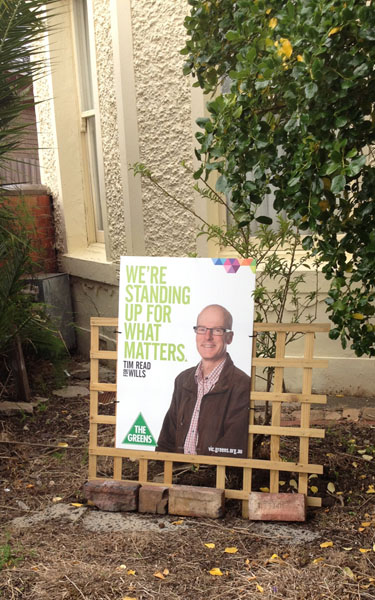
In the spirit of actually doing something, I spent Saturday morning putting fliers in letterboxes, and there’s a sign in our front yard, and I’m handing out how to vote cards on election day. (Problems of the newly gluten-intolerant: I planned my whole election day around accessibility to sausage sizzles — but now I can’t eat bread or cheap sausage!)
The candidate poster for the electorate of Wills.
So that’s all very nice, and I take heart from the media’s obsession with the Greens being a spent force and the major parties’ simultaneous obsession with dissuading people from voting for them. At any cost, ie, they’re even preferencing each other.
Accordingly, the Greens member for the electorate of Melbourne (as opposed to the city of Melbourne), Adam Bandt, the party’s only member of the House of Representatives, is spending a whole lot of money on advertising. More, in fact, than the ALP candidate, so that’s nice?
Only, I keep looking at the ads. They’re your standard sort of happy, aspirational advertising. A slogan and attractive, slim white people–
Oh, hang on a minute.
I’ve seen a fair amount of Greens billboards around the inner suburbs. With one exception — a poster criticising university funding cuts, featuring two women, one white, one South Asian — all feature white people.
(I should say, I haven’t seen every single Greens poster. I had hoped to find the material for the Melbourne campaign online, but it doesn’t seem to be around.)
This billboard stands at the corner of Lygon and Elgin Streets.
And Melbourne is a very diverse electorate! Crikey, in 2012, noted that just over 40% of residents are non-English speakers (I wonder if that is no English at all, or English as a second language?), and that the area has “substantial Chinese, Vietnamese and Korean populations”. The inner city contains several universities and a lot of student housing, so some of those people are going to be international students rather than voting citizens. But I have no idea how big or small that proportion is going to be.
(And given the amount of people on student visas who go on to become permanent residents and later citizens, it makes sense to represent that demographic as well. I don’t actually have numbers here, mind, I’m just going from experience, ie, I transcribe a lot of immigration cases involving students who wish to stay.)
Basically, it is really dodgy that the Greens campaign is so white. It would be dodgy even in an electorate that wasn’t incredibly diverse, but as it is, it just seems like a really terrible oversight.
Curious, I went along to the Greens website. The rotating advertising on the front page features two white children; a turtle; a group of eight white people and one Indigenous man; white protesters against refugee policy, photographed from the back; and one woman of colour, wearing a hijab, presumably representing asylum seekers.
The most prominent person of colour on the Greens website.
This picture is quite interesting. The face of asylum seekers, in the eyes of the Greens, is a young, attractive woman, wearing make-up, presenting a passive face to the viewer. She’s both object and fantasy figure.
There is another face of asylum seekers in the media.
This picture was released by the Department of Immigration as a symbol of its successful policies. Yeah.
This is a picture of an Iranian asylum seeker learning that she will not be resettled in Australia. It was posted by the Immigration Department as propaganda for the new “PNG solution”. Because this is a country where we’re expected to see a picture of a distraught person in need and feel satisfaction.
Unlike the Greens’ picture, she’s not passive. She’s dressed functionally, in western clothes. She’s not posing. She is an object and a fantasy figure, but an unwitting one, conscripted into the role and used for propaganda.
In the interests of fairness, I should point out that the cover of the Greens’ policy platform features two people of colour in amongst the white faces. And I’m sure it’s just coincidence that the black woman’s face is cut off. I mean, lots of faces are cut off, but hers more than anyone else. Pure accident, I’m sure. No subtext here.
Now, here’s the thing. If the Greens are going to thrive as Australia’s third major political party, they need to have a wider appeal than their current “educated, middle-class inner-urban” type of demographic. Outside of that group, there’s a perception that the Greens will throw working class and blue collar workers under the bus if it means they can save a koala. That’s a problem they need to start addressing, both through policy and through presentation.
What they should also be addressing, perhaps, is the way they have positioned themselves as white saviours in the refugee debate. As Stephanie linked the other day, “immigrants against immigration” is a peculiar aspect of the current debate, but it’s not the whole of the story. Not all Greens supporters are white, and not all refugee advocates are white. And the overlap between those two groups, I would say, is not inconsiderable. The use of mostly white models in their advertising creates an ugly subtext, one that cheapens their message. I like the Greens, but they’ve dropped the ball here. They can do better.
I saw Elysium on the weekend. It’s not very subtle. It’s so not very subtle that I’m not even going to talk about its blatant immigration narrative, its poverty porn of brown people and brown spaces and deserts, its third world despair as represented by Matt Damon (MATT DAMON).
(My short review: Gosh, there were some interesting ideas presented! Completely wasted, totally pointless, Jodie Foster chewing on the scenery and despite it being the only believable white future I’ve ever seen it was boring and kind of offensive.)
Also I’m sick with the death cold I picked up on the flight home from Singapore, which I still haven’t shaken, so today you’re getting links on immigration and immigration narratives. You love it, I know you do.
My favourite post about Elysium is I renounce my Elysium Citizenship by J Lamb. It is a super excellent post about privilege, representation, and boring boring narratives that seek to interrogate but merely reinforce.
Blomkamp offers this antiseptic, conformist Whiteness as the celestial haven all the darker nations covet; lush green grass tickles the bare toes of towheaded human gazelles who play and laugh and smile because their lives demand no other purpose. Watch as a statuesque beauty drops her theatrical red robe to lie upon what appears to be a personal tanning bed; you learn it’s actually a miracle machine that can cure cancer in seconds. Horror paralyzes. This manicured playground for Teutonic supermodels and corporate overlords gives life everlasting to a Whiteness so privileged it never need die. Earth’s cautionary tales spend the entire film gripped by a feral desperation to emigrate to this orbital nirvana; the entire movie posits a world where no person of color wants anything less than Elysian citizenship. Ask yourself how this morality play ends.
Many good liberal folk applauded this film, and considered Elysium a warning against American xenophobia and isolationism. We have so much, why can’t we share? But the Elysium immigration metaphor characterizes the darker nations as eternally broken, and always wanting.
Anyway, but that’s the USA! Australia has a totally different immigration narrative from that.
I exist because of immigration. Don’t many of us? I exist because of illegal immigration. I exist because my grandmother escaped the Chinese mainland, swam to Hong Kong as a child, and made her way on a boat to Malaysia. I don’t know anything more about that, because here’s one of the things about asylum seeking: when your circumstances are such that a seven year old child has to swim away from the only home she’s ever known, you tend to lose your grasp on your past and your family history. My family history starts in Malaysia, where my family worked and stressed and lived, and continues here to me (I wrote a thesis on illegal flows of migration in and around China in 2005, which is hilariously not the same). I can’t imagine a world where I would deny someone the chance to run away and start again, whatever the situation they’re having to leave; let alone when they’re a refugee from persecution.
Candidate for the Eastern Melbourne seat of Chisholm, Liberal candidate and former Vietnamese refugee, John Nguyen (below) shares my mother’s sentiments. He came by boat, yet pledges to stop the boats.
Nguyen says his family came to Australia the “right way”, because they sought asylum in Malaysia which is the first country they arrived in.
They were later processed and brought to Australia. But now, Nguyen wants the integrity of our borders upheld. This baffled me. I wanted to know more.
So I visited ethnic hubs across western Sydney approaching shopkeepers, mums and couples dining at cafes and simply asked: “Do you think we should end immigration and stop the boats?”
This post is a lot shorter than the last one, because … well, it’s not that I don’t like Ethan and Ben, but they don’t set my world on fire. They’re characters you can find in any media aimed at tweens. And Ollie is a very new character, and I feel like I’m still getting a handle on him — we are in the first half of the first season, after all.
(This post features quite detailed spoilers for season three.)
Ethan Karamakov: he smells like Christmas, apparently
I’ve had some trouble writing the second half of this piece, because, well, I’m kind of dealing with two characters I don’t care for, and one I’m still getting to know.
Take Ethan, for example. Ethan is the older half-brother of Tara’s best friend Kat, and her first crush. He’s a third year, aged about seventeen; she’s a brand new fifteen year old first year with about as much common sense as a newborn lamb. I don’t hate Ethan (anymore), but I feel like he was a necessary evil — a rich, white counterpoint to Christian — and not a hugely interesting character.
Basically, when I watched the first season, I appointed myself President of the Go Away Ethan Karamakov Club. (For one thing, although actor Tim Pocock is actually quite good — if anyone actually saw Wolverine: Origins, he played a young Scott Summers, and was promptly named the Next Heath Ledger — he’s the least convincing teeenager in the cast. I presume it was difficult to find an actor who could also dance, but he looks about ten years older than everyone else. And he has an abnormally symmetrical face.)
Look at that face. It’s grotesque.
What made me grudgingly like Ethan in the second season was that he began sharing scenes with Abigail, who is scientifically proven to make everything better. She’s an overachieving, anxiety-ridden lifelong dancer who is slowly coming to terms with the fact that hard work isn’t going to overcome her lack of natural talent. She’s also incredibly blunt, and thinks being likeable is for lesser people.
Ethan has given up a place in the National Ballet Company to become a choreographer, and he approaches Abigail for his showcase piece. He wants someone who is intense and a little scary.
Okay, then. She’s interested.
I began to like Ethan, not so much for himself, but for the way he became a vehicle for Abigail to find new options. Together they become involved in musical theatre, and have a funny, sweet friendship that verges sometimes on romance. I wasn’t sorry when Ethan went to Barcelona to pursue his ambition, but I wasn’t counting down the minutes until he left, either.
The Self-Styled Benster
Ben Tickle, introduced in the second season, is a much more interesting character, even though I frequently find myself wanting to punch him in the face a bit. When he joined the cast — as a first year student promoted to second year because he was just that good — I was like, seriously, the last thing we needed was yet another white guy.
And I still feel that way, but in terms of portrayals of masculinity, Ben’s an interesting case. See, he feels he has a lot to prove, being the youngest in the group, and he starts out by putting on a display of braggadocio and masculinity. And not the positive kind of masculinity. He’s sexist, racist and homophobic. Kind of your standard stereotype of … you know.
This is a guy who introduces himself as “The Benster”.
(This also leads to charming moments, like when Sammy explains that you shouldn’t use “gay” as a pejorative. I’m not usually one for didacticism in my entertainment, but Sammy is so earnest — having himself just started addressing his own sexuality — that it’s charming. And frankly, my teacher friends have to work really hard to get “gay” out of their students’ vocabularies, I feel like it really means something to have a bisexual character on kids TV explaining this.)
(Ben proves his basic likeability by apologising, and then baking rainbow cupcakes for Sammy and Christian. Because he thinks — well, at least there are cupcakes.)
Ben also gives us one of my favourite exchanges of dialogue. From memory:
Ben: Hey, Christian, do you do martial arts? There was this Asian guy at my old dance school who did martial arts. You remind me of him. Christian: Are you saying we all look alike? Ben: That’s pretty racist, dude.
Well, I laughed.
This is my very favourite picture of Ben. No, not just because you can’t see his face.
Having been called out, humiliated and initially rejected by the group, Ben settles down and becomes, you know, a nice kid. It comes out that he suffered leukemia as a child, and doesn’t want anyone to know because he fears he’ll become an object of pity and special treatment. (Tara, who has her own problems with respecting boundaries, tells everyone. I love Tara a lot, but she makes a lot of mistakes in her journey.)
Late in the second season, Ben and Tara start going out. Ben has a massive crush on Tara; she seems to care about him, but mostly she has that problem common to teenage girls where she thinks she can’t be without a boyfriend. It doesn’t last, but Ben tells Tara at the beginning of season three that, “I still ship it.” Basically.
This made me really mad at the time, because I was like, BEN, SHE’S NOT INTERESTED! HAVE SOME RESPECT! STOP ENGAGING IN BEHAVIOUR THAT BORDERS ON CREEPY NICE GUYNESS!”
Well, joke’s on me, because Tara was interested, she was just making a concerted attempt to be boyfriend-less for third year. (Good try, Tara. When I eventually do my post on the girls of Dance Academy, I am going to talk about her SO MUCH. And also the way the fandom slut shames her, because no teenager ever had three boyfriends in three years, right?)
And maybe I was reacting against Ben because, well, I’m a product of a patriarchal society too, and maybe I wasn’t comfortable seeing a male character express his feelings so openly. (I am generally drawn to the stoic types, but these preferences don’t develop in a vacuum.) Ben really likes Tara, and he’s not offended when she wants to be “just friends”. He doesn’t go off to Reddit to complain about being friendzoned, he just goes, “Yep, well, I hope one day you change your mind,” and then gets on with trying to be a good friend.
We’re in the middle of season three right now, and I have no idea where Ben’s story is going to take him. But his arc so far has been interesting. He, Tara and Grace were picked up to fill positions in the Company, and he was selected by the principal dancer, Saskia Duncan, as a protege.
Now, Saskia also appeared in season two, and I could write a whole essay about her, but it basically comes down to this: Saskia Duncan is Dolores Umbridge in pointe shoes. She literally broke Tara’s back in season two. She is so friendly, and so reasonable, how could she possibly be a bully who targets younger dancers?
One thing I really loved about Saskia was how she was a villainess who wasn’t sexualised. And then she started mentoring Ben, and they were dancing together, and she was asking him out to dinner … and she still wasn’t sexualised.
I mean, she was coming across as a sexual character, but she wasn’t being exploited, either by the script or the camera. Her behaviour bordered on inappropriate, but she seemed sincere in her belief that Ben could be the Nureyev to her Fonteyn.
She also seemed pretty sincere in the way she was using Ben to humiliate her current partner and the other adult male dancers. Who seem, on the whole, to be an unpleasant lot in general, at least in the way they treat the three student dancers.
And when Ben realised that, he did something I’m really uncomfortable with: he dropped Saskia. I mean, literally. On stage. Twice.
But was it deliberate? I actually couldn’t tell. But the way he was watching her made it plain he was enjoying her humiliation as she ran off stage. And as much as I think Saskia is a terrible person who undermines and bullies people whom she regards as threats, it wasn’t exactly fun to watch a professional woman being humiliated by a schoolboy.
(Humiliation doesn’t even look like a word anymore! But I keep coming back to it, because it’s Saskia’s main weapon.)
At this point in the series, Ben and Tara are dating, and Ben is back in school, taking the lead role in the third year tour. As much as I think I’ve been unfair to him in the past, he’s still not a character for whom I have any great love. I save that for …
Ollie: not actually a chick magnet
Ollie is introduced in season two as Sammy’s tutor turned love interest, and with Sammy’s death, he has become a regular in the third season.
I mentioned in the first post that Ollie has an ego the size of Western Australia. A lot of his character development involves learning to temper that, and work in a team. (For starters, he’s now a regular because he’s repeating third year.)
For a while, I wondered if it was, you know, problematic that one of the few regular black characters on Australian TV is defined by his arrogance, and that the narrative needs to bring him down. Taken in isolation, I think that would be highly problematic. But in the context of the series, this is something nearly every character struggles with. (Even Tara, who simultaneously struggles with the need to be something other than a human doormat. People are complicated!)
Awkward fact: it’s kind of hard to find pictures of Ollie.
Ollie is coming to grips with the idea that maybe he won’t have a brilliant career in ballet, and maybe, as he says, “I’m just another middle class kid who can’t do fractions.” This struggle forms the foundation for his friendship with Abigail, Sammy’s other love interest, and brings him into conflict with Christian, who is so talented that he can miss half a term and still keep his place and his scholarship.
Ollie’s back-up plan is commercial dance, but he’s also dabbling in pop/hip hop. For which he adopts a heterosexual persona, because it’s hard enough to succeed in the Australian music industry when you’re black, let alone black and gay. “Everyone knows you’re not into girls,” says Abigail disdainfully, but Ollie just shrugs.
He’s not exactly going back into the closet, though, if there was ever a closet that could hold him. As of the most recent episode, he’s openly flirting with a young actor who’s taking the lead in a dance movie — YES, THERE IS A DANCE MOVIE WITHIN THE DANCE SHOW, IT IS AMAZING — and if this doesn’t end with him being “discovered” and going on to achieve fame and fortune, I’ll eat one of my many hats.
In conclusion
I don’t think the creators of Dance Academy set out to create great feminist television for tweens. But I do think they set out to create good television, and that means having a wide range of interesting characters. The mere fact of the dance school setting meant that the male characters would have to address concepts of masculinity in some way, and I think it’s been executed well.
The season three cast. Left to right: Ollie, Kat, Abigail, Christian, Tara, Ben, Grace
This is mostly a book review rather than a 101 on writing someone else’s face, so we’re going book review first, issues town second.
The Book: My Island Homicide by Catherine Titasey (2013, UQP)
[Mild spoilers to follow but nothing about the crime or anything]
My Island Homicide is the first novel by Catherine Titasey, not quite a crime novel set on Thursday Island in the Torres Strait, though I received it under the guise of being a crime novel. I would not describe it as a crime novel, though the crime is there and looms large: it’s more a slice of life, and it’s kind of fun.
There are not that many fiction books about the Torres Strait, and there are even fewer books that end happily (as it were); that have an Islander protagonist; that are this great slice of Torres Strait Life that I wanted to just keep on keeping on. I loved the minutiae in the book. I loved the Sissys getting more and more animals as Jack palmed them off. I loved everyone’s casual acceptance of maydh (a curse), and the mostly natural weaving in of the local Broken English, and I loved loved loved the protag’s mum coming home to Thursday Island and finding herself again.
And I wanted to love it as a book. But it reads weird. It was billed as a mystery (and it is), but it’s also a romance and it’s also a slice of life. On pg 138, almost halfway through the book, there’s suddenly a family mystery! At times it seems as if the pedestrian plodding of the story – not of the plot, but the pace of the book itself – is a reflection of life on Thursday Island, just going with the flow and letting it happen, but at other times it simply felt like uninspired pedestrian writing. I wish that the book had been able to settle into what it wanted to be, rather than hopping back and forth.
My Island Homicide talks about all sorts of issues, but only briefly. It mentions in passing the predominant local crimes (assault and theft) and their causes (alcohol, hunger). It makes a major plot point of the lack of education in the Torres Strait, and how easy it is to pretend like the white man is doing something when really he isn’t. It laughs away DV and assault, and it’s hard to tell when it’s poking fun with versus when it’s poking fun at the things that happen in island life. These are major issues in the Torres Strait and also incredibly damaging stereotypes when seen through non-TSI eyes, and I wish more had been done to flag this as not okay.
There’s a lot of unquestioned behaviour and acts which seem less than ideal. A white person describes the abuse they’re suffering from a black person as ‘racist,’ with no looking at the fact that it’s not possible (due to the equation of privilege + power = racism). There was some super dodgy stuff going on around the young gentleman who was unable to talk (sometimes it was implied he had suffered brain damage, sometimes just that he couldn’t speak and refused to sign) in terms of attitudes.
The book keeps making jokes at the expense of Gen Y, followed by some vegan hate, which didn’t endear it to me. (At one point a member of Gen Y declares they don’t know what Twister the board game is, which, I call nope). This is obviously less critical than the class and social issues in the Torres Strait, but also totally not cool!
Thea’s mother thinks Thea’s under maydh, and though Thea is unsure she goes with it, being treated for the curse and in the end she recovers with two answers: a western medicine answer, and a maydh answer. I love this resolution. Of course there’s a western medicine answer, because western medicine is always trying to quantify non-western traditional methods and outcomes. But there’s a ‘traditional’ outcome and solution too, and we’re never told which one is right in the context of the text. It just is.
It was really nice to read a book set in the Thursday Islands, and to be reading a book that was trying so hard to do justice to the Torres Strait and to this part of Australia’s population and culture. But it wasn’t a great book, and I can’t whole-heartedly recommend it to you. It was fun and easy to read, but it took me about 100 pages before I was actually into it. If I was handed another book by this author I would consider reading it, and I would certainly support what she’s doing (writing about Torres Strait Islander communities) but I wouldn’t leap to read it. Three out of five jiaozi.
If you want to read the book, let me know, there’s a possibility this copy is mine.
I made a list of the ways brown people are described in My Island Homicide. I recoiled at that last one, particularly as it was the last sentence of the novel, used to described Thea’s (the POV character) baby. Note Thea describes herself as light brown. (Her mother is milk chocolate)
Hey you know what we are not? We are not a menu. We are not food items or items for export or exploitation or fetishisation, even after you give birth to us, much like many of these items were (or still are). Coffee and cocoa in particular, with their slave labour connotations and the indigenous exploitation inherent within, makes these comparisons, even when unintentional, totally on the dodgy side.
It is not a compliment to describe brown characters in food terms.
Working with (and Reading) Someone Else’s Culture
This blog post is not a cultural appropriation primer or anything like that, because I don’t have the time nor the patience, and also because many other people have done that work, though maybe not from an Australian point of view. So maybe that’ll come another day.
My Island Homicide is very firmly a book set in the Torres Strait. It is on Thursday Island and Horn Island and a couple of tiny dotted islands in between. Titasey is white; though she is married to a Torres Strait Islander with TSI children, and has lived on Thursday Island for 20 years.
The POV character is a half-Islander, half-Caucasian woman whose family moved away from the Torres Strait and now she’s come back, wanting to live her stereotypical idyllic island lifestyle and maybe along the way she’ll learn some things. This worked for the most part as a frame for explaining things about the culture to an assumed non-Torres Strait audience. Thea learning Broken English was woven with shame (at not knowing it) and embarrassment and also naturally into the text, in a way that didn’t throw me out and that was awesome. Things were explained where explanations worked, but the text didn’t assume the reader was completely lacking in knowledge (except, inexplicably, when it explains that Billabong is a surf company).
You can tell, when you’re reading My Island Homicide, that Titasey is an outsider but has worked to not be an outsider. She presents this culture that isn’t hers as respectfully as she can, and though I wish it’d been better written I really appreciated that.
Today was going to be the day I posted the second part of my Dance Academy piece, but I totally forgot I’d be in Queensland, visiting my family. Instead, have a couple of links:
I link to this not just because it’s interesting, but because I have some thoughts about Krogans and Wrex that I’m saving until I finish, you know, the game.
The Innocence of Australians – last year, an intelligence think tank created a short story award for, basically, Australia’s security fears. This article dissects the results and implications.
Personally, I don’t think fiction is a good vehicle for exploring realistic security concerns, but I guess I’m the only one with an ongoing fear that the planet is going to be sucked into an unexpected black hole that parks itself next to the moon. IT COULD HAPPEN. Anyway, the anthology is as xenophobic as the premise is Orwellian.
Stop, and don’t come back – following on from our post the other week, a howl of outrage at the presence of booth babes at PAX Australia.
A few weeks ago I was the door bitch for A Night of Intrigue, a goth/alt/dark event. As you can imagine, explicit consent is a must in such an area, and hard to enforce. And much as it can be difficult to convey in a SFF convention space, it can be hard to remind everyone to be respectful and to ask permission and very importantly, especially in such a space, ‘nudity is not consent’ is critical.
I took on the role of gateway consent controller for the night, if I may call it that. We had signs up at the inner doorway (after paying and getting your tags and all the rest of it), and I gave the same spiel hundreds of times. We had a red tag for ‘PLEASE DO NOT TALK TO ME IF YOU DON’T KNOW ME,’ and a green tag for ‘hey, feel free to start a convo respectfully,’ or you could choose not to tag at all. And so many people were skeptical, why do you even need that? This is silly. Some people I had to explain it wasn’t a sex thing, but the traffic light was a good comparison. Some people made fun of people who were coming to a nightclub/social event and didn’t want to meet/hang with anyone new.
But there were a dozen or so people who ran towards that red armband and put it on so fast, and so obviously, so that their red stripe would be clear. And as Ju reminded me, when my voice was hoarse and it was after 1am and I was getting tired and frustrated at people rolling their eyes at me, every person who came through that door heard my spiel. So even if they thought the system was silly, they had all had the same thing personally delivered to them as they came to through the door: that we were looking for respect, and we expected it from everyone, and that we were gonna be enforcing that.
It’s not perfect; it’s hard to prevent bottleneck, and I felt at times that I was working against my own desire not to put anybody out. It’s not a system that works for everyone, but it’s a start, and I think having it personally delivered almost one on one helped.
(ps if you are interested, the next event is September 13 and you should totally come along)




 no-award.net