First Term at Malory Towers – Chapters 17 and 18

Previously: Sally is desperately and mysteriously ill following an altercation with Darrell.  Darrell feels terrible about this — AS SHE SHOULD — and, after a day of moping, has written a letter to Sally’s mother confessing all.

Now, suffering from insomnia, she goes for a walk outside, discovering a Mysterious Visitor to the school.  The door to the Sanitarium is unlocked.  She enters… Continue reading “First Term at Malory Towers – Chapters 17 and 18”

First Term at Malory Towers – Chapters 15 and 16

(Note: we’ve done some redecorating!  But there is a certain amount of housekeeping that needs to happen with our header, what with it being too large, and also Official No Award Calligrapher Moya has forbidden us to use one of those fonts.  Stay tuned.)

Back in the day, before I realised that blogging with Stephanie is more fun, I had a series of posts about Enid Blyton’s Malory Towers books on my personal blog.  Specifically, I was reading a chapter or two at a time and offering a running commentary with snark, illustrations, random anecdotes from my childhood, and whatnot.

That was 2012.  I don’t know why I stopped, except that I was busy, and there was a lot of typing involved, and probably something shiny came along and distracted me. But I bought the modern (electronic) editions of the books yesterday, and fell madly in love all over again.  Yes, the brown-and-orange uniforms called me back once more.

Accordingly, I’ve imported the original posts over to No Award (that’s totally a thing you can do, thanks, WordPress!), and I’m going to continue here.

(Importing old entries means we’re in the odd situation of having content that predates the existence of this blog.  No Award’s second birthday was last weekend, by the way.  We should have vegan, gluten-free cake to celebrate.)

And first, let me say, these new editions are weird.  There’s no more talk of slapping people, not even jokes.  Instead of giving Gwendoline four sharp slaps for her cruelty towards Mary-Lou, Darrell gives her “a rough shake”.  I’m not sure how inflicting brain damage is supposed to be an improvement, except that it’s probably harder for small humans to cause any damage when they engage in imitative behaviour.

Additionally, someone has done a search and replace, substituting “strange” for “queer” throughout. Which is fair enough, shifts in meaning and all, but I feel like something important has been stolen from, like, two-thirds of the queer people I know.

(I know, I know, it’s not as if they’ve rounded up all the old editions and set fire to them.  I might start nosing around secondhand stores for old copies, though, just for comparison/completion purposes.)

Continue reading “First Term at Malory Towers – Chapters 15 and 16”

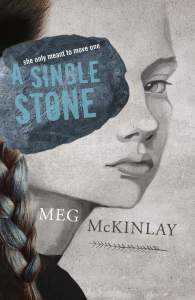
Aussie spec fic for young readers: A Single Stone by Meg McKinlay

A Single StoneEvery girl dreams of being part of the line – the chosen seven who tunnel deep into the mountain to find the harvest. No work is more important.

Jena is the leader of the line – strong, respected, reliable. And – as all girls must be – she is small; years of training have seen to that. It is not always easy but it is the way of things. And so a girl must wrap her limbs, lie still, deny herself a second bowl of stew. Or a first.

But what happens when one tiny discovery makes Jena question everything she has ever known? What happens when moving a single stone changes everything?

A Single Stone is a deliciously claustrophobic piece of semi-dystopian body horror for middle grade readers, inspired by Kafka (because why not?) and The Silver Chair (because it is the best Narnian book FIGHT ME).

Continue reading “Aussie spec fic for young readers: A Single Stone by Meg McKinlay”

In space, no one can hear you have manpain

Infini was written and directed by an Australian, features an all-Australian cast, and was filmed in Australia.  It should rocket straight to the top of the No Award List Of Things We Really Like.

'infini: search. rescue. destroy'

If only that were true.

The all-Aussie cast are doing American accents — except one guy who I think is meant to be British, but he sounds like an American actor trying for Aussie — and it’s just a tedious fest of rehashed Star Trek plots mixed with manpain.

Now, I don’t mind a bit of rehashed Trek.  Serve it up with some shiny low-budget effects and local accents, I’d have eaten it up with a spoon.  (And then whinged here about the dude-heaviness of the whole thing, but that’s half the fun!)  But setting it in the US is just … lazy.  Everyone has seen this before.  Why not change it up a bit?  (Answer: the accountant was in charge.)

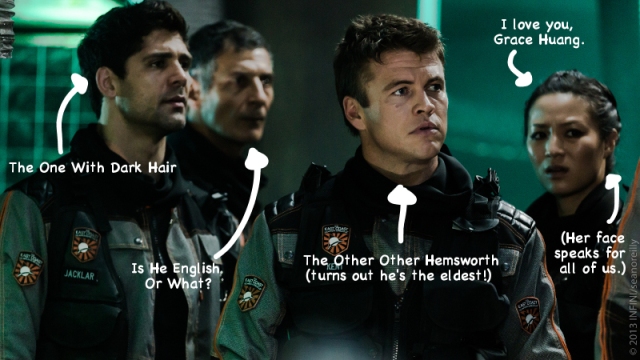
Similarly, the casting is just woefully dull.  Of the fourteen cast members — that includes bit players — ten are men, and nine of those are white men.  I’m not great at distinguishing faces, so I knew them as Lead Guy (aka The Dancing With The Stars Host), The Other Other Hemsworth (turns out there are three!), Beardy McBeardsalot (aka Guy From Animal Kingdom), REX MANNING (that was his character’s name — I could recognise him because people kept saying it in allcaps), Is He English Or What?, The One With Dark Hair, and The Rest.

(I should note that Kevin Copeland, The One Guy Who Isn’t White, is in fact American.  He does a lot of Australian stuff, though.  I totally forgot he wasn’t One Of Us.)

One of the film’s four women is a bit player.  The remaining three are:

  • Lead Guy’s pregnant wife, who cries and makes him promise to come home, then cries a bit more;
  • Claire, the medic, who has Abortion Angst and a failed romance with … I think it was The One With Dark Hair;
  • Philippa, who is introduced like she’s a big deal — though not as big as REX MANNING, of course — but who doesn’t really get much to do.

If you’re keeping track, that’s two-thirds of the female characters having uterus-related character development.  Infini

Claire is played by the beautiful and underrated Grace Huang, so that’s two non-white people in the cast.  There’s a moment where, as she goes mad from PLOT REASONS and also Abortion Angst, she says goodbye to her mother in Mandarin, and that’s the closest we come to further character development for her.

Not that the men fare any better.  These characters are strictly cardboard cut-outs.  Lead Guy bonds with Is He English Or What? over fatherhood, and has high level manpain because What If He Dies?  REX MANNING shouts and shoots things.

There’s quality dialogue like, “I’M TALKING TO MY FUCKING KIDS, MOTHERFUCKER!”  The final act is basically just guys screaming at each other, while I texted Stephanie to ask if I had to keep watching.  She said yes, which I’m pretty sure is a human rights violation.

Maybe Australian accents wouldn’t have saved this movie.

The highlight, for me, was the repeated shots of Sinister Wind Farms On An Alien Planet.  A lot of the dialogue was mumbled, so I’m not sure why they were sinister, but there they were.  Wind farming.  Ominously.  Maybe Going Crazy In An Isolated Facility On An Alien Planet is one of the symptoms of Wind Turbine Syndrome?  I made a joke on Twitter about this being what it takes to get an arts grant these days, but it turns out Infini received no taxpayer funding.  Thank heavens.

Oh, and the plot — a mining operation on a distant planet turns out to be digging up an alien life form, and it’s maaaaaaaaad.  Star Trek did it with “The Devil in the Dark” (TOS) and “Home Soil” (TNG); Doctor Who did it with “42” and, like, every third Pertwee serial.  This is entirely skippable.

Infini was released direct to iTunes and maybe other video on demand sources, who knows?  Liz paid AU$6.99 to rent a HD copy of Infini from iTunes and kind of wants her money and her two hours back. 

Reading the Hugos: The Goblin Emperor by Katherine Addison

This is the last of my Hugo reading, as I decided after the short stories that life is already full of pointless suffering, and why should I inflict more upon myself?  Plus, I’ve had a convention to chair, a novel to write/revise, and also a day job.

Accordingly, my ballot looks like this:

The John W. Campbell Award for Best New Writer and Best Fan Artist

Not voting, haven’t had time to do research.

Best Fan Writer

Not voting, as the only nominated writer I’ve read is Laura J Mixon for her piece on RequiresHate/Winterfox/Benjanun Sriduangkaew, which to my mind doesn’t constitute a body of work.  (Plus, I just hate giving Sriduangkaew oxygen.)

Best Fancast

I’ve only ever enjoyed one podcast enough to listen to it religiously. (Sorry, podcasters, I’m just not very aurally-oriented.)  Luckily, Galactic Suburbia is one of the nominees.  I’m going to give that my first preference, and otherwise not vote.

Best Fanzine, Best Semiprozine, Best Professional Artist, Best Editors (long form and short form)

Not voting, as haven’t had time to look at nominees.

Best Dramatic Presentation, Short Form

Finally, a category where I’m familiar with more than one nominee!  I’ll be voting thusly:

1. Orphan Black, “By Means Which Have Never Yet Been Tried”

2. Doctor Who, “Listen”

3. Game of Thrones, “The Mountain and the Viper”

I haven’t seen Flash or Grimm, so I’m ignoring those.  I hope Orphan Black wins, just because I love it so much, and the second season finale was outstanding — but I also suspect this episode will be completely mystifying to anyone who hasn’t watched at least the preceding season.  Likewise Game of Thrones.

“Listen”, on the other hand, is a perfect, standalone piece of creepypasta, and I adored it, and won’t be at all sorry if it wins.

Best Dramatic Presentation, Long Form

I’ve seen three of the nominated movies — Captain America: The Winter Soldier; Guardians of the Galaxy and The Lego Movie — but I can’t get excited about any of them.  I’m not voting in this category.

(Stephanie note: This is because Liz doesn’t have enough heart to have feelings about the Steeb and Bucky story)

(Liz response: My heart is a cold, misandrist lump of coal with no room for manpain.)

Best Graphic Story

You know, I probably have time to read the nominated works before the deadline.  I read Ms Marvel: No Normal last year, and loved it, but there are a couple of other nominees that were already on my radar.  Let me come back to this.

Best Related Work

I’m not voting in this one, partially because I haven’t read any of the nominees, but also because I’m pissed off that the thoroughly deserving Queers Dig Time Lords didn’t get a nomination, thanks, Puppies.

Plus, Companion Piece — remember that book I co-edited? — is eligible for nomination next year, and I feel like I just have too much personal involvement in this category.

Best Short Story

No Award.  No hesitation.

(Okay, some hesitation.)

Best Novelette and Best Novella

Not voting; haven’t read them.

Best Novel

  1. The Three-Body Problem by Cixin Liu
  2. Ancillary Sword by Ann Leckie
  3. The Goblin Emperor by Katherine Addison
  4. No Award

“Wow, Liz,” you might be thinking, “you’re ranking The Goblin Emperor below Ancillary Sword, which you were quite lukewarm about?”

Yes, Hypothetical Reader, I was surprised, too.  Lots of my friends loved The Goblin Emperor, and found it engaging and enjoyable on every level.  And that’s great!  I am quite happy, and also a little jealous, that they enjoyed it so much.

I found it beautifully written, with interesting worldbuilding, and completely boring.

The plot: Maia, unloved half-goblin son of the elf emperor, unexpectedly takes the throne when his father and half-brothers are all murdered.  Despite his lack of training, and lack of self-confidence, he sorts out various political situations and solves the mystery by being really, really decent to people.

I’ve seen a lot of people saying that The Goblin Emperor is a response to the trend for grimdark fantasy.  I really hope not, because the opposite of grimdark is not dull.

I feel a bit weird saying this, because Characters Being Competent and Political Shenanigans are two of my favourite things in fiction.  But Maia’s competence feels unearned.  He instinctively knows how to deal with people, he instantly befriends trustworthy and reliable allies, and where he makes bad decisions, the consequences are minor.

Likewise, the Political Shenanigans are, well, predictable.  The traitors are just who you would expect, and Maia deals with them appropriately, and no one minds very much because the traitors weren’t even that good at their jobs, let alone popular or widely supported.

I’ve been thinking about the problems with The Goblin Emperor for a few weeks, and I think what it needed was a second POV character.  Maia is interesting, but he has very little context for the places he goes and the things he does, and that gets old fast.  And all of the supporting characters around him are two-dimensional in the extreme.  It’s difficult to imagine any of them having a life that doesn’t revolve around the main character.

Likewise the women — not that there are many.  The sympathetic female characters are what I think of when I hear that horrible phrase “awesome ladies”: they turn up, do or say something to subvert the patriarchy, and then step back and let the men get on with the plot stuff (such as it is).

The unsympathetic women are all ambitious and super-feminine (and they’re still subordinate to the plot-driving men).

In short, I was extremely disappointed in The Goblin Emperor, and really only forced myself to finish it for the sake of the Hugos.  It’s possible I was just in the mood for something more plot-driven.  But I don’t plan to read anything else by Addison, whether under that name or her Sarah Monette identity.  Life’s too short.

5 Seconds of Linkspam

That awkward moment when you’re looking for lobsters and find volcanoes.

“That’s what happened between me and Clark” – Revising Hollywood’s Greatest Scandal

Loretta Young has been excoriated for decades for presenting herself as a moralist while raising Clark Cable’s secret love child.  Anne Helen Petersen uncovers the sadder, darker story behind the rumours.

It was in 1998 — in the wake of Judy’s memoir — that Young, by then in her eighties, first heard the term “date rape” on Larry King Live, at home in Palm Springs with Ed Funk. “She asked me what that meant and I explained to the best of my ability,” Funk told me.

…“And there was this whole dawning,” Linda said. …She said, ‘That — that’s what happened to me.’”

New from Telstra: the Time Phone

Normally, of course, No Award gets a bit shirty when the US media reports on Australia — not that it shouldn’t, it’s just that defensive reflex — but we make an exception for hanging shit on the Abbott government: “If the Koch brothers ran a country, it might look like what’s happening in Australia.”

Steph isn’t sure what’s happening here: Skip Showers for Beef (please note that all figures appear to be in USA measurements, ie, weird shit like ounces.).

showers to beef conversion chart (us measurements)

(As always, No Award recommends 4 minute shower timers, and also civil disobedience).

13 interesting things you can see out your Melbourne train window.  The Heavenly Queen Temple and Franco Cozzo mural are the highlights of Liz’s commute.

Actual discrimination against a ginger! (Not really, but the phrase “not sick, just Scottish” will live in Liz’s ginger-haired Anglo-Celtic heart forever.) (Steph notes this is what our dystopias will be: the brown morass discriminating against pale people for obviously being deficient. So great. So exciting.)

If you, too, enjoy filling your kitchen with completely useless and ridiculous appliances, The Guardian’s Inspect A Gadget feature is for you.

While preparation of leaf tea is traditionally a ritualised communion with ideas of elegance and solemnity, there’s always room for novelty pants.

Teen spends babysitting money on getting vaccinated; parents mad.

Friend of No Award, In Which I, posts about tea.

Important Hanging Rock update.

No Award leaves the house: #loveOzYA at Readings

Back in May, ALIA (that’s the Australian Libraries and Information Association for those readers who don’t have a defunct Grad Dip in Library and Information Studies) released the top 10 YA titles borrowed from Australian public libraries.

Only two out of the ten were Australian.  John Green had more entries in this list than Australian YA authors.

Out of this problem grew the #loveOzYA hashtag, a grassroots reader movement that was quickly embraced by booksellers and publishers.  Danielle Binks writes more about that for Kill Your Darlings.

I read Australian YA, and I also write it (or try to), so this is an issue very dear to my heart.  I want to be a published author one day, and I want to reach a wide audience — who doesn’t? — but I also want to tell Australian stories.  And I don’t want to choose.

(Yesterday I sat down and made a list of all the ideas I have for middle grade and YA novels, and where they’re at, and roughly how I’d prioritise them.  I have ten ideas that I think are worth pursuing.  Nine are specifically set in Australia.  I clearly have a vested interest in promoting Australian fiction for young readers.)

On Tuesday night, I went to a #loveOzYA event at Readings Hawthorn, a panel discussion titled Where’s OzYA going right, and where’s it going wrong?  The panel was moderated by Isobel Moore, the specialist YA bookseller from Readings St Kilda.  On the panel were Melissa Keil, winner of the inaugural Ampersand Prize and author of contemporary Melbourne-based YA; Marisa Pintado, commissioning editor of YA for Hardie Grant Egmont and coordinator of the Ampersand Prize; the abovementioned Danielle Binks; and Susan la Marca, a senior teacher-librarian.

This was the perfect event — Readings Hawthorn was warm, dry, spacious and had toilets, not to mention that it was full of books, and the panel only ran for three-quarters of an hour, which is handy when it’s a Tuesday night and it takes me an hour to get home.

For once, I didn’t livetweet the event, but instead chose to take notes on my phone.  (Okay, I’ll be honest: I’m nearly out of data.)  Important lesson for Future Lizzes: just take a notebook.  It’s low-tech, but at least doesn’t have autocorrect.

Continue reading “No Award leaves the house: #loveOzYA at Readings”

That word: L-I-N-K spam

The ABC brings us an important fatberg update from Brisbane.  (Maybe not safe to read if you’re eating.  A key quote: “We always get corn.”)

Official rebuttal from Noted Fatberg Zoe: #NOTALLFATBERGS

The Breakfast Clubbing Season – In which an intrepid ABC editor inserted talking ex-prime ministerial heads into the trailer for The Breakfast Club.  Many thanks to Friend of No Award Sarah B for bringing this to our attention.

Why Grandma’s Sad, tales from the olds who need youths to get off their lawn, pay attention to grandparents, prioritise boring adults, etc etc. Steph laughed her way through this whole thing, it’s so great.

Kids spend an enormous amount of time looking at a type of device that didn’t really exist ten years ago. Among some young people, looking at these devices is the central animating activity. This is weird. Truly! Younger people are cyborgs and older people are meat, more or less.

At The Conversation: Coles: Not So Good For Humanity, Particularly If You’re A Truck Driver. We’re not saying Steph spent her birthday phonecall from her sister lecturing her sister about not going to Coles for strawberries, but Stephanie has long-term frowned at Australia’s supermarket duopoly (whilst occasionally still using it).

WA, no: WA’s Department of Culture and Arts under fire for ‘turning hoses’ on homeless.

This post was great: Why I’m Done Defending Women’s Sports.

While I’m being asked why “no one cares,” the Women’s World Cup is getting ratings that would make the NBA or Major League Baseball weep with joy. While ESPN Radio self-parody Colin Cowherd says that men are stronger and better athletes and we appreciate greatness in America and that’s why men’s sports is more fun to watch, his radio contract appears in peril because fewer and fewer people care what he has to say.

Steph loves Mount Zero Olive Oil, she can buy it in bulk (pouring it directly into her oil bottles) from Friends of the Earth and it tastes lovely and it’s from Victoria. But I probably wasn’t this thief. Thieves steal almost 600 litres of extra virgin olive oil from Grampians grove Mount Zero Olives.

Liz notes: “probably”.

Plastic Free July update: Steph almost had a meltdown in the aisles of Minh Phat in Richmond, when she realised her choices were the following, as a Chinese-Malaysian in Australia:

  • Don’t cook Chinese food, keep plastic free status
  • Cook Chinese food, don’t keep plastic free status

Reader, she bought her oyster mushrooms grown in Victoria, wrapped in plastic and on a polystyrene board; she bought her noodles fresh made and wrapped in a plastic bag. She is going to make tofu tonight at home, so at least she has that. Anyway, cultural elements of Western society concepts that are about individualism and clash with other things, etc etc.

On a related note, here is Naomi Klein talking about the western emphasis on individual action as a vehicle for change, versus the collectivist perspective of sweatshop workers in developing countries.

You see, for him and his colleagues, individual consumption wasn’t considered to be in the realm of politics at all. Power rested not in what you did as one person, but what you did as many people, as one part of a large, organized, and focused movement. For him, this meant organizing workers to go on strike for better conditions, and eventually it meant winning the right to unionize. What you ate for lunch or happened to be wearing was of absolutely no concern whatsoever.

Invisible Australians: Life under the White Australia policy.

Finally, Melbourne is about to enter a cold snap, so here’s a pattern for a penguin hot water bottle cover.  Stay warm!

Important moments in pirate history

Did you know that the archives of The Argus, once Melbourne’s premier newspaper, are digitised and available to the public?  If you’re a giant nerd like me, this is a great opportunity to roll around in history for a while.

Now, I’ve been curious of late about the lives of Chinese-Australians during the White Australia period, so I selected the records from 1920-1929 and searched for the keyword “Chinese”.  The results are fascinating, revealing and also (unsurprisingly) quite racist.  But there are also some incredible highlights.

Like pirates.

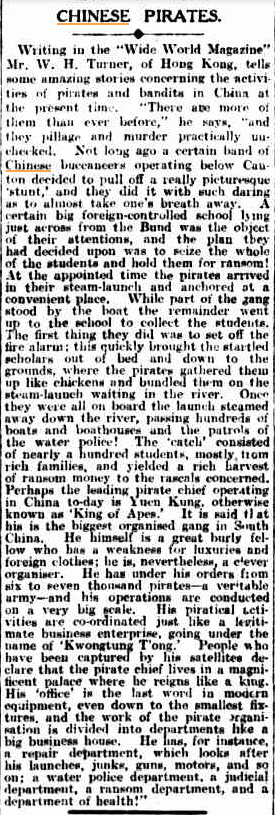
pirates
It had me from “Pirates”!

Transcript for people who don’t enjoy peering at tiny vintage newsprint, with bonus paragraph breaks:

Saturday 20 August 1927

CHINESE PIRATES

Writing in the “Wide World Magazine” Mr W H Turner, of Hong Kong, tells some amazing stories concerning the activities of pirates and bandits in China at the present time.

“There are more of them than ever before,” he says, “and they pillage and murder practically unchecked.  Not long ago a certain band of Chinese buccaneers operating below Canton decided to pull off a really picturesque ‘stunt’, and they did it with such daring as to almost take one’s breath away.

A certain big foreign-controlled school lying just across from the Bund was the object of their attentions, and the plan they had decided upon was to seize control of the whole of the students and hold them for ransom!  At the appointed time the pirates arrived in their steam-launch and anchored at a convenient place.  While part of the gang stood by the boat the remainder went up to the school to collect the students.

The first thing they did was to set off the fire alarm: this quickly brought the startled scholars out of bed and down to the grounds, where the pirates gathered them up like chickens and bundled them on the steam-launch waiting in the river.  Once they were all on board the launch steamed away down the river, passing hundreds of boats and boathouses and the patrols of the water police!

The ‘catch’ consisted of nearly a hundred students, mostly from rich families, and yielded a rich harvest of ransom money to the rascals concerned.

Perhaps the leading pirate chief operating in China today is Yuen Kung, otherwise known as ‘King of Apes’.  It is said that his is the biggest organised gang in South China.  He himself is a burly fellow who has a weakness for luxuries and foreign clothes; he is, nevertheless, a clever organiser.

He has under his orders from six to seven thousand pirates – a veritable army – and his operations are conducted on a very big scale.    His piratical activities are co-ordinated just like a legitimate business enterprise, going under the name of ‘Kwongtung T’ong’.

People who have been captured by his satellites declare that the pirate chief lives in a magnificent palace where he reigns like a king.  His ‘office’ is the last word in modern equipment, even down to the smallest fixtures, and the work of the pirate organisation is divided into departments like a big business house.

He has, for instance, a repair department, which looks after his launches, junks, guns, motors and so on; a water police department, a judicial department, a ransom department, and a department of health!”

Now, I don’t want to cast aspersions, but this was an era of rampant police corruption pretty much all around the world.  I don’t know exactly why, but I’d hazard a guess about technological developments (cars, telephones) becoming widespread just as promising criminal enterprises came along with the introduction of Prohibition in the US, 6 o’clock closing in Australia, the general collapse of government in China, etc.  Different factors around the world leading to a general culture of police corruption.

(Note: I am not a criminal historian, nor do I play one on TV.  I wonder if that’s a thing that exists, though?  How cool would that look on your business card?  “Yes, hello, I am a criminal historian.  I study the history of crime.  And also steal historical artefacts in elaborate museum heists.”)

Anyway, I can never remember if it was Hong Kong or Shanghai whose police chief took early retirement to pursue his hobby full-time, his hobby being running the city’s biggest criminal gang.  Literally the only police department that I know of that didn’t have a corruption problem in the ’20s was Scotland Yard.  (Further note: the world is full of police departments I know nothing about.  I’m just generalising wildly.)

What I’m saying is, I can’t help but wonder if Yuen Kung’s “judicial department” was in fact the actual Shanghai department of justice.  Likewise his “water police”.   I just have some questions, that’s all.  Starting with, has anyone written a book about the “King of Apes”?

And remember, if you want more Chinese pirate shenanigans, Stephanie provides just that in Cranky Ladies of History!

When helping isn’t helpful

Unwanted help has been on my mind the last couple of years.  It started with The Day of the Doctor, which introduced the marvelous Osgood, a young UNIT science officer with a wardrobe full of Doctor-inspired outfits and chronic asthma.  I love Osgood.  She delights my heart.

Osgood is also a gift to cosplayers.

I did not love the recurring thing where Kate Stewart, Osgood’s boss, has to continually remind her to take her Ventolin.  Osgood is a grown woman, who has presumably been living with asthma her entire life.  No matter how many absent-minded scientist tropes she fills, she doesn’t need her boss to remind her to take her medication.

The idea that a person with a chronic illness or disability needs looking after — needs protecting, even from themselves — is pervasive.  It’s big in Marvel Movieverse fandom, where it’s hard to escape the Tumblr posts about Big Brave Masculine Bucky protecting Tiny Weak Delicate Pre-Serum Steve from bullies and diseases alike.  Or the posts about wrapping Tiny Weak Delicate Pre-Serum Steve in a blanket and never letting him leave for his own good.

(For some reason, no one ever frets over Nick Fury’s lack of depth perception, or headcanons Bucky and Steve helping Sam through his PTSD.  So strange.  I can’t imagine a single reason why that would be…)

Continue reading “When helping isn’t helpful”