Back in May, ALIA (that’s the Australian Libraries and Information Association for those readers who don’t have a defunct Grad Dip in Library and Information Studies) released the top 10 YA titles borrowed from Australian public libraries.
Only two out of the ten were Australian. John Green had more entries in this list than Australian YA authors.
I read Australian YA, and I also write it (or try to), so this is an issue very dear to my heart. I want to be a published author one day, and I want to reach a wide audience — who doesn’t? — but I also want to tell Australian stories. And I don’t want to choose.
(Yesterday I sat down and made a list of all the ideas I have for middle grade and YA novels, and where they’re at, and roughly how I’d prioritise them. I have ten ideas that I think are worth pursuing. Nine are specifically set in Australia. I clearly have a vested interest in promoting Australian fiction for young readers.)
On Tuesday night, I went to a #loveOzYA event at Readings Hawthorn, a panel discussion titled Where’s OzYA going right, and where’s it going wrong? The panel was moderated by Isobel Moore, the specialist YA bookseller from Readings St Kilda. On the panel were Melissa Keil, winner of the inaugural Ampersand Prize and author of contemporary Melbourne-based YA; Marisa Pintado, commissioning editor of YA for Hardie Grant Egmont and coordinator of the Ampersand Prize; the abovementioned Danielle Binks; and Susan la Marca, a senior teacher-librarian.
This was the perfect event — Readings Hawthorn was warm, dry, spacious and had toilets, not to mention that it was full of books, and the panel only ran for three-quarters of an hour, which is handy when it’s a Tuesday night and it takes me an hour to get home.
For once, I didn’t livetweet the event, but instead chose to take notes on my phone. (Okay, I’ll be honest: I’m nearly out of data.) Important lesson for Future Lizzes: just take a notebook. It’s low-tech, but at least doesn’t have autocorrect.
This post was mostly inspired by Mad Max fandom. What Steph loves the very most about Mad Max fandom is that it’s full of grumpy Australians being really grumpy about non-Australians (mostly Americans) Getting Things Wrong. Steph is one of these Australians, all get off my lawn and get out of my car, and definitely get out of my town of 2 million people that doesn’t have a Starbucks. She’s a little bit obsessed with an epic coffee shop AU set in a small town in Australia. It has a Starbucks and a piano bar but no pub. NO PUB. Not gonna link the AU because it’s not about making fun of fanfic, it’s about making fun of Americans in general, and revelling in our own ridiculousness.
And so, for the humour and wtf of all Australians, we present:
A Pub With No Beer: Australian slang that foreigners* misuse
Ian the Climate Change Denialist Potato is just looking out for you on behalf of our Prime Minister, Australia. Wind Farms are ugly, noisy beasts. They give you a headache, they take away sleep, they cause fan death on a national scale, and of course they pollute the air and clutter up the landscape with, like, all the fumes they exude and shit.
Be grateful we have a Prime Minister who, despite being conservative, is deeply into state control of the public interest. We’re a better nation for it.
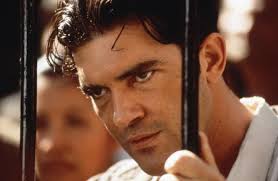
This may come as a shock to you, No Award, so brace yourselves. Evita, the 1997 movie starring Madonna and Antonio Banderas, is one of Stephanie’s most favourite movies in the entire world. YES. And it was her birthday recently, so everyone had to watch it and roll around in the joy of one hundred Argentinian women giving bitch face and also everything that Antonio Banderas chooses to be.
A N Y W A Y
Antonio as Che appears in basically every scene, from the very first to the very last.
i’m here, i’m loitering, ain’t nobody going to stop me
Che is a bartender and a reporter and a waiter; he is a protestor; he is a neighbour in Eva’s shitty neighbourhood, and a neighbour in her fancy neighbourhood. He follows Eva Duarde around from the age of 15 through until the tears at her funeral when she dies at the age of 33, and at no point does he age.
And whenever she turns around, Eva is never surprised to see Che there. In the background or close up beside her, Che criticises her life and her life choices and her inevitable mortality, like a terrible man. How does Che manage this miracle?
stop mansplaining to me, antonio
Che is a time-travelling stalker, is how. IS CHE SECRETLY A TIME LORD?
Particularly given Che is ostensibly an everyman but actually Che Guevara, a man history tells us Eva never met but CLEARLY, as DOCUMENTED HERE BY ANDREW LLOYD WEBBER, a man who STALKED EVA THROUGH TIME.*
i know i’m behind these gates right now, but your guards would let me in whenever
I had no idea mid 20th Century Argentina was so amazing vis time travel and science, given they also deal with their internal juntas with bayonets, but sure. SURE. I BELIEVE YOU, CHE.
Evita is also notable for being a stealth 90s bubblegum pop crossover, with appearances by Billie Piper and Andrea Corr, which basically just confirms this theory. Billie as Companion, back in time with Time Lord Che.
And since Che was on his way to Cuba at the time of Eva’s death in 1952, time travel is definitely needed.
TIME TRAVELLING STALKERS OF HISTORY. Wait maybe this is a new No Award series. STAY TUNED.
Official rebuttal from Noted Fatberg Zoe: #NOTALLFATBERGS
The Breakfast Clubbing Season – In which an intrepid ABC editor inserted talking ex-prime ministerial heads into the trailer for The Breakfast Club. Many thanks to Friend of No Award Sarah B for bringing this to our attention.
Why Grandma’s Sad, tales from the olds who need youths to get off their lawn, pay attention to grandparents, prioritise boring adults, etc etc. Steph laughed her way through this whole thing, it’s so great.
Kids spend an enormous amount of time looking at a type of device that didn’t really exist ten years ago. Among some young people, looking at these devices is the central animating activity. This is weird. Truly! Younger people are cyborgs and older people are meat, more or less.
At The Conversation: Coles: Not So Good For Humanity, Particularly If You’re A Truck Driver. We’re not saying Steph spent her birthday phonecall from her sister lecturing her sister about not going to Coles for strawberries, but Stephanie has long-term frowned at Australia’s supermarket duopoly (whilst occasionally still using it).
While I’m being asked why “no one cares,” the Women’s World Cup is getting ratings that would make the NBA or Major League Baseball weep with joy. While ESPN Radio self-parody Colin Cowherd says that men are stronger and better athletes and we appreciate greatness in America and that’s why men’s sports is more fun to watch, his radio contract appears in peril because fewer and fewer people care what he has to say.
Plastic Free July update: Steph almost had a meltdown in the aisles of Minh Phat in Richmond, when she realised her choices were the following, as a Chinese-Malaysian in Australia:
Don’t cook Chinese food, keep plastic free status
Cook Chinese food, don’t keep plastic free status
Reader, she bought her oyster mushrooms grown in Victoria, wrapped in plastic and on a polystyrene board; she bought her noodles fresh made and wrapped in a plastic bag. She is going to make tofu tonight at home, so at least she has that. Anyway, cultural elements of Western society concepts that are about individualism and clash with other things, etc etc.
You see, for him and his colleagues, individual consumption wasn’t considered to be in the realm of politics at all. Power rested not in what you did as one person, but what you did as many people, as one part of a large, organized, and focused movement. For him, this meant organizing workers to go on strike for better conditions, and eventually it meant winning the right to unionize. What you ate for lunch or happened to be wearing was of absolutely no concern whatsoever.
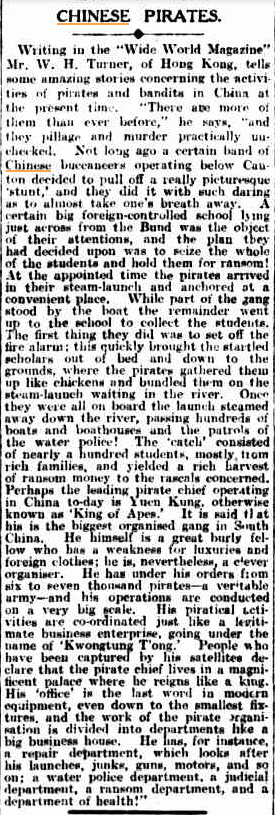
Did you know that the archives of The Argus, once Melbourne’s premier newspaper, are digitised and available to the public? If you’re a giant nerd like me, this is a great opportunity to roll around in history for a while.
Now, I’ve been curious of late about the lives of Chinese-Australians during the White Australia period, so I selected the records from 1920-1929 and searched for the keyword “Chinese”. The results are fascinating, revealing and also (unsurprisingly) quite racist. But there are also some incredible highlights.
Like pirates.
It had me from “Pirates”!
Transcript for people who don’t enjoy peering at tiny vintage newsprint, with bonus paragraph breaks:
Saturday 20 August 1927
CHINESE PIRATES
Writing in the “Wide World Magazine” Mr W H Turner, of Hong Kong, tells some amazing stories concerning the activities of pirates and bandits in China at the present time.
“There are more of them than ever before,” he says, “and they pillage and murder practically unchecked. Not long ago a certain band of Chinese buccaneers operating below Canton decided to pull off a really picturesque ‘stunt’, and they did it with such daring as to almost take one’s breath away.
A certain big foreign-controlled school lying just across from the Bund was the object of their attentions, and the plan they had decided upon was to seize control of the whole of the students and hold them for ransom! At the appointed time the pirates arrived in their steam-launch and anchored at a convenient place. While part of the gang stood by the boat the remainder went up to the school to collect the students.
The first thing they did was to set off the fire alarm: this quickly brought the startled scholars out of bed and down to the grounds, where the pirates gathered them up like chickens and bundled them on the steam-launch waiting in the river. Once they were all on board the launch steamed away down the river, passing hundreds of boats and boathouses and the patrols of the water police!
The ‘catch’ consisted of nearly a hundred students, mostly from rich families, and yielded a rich harvest of ransom money to the rascals concerned.
Perhaps the leading pirate chief operating in China today is Yuen Kung, otherwise known as ‘King of Apes’. It is said that his is the biggest organised gang in South China. He himself is a burly fellow who has a weakness for luxuries and foreign clothes; he is, nevertheless, a clever organiser.
He has under his orders from six to seven thousand pirates – a veritable army – and his operations are conducted on a very big scale. His piratical activities are co-ordinated just like a legitimate business enterprise, going under the name of ‘Kwongtung T’ong’.
People who have been captured by his satellites declare that the pirate chief lives in a magnificent palace where he reigns like a king. His ‘office’ is the last word in modern equipment, even down to the smallest fixtures, and the work of the pirate organisation is divided into departments like a big business house.
He has, for instance, a repair department, which looks after his launches, junks, guns, motors and so on; a water police department, a judicial department, a ransom department, and a department of health!”
Now, I don’t want to cast aspersions, but this was an era of rampant police corruption pretty much all around the world. I don’t know exactly why, but I’d hazard a guess about technological developments (cars, telephones) becoming widespread just as promising criminal enterprises came along with the introduction of Prohibition in the US, 6 o’clock closing in Australia, the general collapse of government in China, etc. Different factors around the world leading to a general culture of police corruption.
(Note: I am not a criminal historian, nor do I play one on TV. I wonder if that’s a thing that exists, though? How cool would that look on your business card? “Yes, hello, I am a criminal historian. I study the history of crime. And also steal historical artefacts in elaborate museum heists.”)
Anyway, I can never remember if it was Hong Kong or Shanghai whose police chief took early retirement to pursue his hobby full-time, his hobby being running the city’s biggest criminal gang. Literally the only police department that I know of that didn’t have a corruption problem in the ’20s was Scotland Yard. (Further note: the world is full of police departments I know nothing about. I’m just generalising wildly.)
What I’m saying is, I can’t help but wonder if Yuen Kung’s “judicial department” was in fact the actual Shanghai department of justice. Likewise his “water police”. I just have some questions, that’s all. Starting with, has anyone written a book about the “King of Apes”?
And remember, if you want more Chinese pirate shenanigans, Stephanie provides just that inCranky Ladies of History!
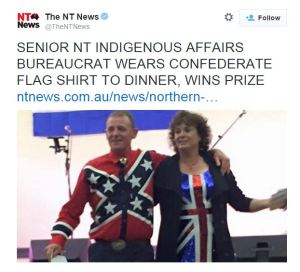
No Award, we considered going into the Confederate Flag for you since, as Australians, we don’t really know the ins and outs of USA history. But the NT News has actually given us all the information we require on the topic.
“I don’t think he deliberately set out to be controversial, I just don’t think he really thought about it,” a person at the ball said.
“But the fact is in his position he needs to be a little more thoughtful about these things. He was a bit remiss not to consider it might offend people, especially so close to the Charleston massacre and the whole white supremacist thing over there.
“It’s quite a hot topic around town, too, with the vigilante group and the like.”
The flag was first flown by the pro-slavery Confederacy during the American Civil War, fought in large measure over the rights of land owners to keep black slaves.
It has since been displayed as a symbol of southern American pride, but has also been co-opted by white supremacist groups.
Most recently, Dylann Roof, who killed nine people in a racially motivated attack inside a historic black church in the United States’ city of Charleston this month, posed with the flag shortly before the massacre.
“THE FLAG WAS FIRST FLOWN BY THE PRO-SLAVERY CONFEDERACY” let me reiterate, the Confederate flag was flown initially to indicate a desire to retain slavery.
Australia.
MATE.
Of course, this history hardly unique to the US, and we have exactly our own Australian ways of commemorating the Australian refusal to view Indigenous Australians as people. We have universities and streets and statues commemorating Macquarie (who legislated that Indigenous people could be shot if they resisted “civilising”), and Batman (who was a bounty hunter of Aboriginal people in Tasmania before he stole Melbourne from people of the Kulin nation), just as examples.
(Not to mention that Australia’s “alternative” flag comes from the Eureka uprising, which was mostly about resisting unfair taxation, but was also about white miners banding together against the tax-paying Chinese miners.)
HOWEVER, we are (for once) talking about America, not Australia, and, guys, if you ever fell compelled to dress up as anything to do with another country, maybe, I dunno, hit up Google to make sure you’re not about to be horribly offensive.
No Award is usually prepared to extend the benefit of the doubt to people who aren’t aware of the context of particular international taboos — we only recently found out why it’s not cool to link watermelon and African Americans — but there’s been a lot of media coverage about the Confederate Flag in the last couple of weeks, even in Australia. And it’s not unreasonable to expect a basic level of media literacy from a public figure.
(Also, why would you go to a 4th of July event wearing the flag of a people who literally tried to secede from the US? In company with someone wearing a Union Jack? Not to go too far down this derail path, but this choice was bad on many, many levels. How did it win a prize? What’s wrong with people?)
Hello, No Award! This week is NAIDOC Week (5-12 July). NAIDOC Week’s theme this week is We all Stand on Sacred Ground: Learn, Respect and Celebrate.
NAIDOC Week is about celebrating Indigenous and Torres Strait Islander cultures. Of course we should always keep talking about the injustices against our ATSI communities, the indignities and racism and straight up fucking bullshit. But it’s also important to celebrate their history and achievements, and the way they’re still here with us. It’s important to fight injustices; it’s important to support, too.
The Federal Government has decided to remove funding from the Aboriginal Medical Service Western Sydney. You can sign the petition to keep it funded. AMSWS is a great service and has over 11,000 active patients, and we should always support Indigenous services, No Award.
Maria is leaving Sesame Street; obviously this is not as big a tragedy as that time Benita left Play School, but she’s been there for 44 years so we can commemorate that.
The list of buildings for Open House Melbourne has been released! No Award loves buildings.
Portrait of a Lady; “Something changed when Africans began to take photographs of one another: You can see it in the way they look at the camera, in the poses, the attitude.” SO GREAT.
It is understood some relatives of patients at Clare Holland House, which sits on the edge of the lake at Barton, felt the sight of the coffin kayaker out the hospice’s windows was inappropriate and insensitive.
HELP, TOO FUNNY.
The politics of ugly food. Steph has literally ended friendships over peoples’ inability to accept my ugly, smelly, green food, because it’s evidence of the way our (your) food is colonised and also pandan is the greatest.
Have you encountered the Public Records Office of Victoria yet? Because it has lots of awesome online and in person exhibitions, including Forgotten Faces: Chinese and the Law. Into it. PROV is No Award’s new favourite website.
Steph is doing Plastic Free July, because Australians send 1 million tonnes of plastic waste to landfill each year. Stay tuned for how badly she fails at it.
No Award loves (a) cocktails; (b) casino heists. Here’s a story that combines both! We expect it to be turned into a Hollywood movie any day now, but set in Las Vegas and starring white people.
The Courier’s New Bicycle by Kim Westwood is a 2011 Australian SF novel set in a grim dystopian Melbourne approximately a generation into the future. A bird flu pandemic ravaged Asia and Australia, and an untested vaccine rendered most Australians infertile. (All we know about the impact in Asia is that Singapore went bust.)
Five years ago, the Generic Christian Oppressor Party (okay, they’re called Nation First) came into government, and along with their dodgy co-religionists (…something-or-other First), they have imposed an oppressive theocratic regime that bans artificial fertility, non-binary gender identities, and queerness in general.
The story follows agender bicycle courier Sal Forth, whose day job is making deliveries for the underground artificial fertility industry, and who is an animal rights activist in zir spare time. Sal becomes embroiled in a set of mysteries: who is trying to destroy zir’s boss’s business; who is responsible for the beating of a surrogate mother; and who has poisoned zir previously only-once mentioned bestie with a contaminated T-shot.
Spoilers: the answer is, STRAIGHT PEOPLE, but especially STRAIGHT WOMEN, because if there’s one thing this book has, it’s spades and spades of misogyny. Trans-misogyny, cis-misogyny, unexamined misogynistic treatments of women of colour, it’s all straight-up woman hatin’ here.
Suffice to say, Steph and Liz didn’t care for it. Which is sad, because lots of people whose taste we normally share loved it! But by coincidence, we started reading it at the same time, and sent colliding text messages going, “I’M READING THIS BOOK AND IT’S AMAZINGLY TERRIBLE WE HAVE TO TALK ABOUT IT FOR NO AWARD”.
There’s some really awesome stuff around gender and sexuality. Lots of queer relationships and people, and a real consideration of how that impacts peoples’ lives. And so much of the book’s underlying messages are about found family and how great and valid they are. It’s a great look at different conditions and different situations, and the way in which Australia might change in our climate change dystopia (the proliferation of bike couriers, the constant warm weather, the creation of glow in the dark pets, good work CSIRO).
But despite the awesome stuff, Liz and Steph had to take turns encouraging each other to get through the book. And that rarely ever happens.
Spoilers. So many spoilers below.
No Award Disclaimer: When we go on rambles like the 3500 words within, it’s not because we want nobody to write anything new or fun or intersectional. It’s just that we have feelings about the respectful way to do these things, and everybody, even people we love, makes mistakes.




 no-award.net