Hello, No Award! This week is NAIDOC Week (5-12 July). NAIDOC Week’s theme this week is We all Stand on Sacred Ground: Learn, Respect and Celebrate.
NAIDOC Week is about celebrating Indigenous and Torres Strait Islander cultures. Of course we should always keep talking about the injustices against our ATSI communities, the indignities and racism and straight up fucking bullshit. But it’s also important to celebrate their history and achievements, and the way they’re still here with us. It’s important to fight injustices; it’s important to support, too.
The Federal Government has decided to remove funding from the Aboriginal Medical Service Western Sydney. You can sign the petition to keep it funded. AMSWS is a great service and has over 11,000 active patients, and we should always support Indigenous services, No Award.
Maria is leaving Sesame Street; obviously this is not as big a tragedy as that time Benita left Play School, but she’s been there for 44 years so we can commemorate that.
The list of buildings for Open House Melbourne has been released! No Award loves buildings.
Portrait of a Lady; “Something changed when Africans began to take photographs of one another: You can see it in the way they look at the camera, in the poses, the attitude.” SO GREAT.
It is understood some relatives of patients at Clare Holland House, which sits on the edge of the lake at Barton, felt the sight of the coffin kayaker out the hospice’s windows was inappropriate and insensitive.
HELP, TOO FUNNY.
The politics of ugly food. Steph has literally ended friendships over peoples’ inability to accept my ugly, smelly, green food, because it’s evidence of the way our (your) food is colonised and also pandan is the greatest.
Have you encountered the Public Records Office of Victoria yet? Because it has lots of awesome online and in person exhibitions, including Forgotten Faces: Chinese and the Law. Into it. PROV is No Award’s new favourite website.
Steph is doing Plastic Free July, because Australians send 1 million tonnes of plastic waste to landfill each year. Stay tuned for how badly she fails at it.
No Award loves (a) cocktails; (b) casino heists. Here’s a story that combines both! We expect it to be turned into a Hollywood movie any day now, but set in Las Vegas and starring white people.
The Courier’s New Bicycle by Kim Westwood is a 2011 Australian SF novel set in a grim dystopian Melbourne approximately a generation into the future. A bird flu pandemic ravaged Asia and Australia, and an untested vaccine rendered most Australians infertile. (All we know about the impact in Asia is that Singapore went bust.)
Five years ago, the Generic Christian Oppressor Party (okay, they’re called Nation First) came into government, and along with their dodgy co-religionists (…something-or-other First), they have imposed an oppressive theocratic regime that bans artificial fertility, non-binary gender identities, and queerness in general.
The story follows agender bicycle courier Sal Forth, whose day job is making deliveries for the underground artificial fertility industry, and who is an animal rights activist in zir spare time. Sal becomes embroiled in a set of mysteries: who is trying to destroy zir’s boss’s business; who is responsible for the beating of a surrogate mother; and who has poisoned zir previously only-once mentioned bestie with a contaminated T-shot.
Spoilers: the answer is, STRAIGHT PEOPLE, but especially STRAIGHT WOMEN, because if there’s one thing this book has, it’s spades and spades of misogyny. Trans-misogyny, cis-misogyny, unexamined misogynistic treatments of women of colour, it’s all straight-up woman hatin’ here.
Suffice to say, Steph and Liz didn’t care for it. Which is sad, because lots of people whose taste we normally share loved it! But by coincidence, we started reading it at the same time, and sent colliding text messages going, “I’M READING THIS BOOK AND IT’S AMAZINGLY TERRIBLE WE HAVE TO TALK ABOUT IT FOR NO AWARD”.
There’s some really awesome stuff around gender and sexuality. Lots of queer relationships and people, and a real consideration of how that impacts peoples’ lives. And so much of the book’s underlying messages are about found family and how great and valid they are. It’s a great look at different conditions and different situations, and the way in which Australia might change in our climate change dystopia (the proliferation of bike couriers, the constant warm weather, the creation of glow in the dark pets, good work CSIRO).
But despite the awesome stuff, Liz and Steph had to take turns encouraging each other to get through the book. And that rarely ever happens.
Spoilers. So many spoilers below.
No Award Disclaimer: When we go on rambles like the 3500 words within, it’s not because we want nobody to write anything new or fun or intersectional. It’s just that we have feelings about the respectful way to do these things, and everybody, even people we love, makes mistakes.
Hey we dunno if you quokkas noticed, but the USA Supreme Court (abbreviated hilariously to SCOTUS) legalised marriage equality across their entire country. Good work, SCOTUS!
Many people are having feels, and Facebook is a literal rainbow. When a flatmate of No Award asked Steph what she thought, she said “I don’t celebrate other peoples’ wins.” Which is maybe a bit harsh. And yet not actually a lie! Especially because all those Facebook rainbows are just a literal rainbow washing and No Award is made up of curmudgeons who believe in online activism but don’t trust Facie. (And also have odd feelings about confirmed straight people turning their wedding photos rainbow.)
(Also, they are giving Liz a bad headache. Enough with the bright colours and sparkly gifs, guys!)
But the equality movement in Australia is already so, often negatively, impacted by the US-centricity of discussions and actions, and as you know No Award rails against the way US-centricity skews and distorts Australian discussions in irrelevant ways.
Take this tumblr meme for example:
(That bottom image of Judge Judy is usually a gif of her tapping her watch as if to say ‘get on with it.’)
This post, and others that we’ve seen much like it, have hundreds of thousands of notes. But the important thing to remember is that this couple is Australian, as you quokkas know, and therefore three things:
SCOTUS has no implications for them.
Marriage equality is still not legal in Australia, where all marriages must be officiated over by a person who then says “Marriage is between a man and a woman to the exclusion of all others,” out loud, in public, how embarrassing, in order for that marriage to be legal.
Actually, legally, this couple will not be granted a divorce by the Family Court of Australia. Section 48 of the Family Law Act 1975 has some excellent (in this instance) clauses around when a divorce will be granted and, having stated that they intend to keep living together and having children together, they don’t formally qualify for a divorce in Australia. Plus, you have to live separately for a year and a day, and swear an oath (or make an affirmation) that your marriage has irretrievably broken down. If these two tried that, after what they’ve been saying to the media, they’d be at risk of perjury.
(Please note, No Award is not qualified to give legal advice.)
In terms of the role of the High Court of Australia in legalising/upholding marriage equality, the HCA can’t rule on this because there’s no Constitutional right to marriage or similar that could be used as that basis. S51(xxi) does hold that laws relating to marriage exclusively come under the Federal Government – which is why the Federal Government has been able to overturn those States and Territories that have legalised marriage equality. The Federal Government can also legislate to make marriage equality legal. It is in fact the only body in Australia that can make that magic happen.
It’s awesome for the USA that this decision has been handed down. But it doesn’t impact us directly, and placing too much importance on it means we’re missing the specifics of how our situation is impacted and how our situation can change.
(Endnote: please note that anyone who says ‘gay marriage’ is going to get in very big trouble. It’s marriage equality, because it impacts more than just gay people. We are bi and queer and asexual and intersex and trans and a whole rainbow of stuff)
ETA: Please read the comments! They are filled with relevant comments from constitutional law geeks and the children of religious ministers.
Multimillion-dollar buildings are sitting empty and underused in WA’s remote Aboriginal communities while traumatised children live in overcrowded houses and go without mental health services.
A new $12 million aged-care home in Warmun has been empty for six months, a multimillion-dollar elders centre in Kalumburu was fitted with two walk-in freezers that are never switched on and a community meeting centre in tiny Woolah was recently built next door to a medical clinic that is used just one day a fortnight.
The WA Corrective Services minister says he is “proud” of the Barnett government’s record on juvenile detention, despite plans to toughen mandatory sentencing laws, which experts say will only lead to more Aboriginal children in jail.
Western Australia currently jails the highest proportion of Aboriginal men, women and children in the country. Aboriginal youth are 53 times more likely to be jailed than their non-Indigenous counterparts.
But the Government has since sought to separate the prospect of community closures from the loss of federal funding, insisting it was about improving health and social outcomes for Aboriginal people.
More than 40 riot police carried out dawn raids on Heirisson Island on Thursday morning to dismantle an Aboriginal activists’ camp.
In a military-style operation, officers flanked by City of Perth rangers swept the camp site, taking down tents, dumping mattresses and belongings into bins in an attempt to move on protestors who had set up camp in response to the WA Government’s plans to close remote communities in the state’s north-west.
The 2009 short film ‘This is Perth’ revealed the existence of Bertie the Giant Squid to the world in general, and as an Australian blog, and with Steph a Perthie and Liz a cephalopod admirer, it’s important we chat about this Perth local.
His presence was further revealed when George Jones and the Giant Squid aired at some film festival in the USA in 2012, garnering Bertie an international fanbase.
George Jones and the Giant Squid arguably fictionalises Bertie a little bit, setting His presence off a small island – which Perth is in spirit but not, at this time, in geography – but otherwise remaining true to Him.
Bertie accepts our presence on the Swan and around Perth, but only with offerings and due diligence and respect (we are named ‘sandgropers’, after all, which surely implies a kind of creature harkening back to Him). If you are coming to Perth, please note the courtesies one is expected to pay Him.
Please, Perthies and visitors, share your stories of Bertie in the comments.
The City of Ballarat had wanted to name an area in the city’s west after respected Aboriginal elder William Wilson, known as Mullawallah.
But objections were raised at a heated council meeting.
These included that the name was polysyllabic, hard to pronounce and spell, and too similar to other place names, creating possible confusion for emergency services and pizza deliveries.
At the Edmund Rice Centre Mirrabooka we support young people from Refugee and Aboriginal backgrounds who are experiencing disadvantage and marginalisation.
Our programs help empower young people to reach their full potential by teaching sport, art, and leadership skills which allow them to better connect with the Australian community. We provide equal opportunities to help people develop and learn in a supportive and encouraging environment.
Unwanted help has been on my mind the last couple of years. It started with The Day of the Doctor, which introduced the marvelous Osgood, a young UNIT science officer with a wardrobe full of Doctor-inspired outfits and chronic asthma. I love Osgood. She delights my heart.
Osgood is also a gift to cosplayers.
I did not love the recurring thing where Kate Stewart, Osgood’s boss, has to continually remind her to take her Ventolin. Osgood is a grown woman, who has presumably been living with asthma her entire life. No matter how many absent-minded scientist tropes she fills, she doesn’t need her boss to remind her to take her medication.
The idea that a person with a chronic illness or disability needs looking after — needs protecting, even from themselves — is pervasive. It’s big in Marvel Movieverse fandom, where it’s hard to escape the Tumblr posts about Big Brave Masculine Bucky protecting Tiny Weak Delicate Pre-Serum Steve from bullies and diseases alike. Or the posts about wrapping Tiny Weak Delicate Pre-Serum Steve in a blanket and never letting him leave for his own good.
(For some reason, no one ever frets over Nick Fury’s lack of depth perception, or headcanons Bucky and Steve helping Sam through his PTSD. So strange. I can’t imagine a single reason why that would be…)
Now, I love my parents dearly, and they gave me a strong grounding in the humanities and encouraged my intellectual curiosity and desire to read e v e r y t h i n g. But they were also quite strict, not only in terms of discipline, but in the sense of the media they encouraged me to consume.
As it happens, I agree with them that a young child’s reading should be steered a little, and an older child should be encouraged to recognise discuss the ideas and morals behind a piece of media.
It’s just that my parents were a little bit idiosyncratic. They belong to a right-wing Catholic tradition which, while strongly anti-capitalist, is coincidentally in lockstep with certain capitalist ideas. Specifically, the environment.
Guys, I was raised by climate change deniers.
I mean, back then we called it global warming and talked about the hole in the ozone layer, but the point is, my parents didn’t believe in it. (These days, they’ve conceded that climate change exists, but not that it’s caused by human activity.)
Suffice to say, I’ve been looking forward to the Pope’s Encyclical on the environment with no small amount of curiosity and schadenfreude. And in honour of that Encyclical (probably not a phrase No Award will get to use very often), here is a list of media I was either forbidden or strongly discouraged from consuming:
Possum Magic by Mem Fox
I had a copy, and I vaguely recall Mum loving it, but Dad was not a fan. Native animals = STEALTH ENVIRONMENTALISM.
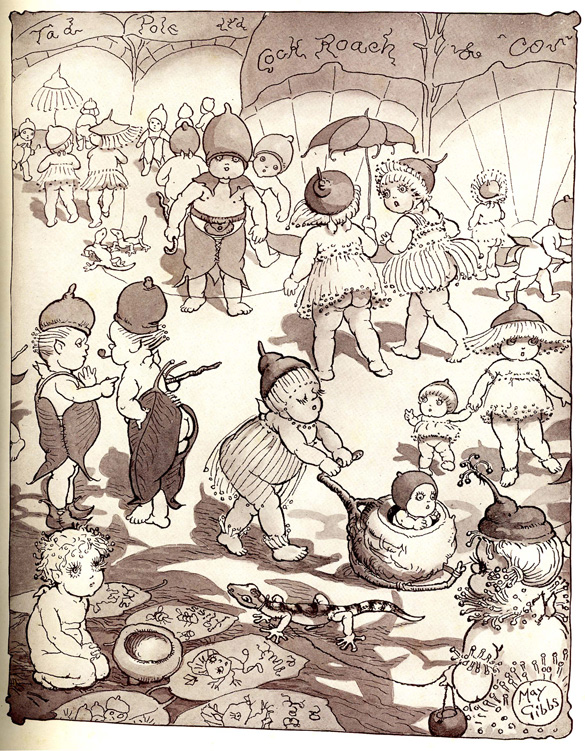
Snugglepot and Cuddlepie by May Gibbs
This Australian classic is problematic in many ways, but what gave my parents pause was the knowledge that Gibbs (1877-1969) was something of a socialist and early environmentalist.
I don’t think I appreciated how WEIRD these books were.
They discussed the problem (within earshot of me? Was I a childhood eavesdropper?) and decided that the books weren’t likely to cause any damage to my long-term development. Which, indeed, they didn’t. Only confusion. So much confusion.
(Steph’s aside: No Award will be publishing a post on the issues with Snugglepot and Cuddlepie in the near future)
Where the Forest Meets the Sea by Jeanie Baker
I think I need to find a copy of this book, because clearly I didn’t appreciate the art enough as a child.
1988 picture book about a boy visiting his grandfather in Far North Queensland, admiring the beauty of the rainforests, musing on their history as a home to Indigenous peoples, and wondering, “But will the forest still be here when we come back?”
It occurs to me that my parents probably disapproved of this, not just because of its environmental message, but because it’s specifically critiquing the pro-development policies of the immensely corrupt Bjelke-Petersen government, of which my mother was a strong supporter, and which, even now, she still remembers fondly. (Note: by coincidence, she didn’t actually live in Queensland during the Fitzgerald Inquiry.)
I was an early reader, and grew out of picture books pretty fast. And by the time I was into chapter books, I was … not precisely self-censoring, but mentally distancing myself from any pro-environment/pro-sustainability plots I came across. Suspending disbelief, basically: “I know the environment is nonsense, but just as I believe in faster-than-light-travel when I watch Star Trek, I’ll put up with this for now.” Chapter books I distanced myself from in this way:
The Lake at the End of the World by Caroline MacDonald, in which Australia is devastated by chemical bush clearance. The heroine’s parents had a long scene where they explained that, in their youth, “Conservation became a dirty word” because everyone was getting rich, and by the time people realised the land could no longer support (much) human life, it was too late.
“Typical left wing propaganda,” I didn’t think at the time, not having a well-developed political vocabulary, but that was my nebulous and unformed feelpinion.
These days, I think about that scene a lot, for some reason. I bought a secondhand copy last year and fully intend to do a No Award post on it one day.
But it wasn’t just books my parents were wary of! It was television! And song!
WARNING: Earworms dead ahead!
This is a terrible song, and was therefore much beloved by my year five music class. My parents didn’t share the affection, and not just because they have ears. They were very pro-woodchipping on the grounds that timber and paper mill staff are completely incapable of training for any other work, and the entire economy of Tasmania would collapse without the tree destruction industry.
As it happens, the value of the timber industry was vastly distorted by government subsidies, and it employed far fewer people than even the unions realised, but that all came to light later.
Why is Captain Planet so much bigger than the Planeteers?
Good reasons to hate Captain Planet and the Planeteers:
the theme song
the tokenistic nature of its multi-ethnic group of smiling young people
terrible puns
Wheeler is the worst
what kind of power is heart anyway?
Reasons my parents hated Captain Planet and the Planeteers:
it was produced by Ted Turner
who was/is(?) married to Jane Fonda
something something Hanoi Jane?
please note, my parents were children when the Vietnam War ended
environmentalism
ZOMG PAGANISM
there’s an episode about population control
Mum is very anti-superhero
terrible puns
Reasons I loved it and watched it whenever I could, even though I knew it was terrible:
like, two-thirds of the cast were Star Trek: The Next Generation actors
I wanted Wheeler and Linka to kiss
Teenage Mutant Ninja Turtles
Okay, this one’s stretching it a bit — my parents didn’t know it often had environmental messages, and neither did I. It was banned for containing “imitable violence”, ie, martial arts.
I don’t know why my parents were so concerned about this, given that the only television I was interested in imitating at this time was Star Trek: The Next Generation, but there you go. They also forbade Power Rangers. If it had been around when I was young, they would have also banned me from Avatar: The Last Airbender and Legend of Korra, too.
The Adventures of Blinky Bill
The original Blinky Bill stories (about a cheeky koala and his friends) were published in 1933, and had mild conservation themes. The Adventures of Blinky Bill, the animated series of the ’90s, ramped these themes up, the series opening after Blinky’s habitat is destroyed by humans, forcing him and his friends to befriend the Dingos.
Mum and Dad thought it was strange and terrible that modern political issues were being forced into light entertainment. Something something something Puppies.
FernGully: The Last Rainforest
Such an amazing, terrible movie.
This is an odd one — I wasn’t forbidden to see this (in fact, Dad took my brother and I to the movies, and really enjoyed it!), but I was convinced I’d get in trouble just for asking to see it. I got the novelisation via a Scholastic book fare, and it came with a poster that I put up behind my door, where I was sure my parents wouldn’t see it.
(A few years later, I did the same with a pair of ATSI art posters I got from school as part of Reconciliation Week. Apparently I was quite secure in my belief that my parents would never enter my room, close the door behind them and then look at the door.)
Anyway, I was really intoFernGully at the time it came out, and was quite amazed when I recently learned that (a) it’s known outside Australia and (b) its international audience is largely unaware that it’s set in real Australian places. IDK, maybe because all the fairies are white and European-looking?
A few days ago, I mentioned the leaked Encyclical to Mum.
“What is it about?” she asked.
“Climate change, and the need to take responsibility for addressing it,” I said.






 no-award.net